Smithfield in Dublin, Leinster, Ireland — Mid-East (and Dublin)
Arran Street East (Church and Graveyard)
Photographed by Ian Lefkowitz, May 17, 2026
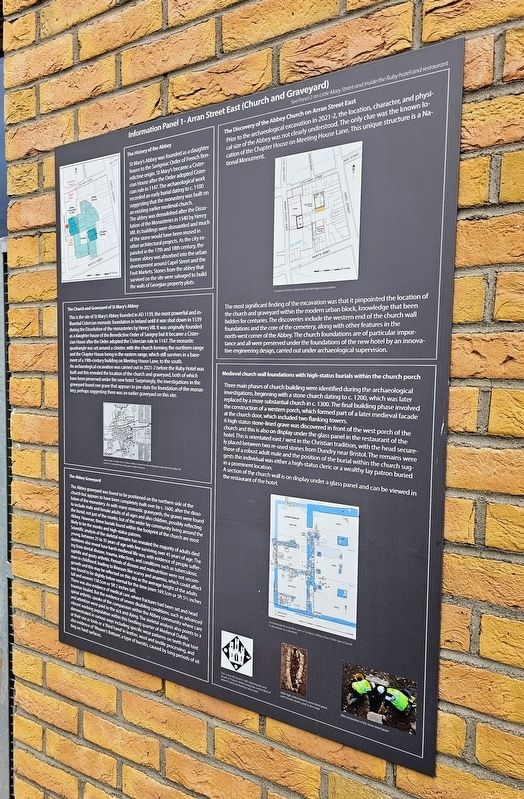
1. Arran Street East (Church and Graveyard) Marker
See Panel 2 on Little Mary Street and inside the Ruby hotel and restaurant
The History of the Abbey
St Mary’s Abbey was founded as a daughter house to the Savigniac Order of French Benedictine origin. St Mary’s became a Cistercian House after the Order adopted Cistercian rule in 1147. The archaeological work recorded an early burial dating to c. 1100 suggesting that the monastery was built on an existing earlier medieval church. The abbey was demolished after the Dissolution of the Monasteries in 1540 by Henry VIII. Its buildings were dismantled and much of the stone would have been reused in other architectural projects. As the city expanded in the 17th and 18th century, the former abbey was absorbed into the urban development around Capel Street and the Fruit Markets. Stone from the abbey that survived on the site were salvaged to build the walls of Georgian property plots.
The Church and Graveyard of St Mary’s Abbey
This is the site of St Mary’s Abbey founded in AD 1139, the most powerful and influential Cistercian monastic foundation in Ireland until it was shut down in 1539 during the Dissolution of the monasteries by Henry VIII. It was originally founded as a daughter house of the Benedictine Order of Savigny but it became a Cistercian House after the Order adopted the Cistercian rule in 1147. The monastic quadrangle was set around a cloister, with the church forming the northern range and the Chapter House being in the eastern range, which still survives in a basement of a 19th-century building on Meeting House Lane, to the south. An archaeological excavation was carried out in 2021–2 before the Ruby Hotel was built and this revealed the location of the church and graveyard, both of which have been preserved under the new hotel. Surprisingly,
this page online
The Abbey Graveyard
The Abbey graveyard was found to be positioned on the northern side of the church but appears to have been completely built over by c. 1600, after the dissolution of the monastery. As with many monastic graveyards, the graves were found to include male and female adults of all ages and also children, possibly reflecting the burial, not just of the monks, but of the wider lay community living around the Abbey. However, those burials found within the footprint of the church are most likely to be the monks and high-status patrons.
Scientific analysis of the skeletal remains has revealed the majority of adults died young, between 25 to 35 years of age with few surviving over 45 years of age. The skeletons also reveal how harsh medieval life was, with evidence of people suffering from dental disease, trauma, infections, and conditions such as tuberculosis, syphilis and gouty arthritis. Periods of disease and malnutrition
Photographed by Ian Lefkowitz, May 17, 2026
2. Arran Street East (Church and Graveyard) Marker
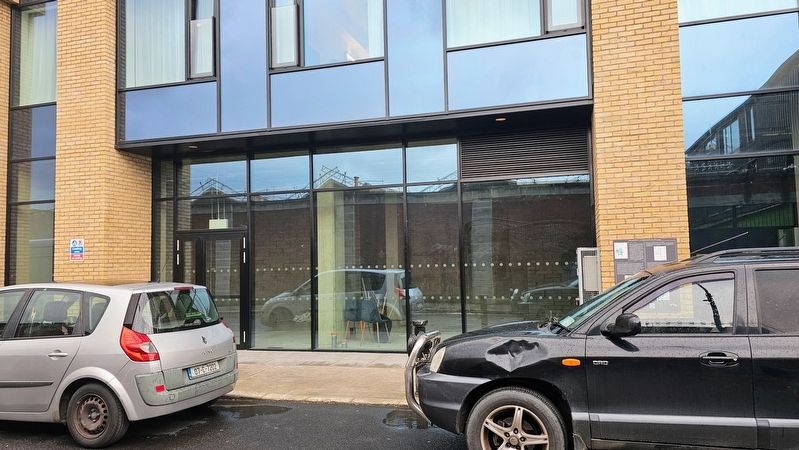
The marker is located near the Ruby Molly Hotel, south of the entrance.
There was also evidence of medical care, where fractures had been set and head trauma healed. But the evidence of severe disabling conditions such as advanced spinal arthritis, speaks of the compassion within the Abbey community, where care and attention were paid to the sick and dying. The skeletal analysis also points to a vibrant working population within this bustling quarter of Medieval Dublin, demonstrated in various ways including skeletal wear patterns on teeth that hint at their use as tools or a ‘third hand’ in leather, wool and textile processing, and also evidence of Weaver’s Bottom, a type of bursitis, caused by long periods of sitting on hard surfaces.
The Discovery of the Abbey Church on Arran Street East
Prior to the archaeological excavation in 2021–2, the location, character, and physical size of the Abbey was not clearly understood. The only clue was the known location of the Chapter House on Meeting House Lane. This unique structure is a National Monument.
The most significant finding of the excavation was that it pinpointed the location of the church and graveyard within the modern urban block, knowledge that had been hidden for centuries. The discoveries include the western end of the church wall foundations and the core of the cemetery, along with other features in the north-west corner of the Abbey. The church foundations are of particular importance and all were preserved under the foundations of the new hotel by an innovative engineering design, carried out under archaeological supervision.
Medieval church wall foundations with high-status burials within the church porch
Three main phases of church building were identified during the archaeological investigations, beginning with a stone church dating to c. 1200, which was later replaced by a more substantial church in c. 1300. The final building phase involved the construction of a western porch, which formed part of a later medieval facade at the church door, which included two flanking towers.
A high-status stone-lined grave was discovered in front of the west porch of the church and this is also on display under the glass panel in the restaurant of the hotel. This is orientated east / west in the Christian tradition, with the head securely placed between two re-used stones from Dundry near Bristol. The remains were those of a robust adult male and the position of the burial within the church suggests this individual was either a high-status cleric or a wealthy lay patron buried in a prominent location.
A section of the church wall is on display under a glass panel and can be viewed in the restaurant of the hotel.
Topics. This historical marker is listed in these topic lists: Anthropology & Archaeology • Religion & Religious Structures. A significant historical year for this entry is 1139.
Location. 53° 20.864′ N, 6° 16.213′ W. Marker is in Dublin, Leinster. It is in Smithfield. It is on Arran Street East north of Chancery Lane, on the right when traveling north. Touch for map. Marker is at or near this postal address: 42 Arran Street E, Dublin, Leinster, Ireland. Touch for directions.

Regionally, it is on the Atlantic Ocean, in the North Atlantic Region, in Europe, on the Island of Ireland, on the Celtic Fringe, in the European Union, in Atlantic Europe, on one of the British Isles, in the Western World, and in the Anglosphere.
Other nearby markers. At least 8 other markers are within walking distance of this marker: Éire 1798 Memorial (about 180 meters away, measured in a direct line); St. Mary's Church History (approx. 0.2 kilometers away); Grattan Bridge (approx. 0.3 kilometers away); Birthplace of Sir John Gilbert (approx. 0.3 kilometers away); Robert Mallet F.R.S. (approx. 0.3 kilometers away); O'Donovan Rossa Bridge / Droichead Uí Dhonnabháin Rosa (approx. 0.3 kilometers away); Volta Cinema (approx. 0.3 kilometers away); Penneys (approx. 0.3 kilometers away). Touch for a list and map of all markers in Dublin.
Also see . . . St. Mary’s Abbey – Chapter House – Cistercian Monastery (Heritage Ireland).
Founded in 1139, St. Mary’s Abbey was one of the largest and most important medieval monasteries in Ireland. There are few visible remains of the Abbey, and of the original buildings only the Chapter House and Slype remains.(Submitted on July 2, 2026, by Ian Lefkowitz of New York, New York.)
Credits. This page was last revised on July 2, 2026. It was originally submitted on July 2, 2026, by Ian Lefkowitz of New York, New York. This page has been viewed 12 times since then. Photos: 1, 2. submitted on July 2, 2026, by Ian Lefkowitz of New York, New York. • Andrew Ruppenstein was the editor who published this page.
