
Hampden Township near Enola in Cumberland County, Pennsylvania — The American Northeast (Mid-Atlantic)
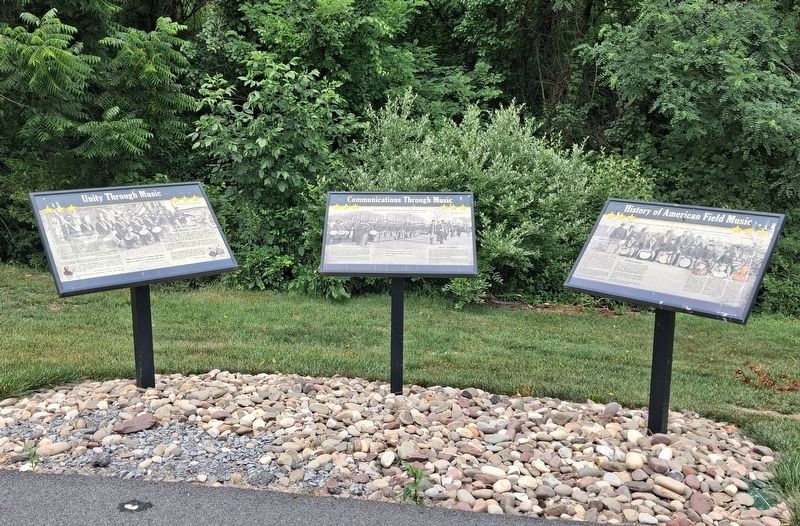
Unity Through Music

Photographed by William Fischer, Jr., June 28, 2026
1. Unity Through Music Marker
"Music has done its share, and more than its share, of winning this war"
Union Cavalry General Philip Sheridan
COMMON BOND
There are many written accounts of how music inspired and united the armies during the civil war. During the winter of 1862-1863, Union and Confederate armies were camped near each other in Fredericksburg, Virginia, separated only by the Rappahannock River.
As was customary in camp at dusk, the regimental bands mustered and played their evening music. A Union band started playing Northern patriotic tunes, with a Confederate band responding by playing Southern patriotic tunes. Back and forth they continued into the night until a Union band began playing "Home Sweet Home". A favorite of all soldiers away from home, Confederate bands took up the song until eventually every band in both armies joined in. Accounts are that everyone ceased what they were doing, games stopped and cards were put down. There wasn't a sound, except for the music.
"Everyone went crazy!...Had there not been a river between the two armies, both of them would have come face to face, shaken hands and ended the war on the spot"
Private
this page online
Another account of the healing power of music occurred near Spotsylvania Courthouse in May 1864. Soldiers wrote in the diaries and in letters sent home attesting to the power of music on the battlefield.
"I saw something on this campaign I never saw before - we were drawn up in a line of battle and the enemy and us had breast works in plain sight...we had three bands up on the works and the enemy had two in front of us playing for two hours. Neither side fired a shot during this time"
James Decker, Artilleryman, Battery B, 1st New York Light Artillery
John Howard Payne [inset portrait] penned the widely popular song called "Home Sweet Home" in 1822.
LIGHTS OUT BECOMES OUR NATIONAL TRIBUTE
The Union Army played a bugle call, "Extinguish Lights", to signal the end of the day. Brigadier General Daniel A. Butterfield [inset photo] believed this call was too formal. Following the Seven Days Battle in June 1862, Butterfield wrote a few notes on the back of an envelope. While he was in camp in Harrison's Landing, VA, he send for the brigade bugler. Butterfield did not read or compose music;
Photographed by William Fischer, Jr., June 28, 2026
2. Unity Through Music Marker
Left marker
The brigade bugler was Oliver Willcox Norton [inset photo], 23, of Pennsylvania. Both Butterfield and Norton survived the war and eventually wrote letters confirming the first sounding of "Taps". After the notes were played in 1862, the call circulated to other neighboring units. It spread throughout the Union army and reportedly, the Confederates started to use the call as their own lights out as well. "Taps" became an official army bugle call in 1891.
"The music was beautiful on that still summer night, and was heard far beyond the limits of our Brigade. The next day I was visited by several buglers from neighboring brigades, asking for copies of the music which I gladly furnished. ...the call was gradually taken up through the Army of the Potomac"
—Oliver W. Norton, August 1898
[Background photo of] 93rd New York Infantry - Field Music Band Drum Corps
Erected by Hampden Township and Concerned Citizens and Organizations.
Topics. This historical marker is listed in these topic lists: Arts, Letters, Music • Communications • Patriots & Patriotism • War, US Civil. A significant historical month for this entry is June 1862.
Location. 40° 17.488′ N, 76° 58.794′ W. Marker is near Enola, Pennsylvania, in Cumberland County. It is in Hampden Township. It can be reached from no nearby street. Marker is in the Hampton Township Veterans Park. Touch for map. Marker is at or near this postal address: 4345 Marketplace Way, Enola PA 17025, United States of America. Touch for directions.

Regionally, this marker is in South-Central Pennsylvania and in Greater Harrisburg. It is also in the American Northeast, in the Mid-Atlantic, in Appalachia, and specifically in Northern Appalachia. Globally, it is in North America, the Western Hemisphere, the Western World, and the Anglosphere. Historically, it finds itself in what was once the Haudenosaunee (Iroquois) Confederacy and also one of the original Thirteen Colonies.
Other nearby markers. At least 8 other markers are within walking distance of this marker: Communications Through Music (here, next to this marker); History of American Field Music (here, next to this marker); The Medal of Honor (here, next to this marker); a different marker also named The Medal of Honor (here, next to this marker); Spanish-American War (a few steps from this marker); The Civil War (a few steps from this marker); World War I (a few steps from this marker); The Mexican-American War (within shouting distance of this marker). Touch for a list and map of all markers in Enola.
Credits. This page was last revised on July 3, 2026. It was originally submitted on July 2, 2026, by William Fischer, Jr. of Reynoldsburg, Ohio. This page has been viewed 12 times since then. Photos: 1, 2. submitted on July 2, 2026, by William Fischer, Jr. of Reynoldsburg, Ohio.
