Grand Prairie in Dallas County, Texas — The American South (West South Central)
Antioch Life Park Cemetery
Photographed by James Hulse, July 3, 2026
1. Antioch Life Park Cemetery Marker
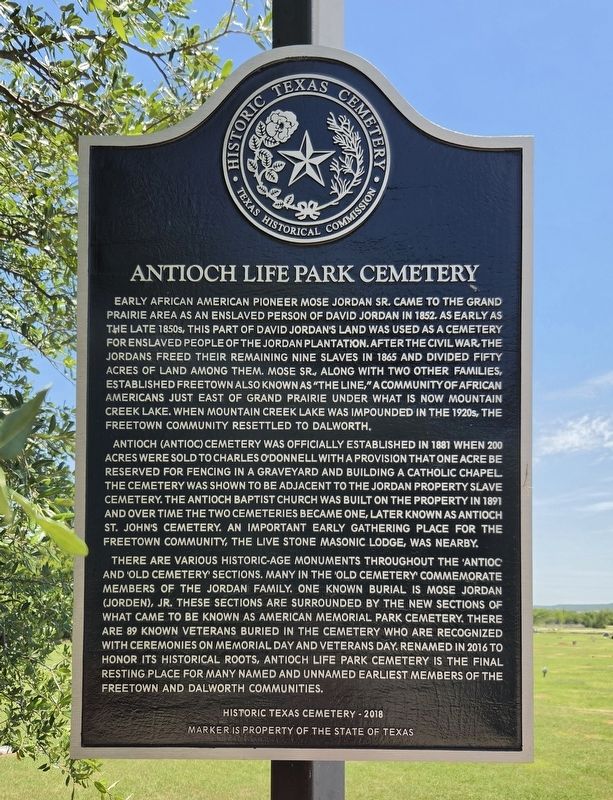
Early African American pioneer Mose Jordan Sr. came to the Grand Prairie area as an enslaved person of David Jordan in 1852. As early as the late 1850s, this part of David Jordan's land was used as a cemetery for enslaved people of the Jordan Plantation. After the Civil War, the Jordans freed their remaining nine slaves in 1865 and divided fifty acres of land among them. Mose Sr., along with two other families, established Freetown also known as "The Line," a community of African Americans just east of Grand Prairie under what is now Mountain Creek Lake. When Mountain Creek Lake was impounded in the 1920s, the Freetown community resettled to Dalworth.
Antioch (Antioc) Cemetery was officially established in 1881 when 200 acres were sold to Charles O'Donnell with a provision that one acre be reserved for fencing in a graveyard and building a Catholic chapel. The cemetery was shown to be adjacent to the Jordan property slave cemetery. The Antioch Baptist Church was built on the property in 1891 and over time the two cemeteries became one, later known as Antioch St. John's Cemetery. An important early gathering place for
this page online
There are various historic-age monuments throughout the 'Antioc' and 'Old Cemetery' sections. Many in the 'Old Cemetery commemorate members of the Jordan family. One known burial is Mose Jordan (Jorden), Jr. These sections are surrounded by the new sections of what came to be known as American Memorial Park Cemetery. There are 89 known veterans buried in the cemetery who are recognized with ceremonies on Memorial Day and Veterans Day. Renamed in 2016 to honor its historical roots, Antioch Life Park Cemetery is the final resting place for many named and unnamed earliest members of the Freetown and Dalworth communities.
Erected 2019 by Texas Historical Commission. (Marker Number 22529.)
Topics. This historical marker is listed in these topic lists: African Americans • Cemeteries & Burial Sites. A significant historical year for this entry is 1852.
Location. 32° 42.95′ N, 96° 58.863′ W. Marker is in Grand Prairie, Texas, in Dallas County. It is on Avenue D 0.1 miles north of Hardy Road, on the right when traveling north. Touch for map.
Photographed by James Hulse, July 3, 2026
2. Antioch Life Park Cemetery Marker
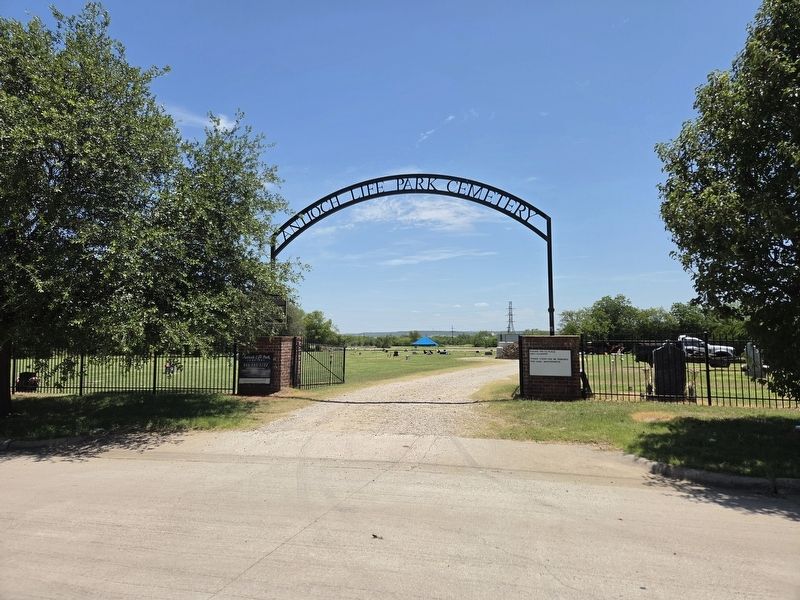
The marker is partially hidden behind tree branches on the left column.

Regionally, this marker is in the Prairies & Lakes Region and in the Dallas-Fort Worth Metropolitan Area. Globally, it is in North America, a Gulf of Mexico state, the Western Hemisphere, the Western World, and the Anglosphere. Historically, it finds itself in what was once New Spain, the Republic of Texas, one of the Confederate States of America, and the Antebellum South.
Other nearby markers. At least 8 other markers are within 3 miles of this marker, measured as the crow flies: Avion Village (approx. 1½ miles away); Old Southland Cemetery (approx. 1.7 miles away); Dallas Baptist University (approx. 2 miles away); Dr. H.V. Copeland Home (approx. 2.3 miles away); Uptown Theatre (approx. 2.4 miles away); Grand Prairie State Bank (approx. 2.4 miles away); Hensley Field (approx. 2½ miles away); America's Airborne Forces (approx. 2.6 miles away). Touch for a list and map of all markers in Grand Prairie.
Photographed by James Hulse, July 3, 2026
3. Antioch Life Park Cemetery Marker
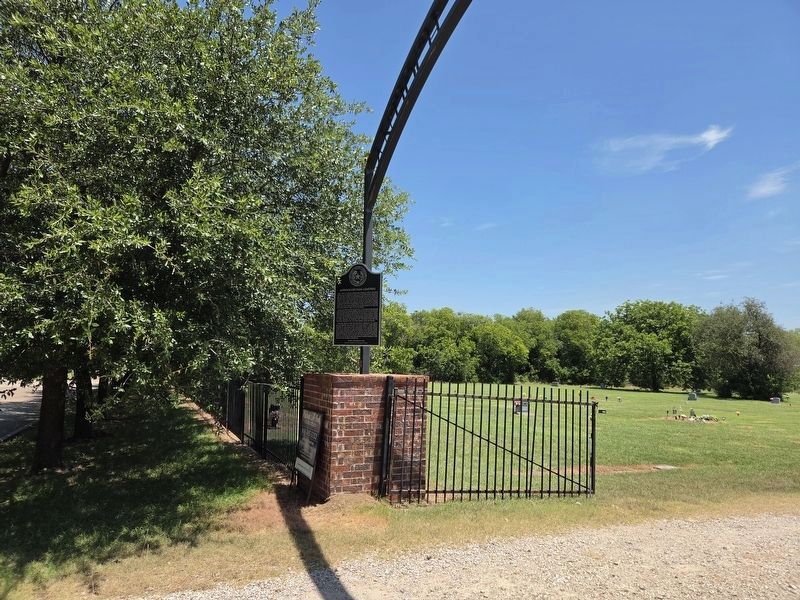
The marker is located on the left side brick column at the entrance.
Photographed by James Hulse, July 3, 2026
4. Antioch Life Park Cemetery Marker
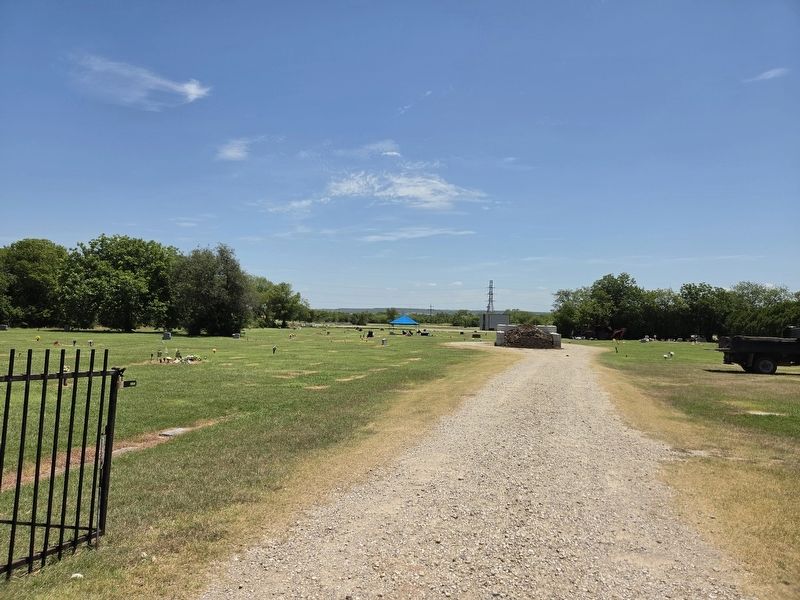
The view of the cemetery at the entrance gate.
Credits. This page was last revised on July 5, 2026. It was originally submitted on July 4, 2026, by James Hulse of Medina, Texas. This page has been viewed 20 times since then. Photos: 1, 2, 3, 4. submitted on July 5, 2026, by James Hulse of Medina, Texas.
