
The Coniagas #4 Shaft
⎯⎯⎯
Le puits de mine n°4 de la Coniagas
| — | Heritage Silver Trail Site #13 | — |
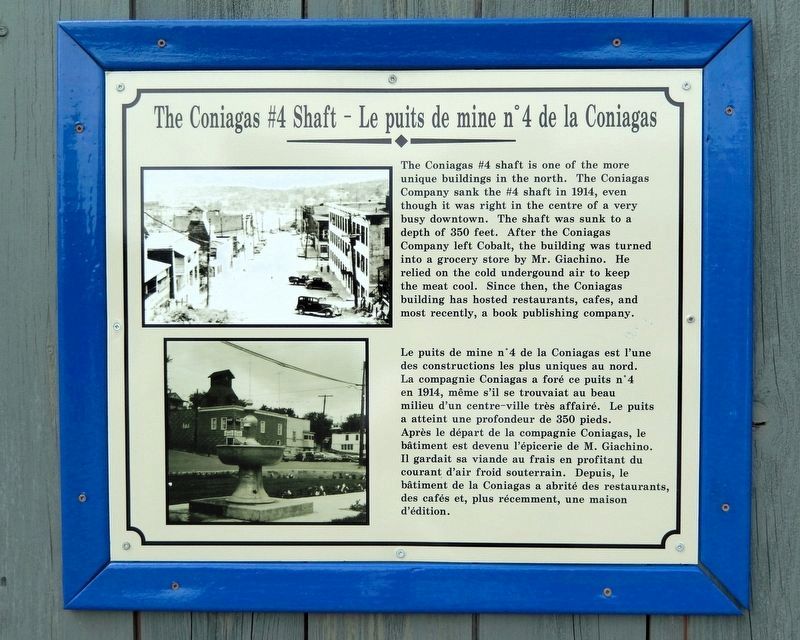

The Coniagas #4 shaft is one of the more unique buildings in the north. The Coniagas Company sank the #4 shaft in 1914, even though it was right in the center of a very busy downtown. The shaft was sunk to a depth of 350 feet. After the Coniagas Company left Cobalt, the building was turned into a grocery store by Mr. Giachino. He relied on the cold underground air to keep the meat cool. Since then, the Coniagas building has hosted restaurants, cafes, and most recently, a book publishing company.
Le puits de mine n°4 de la Coniagas est l'une des constructions les plus uniques au nord. La compagnie Coniagas a foré ce puits n°4 en 1914, même s'il se trouvait au beau milieu d'un centre-ville très affairé. Le puits a atteint une profondeur de 350 pieds. Après le départ de la compagnie Coniagas, le bâtiment est devenu l'épicerie de M. Giachino. Il gardait sa viande au frais en profitant du courant d'air froid souterrain. Depuis, le bâtiment de la Coniagas a abrité des restaurants, des cafés et, plus récemment, une maison d'édition.
Erected by Cobalt Historical Society.
Topics. This historical
this page online
Location. 47° 23.79′ N, 79° 41.157′ W. Marker is in Cobalt, Ontario, in Timiskaming District. It is at the intersection of Silver Street and Prospect Avenue, on the right when traveling south on Silver Street. The marker is mounted on the east side of the subject building. Touch for map. Marker is at or near this postal address: 50 Silver Street, Cobalt ON P0J 1C0, Canada. Touch for directions.

Regionally, this marker is in Northeastern Ontario and specifically in Northern Ontario. It is also in Central Canada. Globally, it is in North America, the Great North Woods, the Western Hemisphere, the Western World, and the Anglosphere. Historically, it finds itself in what was once a British colony, the Viceroyalty of New France, the Haudenosaunee (Iroquois) Confederacy, and Rupert’s Land.
Other nearby markers. At least 8 other markers are within walking distance of this marker: Agnico Eagle Mines Limited (within shouting distance of this marker); Major Holland, VC Park (within shouting distance
Also see . . .
1. Coniagas #4 Headframe - Site # 13 (Cobalt Historical Society).
Excerpt: Connected to the main Coniagas Mine site by underground tunnels, the downtown shaft had the distinction of being across the street from the newly-formed Royal Exchange, which later moved and became the Toronto Stock Exchange.(Submitted on July 6, 2026, by Cosmos Mariner of Cape Canaveral, Florida.)In May 1915, Cobalt agreed to let Coniagas erect a trestle over Silver Street from its shaft on Lot 287 to a vacant area just north of the fire hall. The trestle was to be at least 19 feet high and its sides sheathed for the protection of those below. Coniagas “accepted the proposal as long as the town did not interfere with its mining operations until
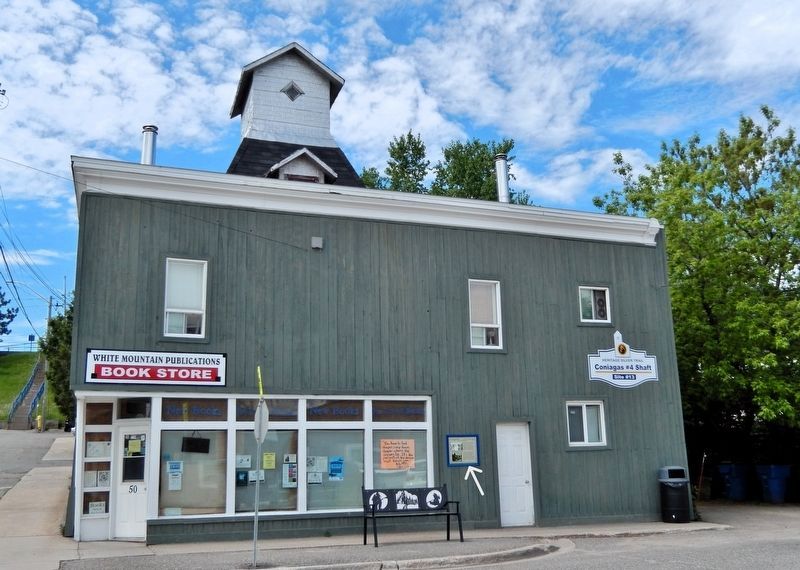
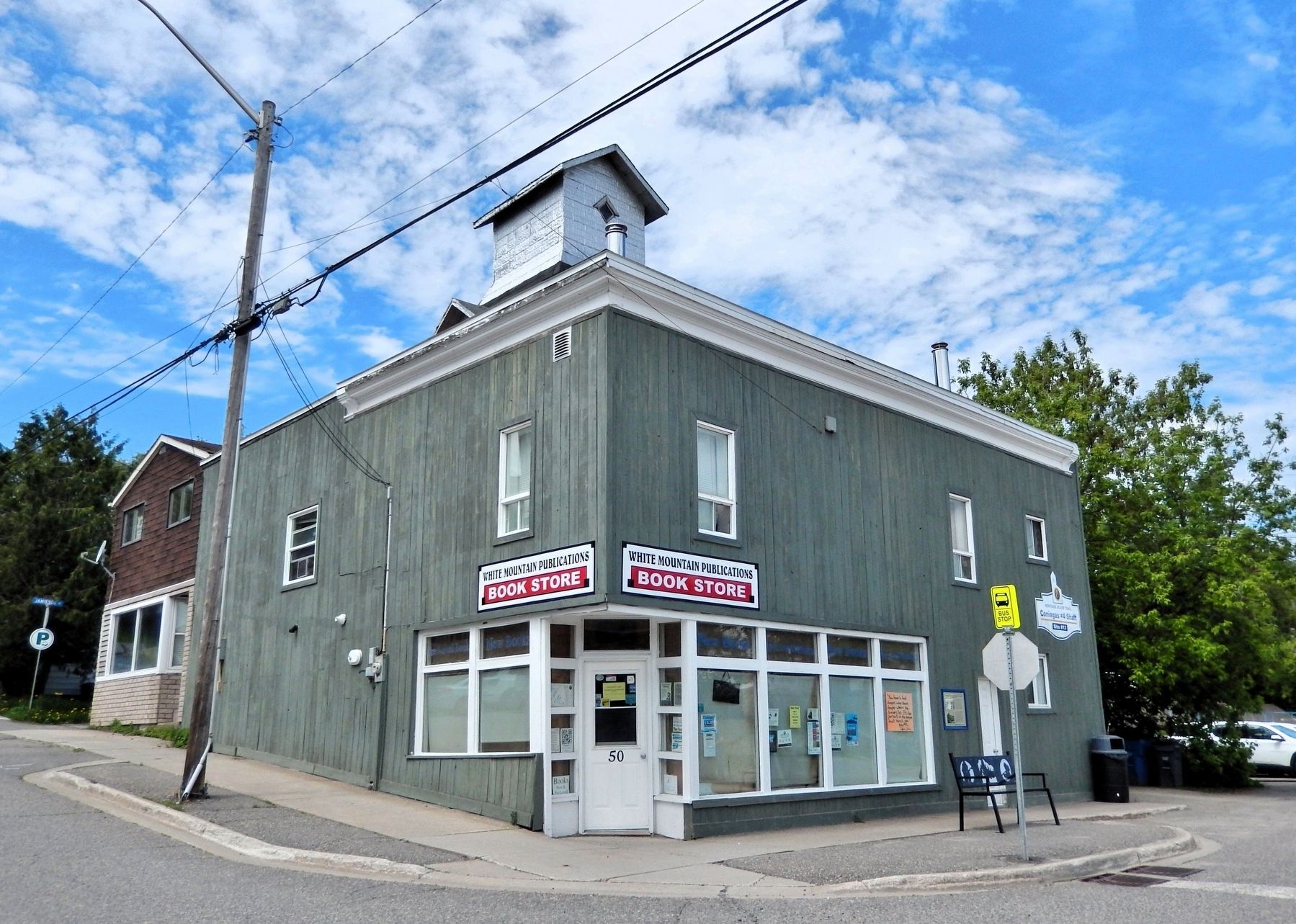
such time as the said Mine exhausts the other places East and North of the said buildings.” The first ore passed above Silver Street in July 1915, three years after the Coniagas Shaft #4 reached a depth of 110 meters.Photographed by Cosmos Mariner, June 2, 20223. The Coniagas #4 Shaft Building (southeast elevation)The top of the historic #4 headframe can be seen atop the building. The building housed book publishing company and bookstore in 2022.Two years after, in 1924, the company ceased operations. Anthony Giachino then purchased the shaft house and converted it into a grocery and meat market. He utilized the rising cold air in the shaft to cool the meat and vegetables and to air-condition the store. The building has gone through several owners, and many uses, since then. White Mountain Publications was the last to occupy the ground floor of this historic building. The shaft itself was filled with concrete in November 2015 for the safety of all concerned.
2. 50 Silver Street — The Lavender Fox.
(Presents many historical photos of the property.) Excerpt: Special thanks to The Cobalt Historical Society for their incredible existing archives, which helped us find all the historical photos and info we put together to give you a journey through 50 Silver St. and its occupants; from the “Coniagas Shaft House #4” in 1915 to “The Lavender Fox” in 2023.(Submitted on July 6, 2026, by Cosmos Mariner of Cape Canaveral, Florida.)
3. Coniagas Mine (Wikipedia).
Excerpt: The Coniagas Mine is an abandoned silver mine in Cobalt, Ontario, Canada, located on the western side of Cobalt Lake. The mine was discovered in May 1903 by William Griffith Trethewey. The claim was sold to R. W. Leonard of St. Catharines Ontario and placed into production in 1904. The mine and the associated Coniagas Reduction Works of St Catharines operated until 1924 when known reserves were exhausted.(Submitted on July 6, 2026, by Cosmos Mariner of Cape Canaveral, Florida.)
Credits. This page was last revised on July 6, 2026. It was originally submitted on July 4, 2026, by Cosmos Mariner of Cape Canaveral, Florida. This page has been viewed 10 times since then. Photos: 1, 2. submitted on July 5, 2026, by Cosmos Mariner of Cape Canaveral, Florida. 3. submitted on July 6, 2026, by Cosmos Mariner of Cape Canaveral, Florida.
