Critz in Patrick County, Virginia — The American South (Mid-Atlantic)
Tobacco Barn
Reynolds Homestead

Tobacco has been a major part of the economy of Virginia since the beginning of settlement. The variety of tobacco grown in Virginia, Nicotiana Rustica, has been traced back to use by the American Indians. As early as 1825, Abraham Reynolds began growing tobacco on Rock Spring Plantation.
In 1828, he sent his son Hardin to Lynchburg to sell a barrel of tobacco. After facing a difficult journey and receiving a low price for the crop, Hardin returned and persuaded his father to start manufacturing plug tobacco on their plantation, thus a small log factory was built near the home. In 1867, Hardin’s son, R. J. Reynolds, purchased a share of the family business, officially beginning his career as a tobacco grower and manufacturer. In 1875 R. J. Reynolds moved his tobacco business to what is now Winston-Salem, North Carolina, about 48 miles southeast of Critz, Virginia.
The R.J. Reynolds Tobacco Company donated a collection of eighteen paintings depicting scenes of harvesting, hanging, and selling tobacco. The paintings were created by the American Regionalists, a group of artists whose paintings, prints, and drawings
this page online
By the 1600s, tobacco was used as currency in the American Colonies and was growing in popularity in Europe. With the demand for more product, tobacco became a thriving business in Virginia. Bright Leaf tobacco was created in Caswell County, North Carolina in 1839. It was with this new milder variety that the Reynoldses made their fortune.
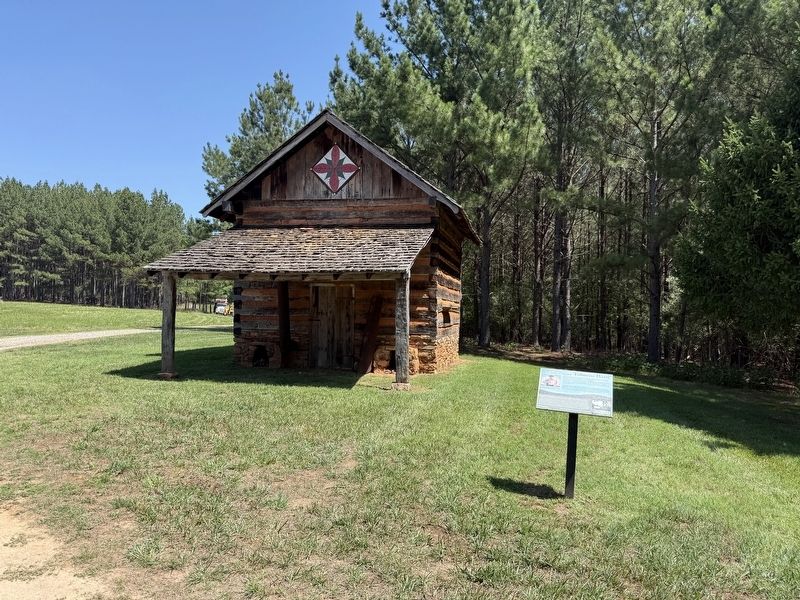
The manufacturing of tobacco was labor intensive, including at least 36 steps from cultivating to curing. Enslaved workers spent long days in the fields caring for the tobacco plants. To prepare his tobacco for consumption, Hardin Reynolds began using the flue-curing method of creating high heat in a small enclosed space. The construction of the tobacco barn reflects this process. Tobacco leaves were picked and strung on sticks, then hung in the barn. The flues, which run from the external fire boxes, created heat
[Captions:]
Boy, That's Tobacco!, an oil painting by artist James Ormsbee Chapin, is among the collection of paintings at Reynolds Homestead.
This barn was reconstructed in 2010 using logs salvaged from tobacco barns on this property and two additioanl structures donated by Ben and Betty Davenport.
Erected by Virginia Tech.
Topics. This historical marker is listed in these topic lists: Agriculture • Arts, Letters, Music • Industry & Commerce. A significant historical year for this entry is 1825.
Location. 36° 38.667′ N, 80° 8.896′ W. Marker is in Critz, Virginia, in Patrick County. It is on Homestead Lane half a mile north of Abram Penn Highway (Virginia Route 626), on the right when traveling north. Touch for map. Marker is at or near this postal address: 22280 Jeb Stuart Hwy, Critz VA 24082, United States of America. Touch for directions.

Regionally, this marker is in Southern Virginia and in the Blue Ridge Highlands. It is also in the American South, specifically in the Upper South, in Appalachia, and specifically in Southern Appalachia. Globally, it is in North America, the Western Hemisphere, the Western World, and the Anglosphere. Historically, it finds itself in what was once the territory of the Mississippian Culture, one of the original Thirteen Colonies, one of the Confederate States of America, and the Antebellum South.
Other nearby markers. At least 8 other markers are within 4 miles of this marker, measured as the crow flies: Family Cemetery (within shouting distance of this marker); Historic Home (about 400 feet away, measured in a direct line); Plantation Kitchen (about 400 feet away); Creamery & Ice House (about 400 feet away); Rock Spring Plantation (about 400 feet away); The Reynolds Homestead (about 500 feet away); a different marker also named Reynolds Homestead (approx. 3.2 miles away); Col. Abram Penn (approx. 4.1 miles away). Touch for a list and map of all markers in Critz.
Another marker is no longer nearby. Colonel Abram Penn (was approx. 4.1 miles away but has been replaced with another marker now near it).
Credits. This page was last revised on July 16, 2026. It was originally submitted on July 6, 2026, by Devry Becker Jones of Washington, District of Columbia. This page has been viewed 15 times since then. Photos: 1, 2. submitted on July 6, 2026, by Devry Becker Jones of Washington, District of Columbia.
