Naperville in DuPage County, Illinois — The American Midwest (Great Lakes)
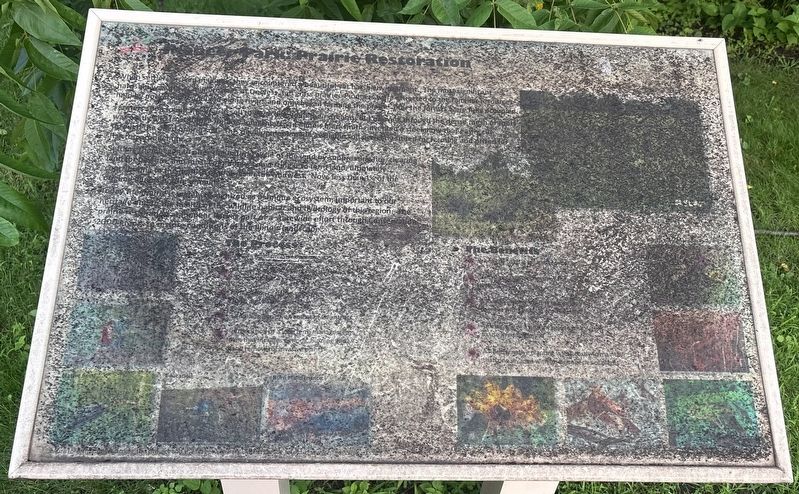
Pioneer Park: Prairie Restoration
Photographed by Sean P. Flynn, July 5, 2026
1. Pioneer Park: Prairie Restoration Marker
Farmers soon found the prairie soil to be rich beyond their dreams, but [something]ing through the dense mesh of soil was costly and [words not readable]. John Deer, an Illinois blacksmith, invented a steel plow that easily cut through the deep prairie soil. This development made available soil perfectly suited for farming and prized for its crop production.
Settlers then began to alter the natural cycle of the land by suppressing fire, clearing land for [unreadable] and most [unreadable] by converting to farmland, ultimately contributing to the demise of prairie in the Midwest. Now less than 1% of the original Illinois prairie remains.
Today, the prairie is widely recognized as a unique ecosystem, important to our heritage and to the health of the wildlife habitat and hydrology
this page online
The Process
• Removal of invasive species
• Removal of plants inappropriate to an oak woodland
• Installation of native plants, including ephemeral wild flowers, native grasses and forbs and oak saplings
• Education and involvement of volunteers • Introduction of a long term management plan that includes periodic burning and hand removal of invasive plants
The Benefits
• A healthy habitat for native wildlife
• Native vegetation improves soil, air and water quality
• A location where visitors can enjoy and connect with the local environment
• An example of a healthy oak woodland to-use in education
• A healthy woodland reduces long-term maintenance costs
Erected by Naperville Park District.
Topics. This historical marker is listed in these topic lists: Environment • Settlements & Settlers. A significant historical year for this entry is 2000.
Location. 41° 45.261′ N, 88° 8.179′ W. Marker is unreadable. Marker is in Naperville, Illinois, in DuPage

Photographed by Sean P. Flynn, July 5, 2026
2. Pioneer Park: Prairie Restoration Marker in the pavilion area

Regionally, this marker is in Greater Chicago. It is also in the American Midwest. Globally, it is in North America, on the Great Lakes, in the Western Hemisphere, in the Western World, and in the Anglosphere. Historically, it finds itself in what was once the territory of the Mississippian Culture and also the Northwest Territory.
Other nearby markers. At least 8 other markers are within walking distance of this location: Pioneer Park: Oak Woodland Restoration (within shouting distance of this marker); Pioneer Park: Wetland Restoration (within shouting distance of this marker); DuPage County Pioneer Park (approx. ¼ mile away); Restoring the Riverbank at Lincoln Greenway (approx. 0.3 miles away); Veterans Park: Remembrance, Nature and Community Service (approx. 0.3 miles away); Revolutionary War Patriots (approx.

Photographed by Sean P. Flynn, July 5, 2026
3. Pioneer Park: Prairie Restoration Marker
More about this marker. The marker, when seen in July 2026, was almost completely unreadable, with most of the words covered by splotches. The text above is a best attempt to recreate the marker's inscription.
Also see . . .
1. Illinois Prairies. From the Illinois Department of Natural Resources.
Excerpt: "Most of the land in the northern two-thirds of Illinois is flat. The movement of glaciers through what is now Illinois shaped the land. Four major glaciers have covered parts of Illinois during its past, the last about 12,000 years ago. One of the glaciers traveled almost as far south as the location of present-day Carbondale.
"Weather conditions in Illinois over thousands of years helped determine that prairies would exist in the state. Climate in prairies is characterized by hot, dry summers and cold winters. When these conditions developed about 8,300 years ago, the tallgrass prairie became a major part of the Illinois landscape."

Photographed by Sean P. Flynn, July 5, 2026
4. Pioneer Park pavilion area
On the right is the marker about the prairie restoration; on the left is a marker about Woodland restoration.
2. What would Chicago look like if settlers hadn't changed it?. Curious City, from Chicago Public Radio (WBEZ), looks at what the Northern Illinois landscape looked like prior to white settlement.
Excerpt: "Much of the city of Chicago proper had once been a web of marshy wetlands, dry ridges and forest groves — often interrupted by wooded areas that formed oases in an otherwise damp, rough terrain. To the west, an ocean of grasses known as tallgrass prairie stretched farther than the eye could see. And a potent wild leek — called “cheekagou” by the Illinois and Creek peoples — was abundant in local marshes."(Submitted on July 8, 2026, by Sean P. Flynn of Oak Park, Illinois.)
3. Conservation grants in Illinois. This list of Illinois conservation programs from the Conservation Almanac includes Conservation 2000, which is referenced on this sign as the source of funding for this prairie restoration in Naperville.
Excerpt: "Illinois Conservation 2000: In 1995, the state legislature passed Conservation 2000 (C2000), a program designed to promote ecosystem-based management of privately held land in a public-private partnership. The C2000 Program funds nine programs across three state agencies in Illinois – the Department of Natural Resources, the Department of Agriculture, and the Illinois Environmental Protection Agency. C2000 devotes most of its funding to planning and management activities, but a portion of its funds go towards land acquisition. C2000 also invests in conservation easements and other mechanisms to help protect privately held land with high quality habitat. The C2000 program sponsors 41 Ecosystem Partnerships—coalitions of local stakeholders such as private landowners, businesses, scientists, environmental organizations, recreational enthusiasts and policy makers—covering 85 percent of Illinois.(Submitted on July 8, 2026, by Sean P. Flynn of Oak Park, Illinois.)
"C2000 was originally a six-year, $100 million program, but in 2008, House Bill 1780 was signed into law as Public Act 95-0139, extending the program to 2021, and calling it Partners for Conservation. This program no longer actively acquires land."
Credits. This page was last revised on July 8, 2026. It was originally submitted on July 8, 2026, by Sean P. Flynn of Oak Park, Illinois. This page has been viewed 12 times since then. Photos: 1, 2, 3, 4. submitted on July 8, 2026, by Sean P. Flynn of Oak Park, Illinois.
