Near Peterstown in Monroe County, West Virginia — The American South (Appalachia)
Old Stone Fountain
travelmonroe.com
304-772-3003
Photographed by Devry Becker Jones (CC0), July 4, 2026
1. Old Stone Fountain Marker
Inscription.
Old Stone Fountain. travelmonroe.com.
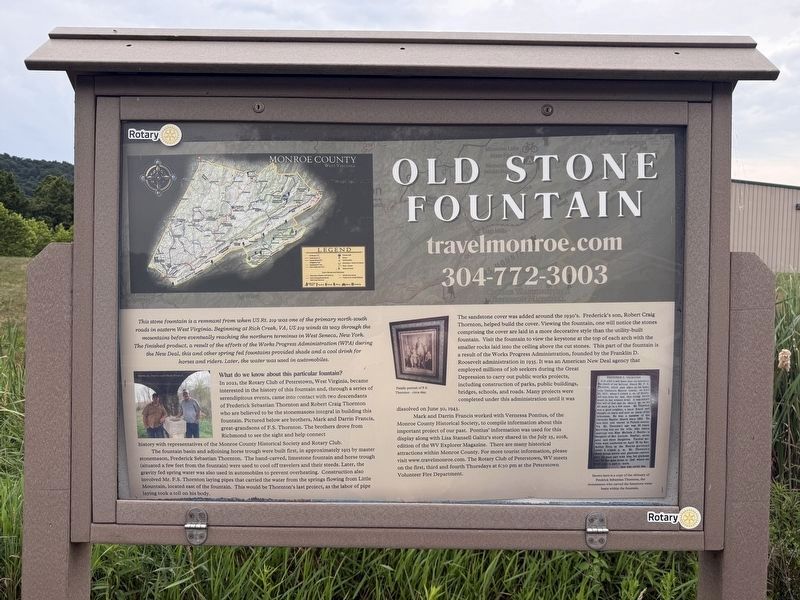
This stone fountain is a remnant from when US Rt. 219 was one of the primary north-south roads in eastern West Virginia. Beginning at Rich Creek, VA, US 219 winds its way through the mountains before eventually reaching the northern terminus in West Seneca, New York. The finished product, a result of the efforts of the Works Progress Administration (WPA) during the New Deal, this and other spring fed fountains provided shade and a cool drink for horses and riders. Later, the water was used in automobiles.. What do we know about this particular fountain? In 2022, the Rotary Club of Peterstown, West Virginia became interested in the history of this fountain and, through a series of serendipitous events, came into contact with two descendants of Frederick Sebastian Thornton and Robert Craig Thornton who are believed to be the stonemasons integral in building this fountain. Pictured below are brothers, Mark and Darrin Francis, great-grandsons of F.S. Thornton. The brothers drove from Richmond to see the sight and help connect history with representatives of the Monroe County Historical Society and Rotary Club., The fountain basin and adjoining horse trough were built first, in approximately 1915 by master stonemason, Frederick Sebastian Thornton. The hand-carved, limestone fountain and horse trough (situated a few feet from the fountain) were used to cool off travelers and their steeds. Later, the gravity fed spring water was also used in automobiles to prevent overheating. Construction also involved Mr. F.S. Thornton laying pipes that carried the water from the springs flowing from Little Mountain, located east of the fountain. This would be Thornton's last project, as the labor of pipe laying took a toll on his body., The sandstone cover was added around the 1930's. Frederick's son, Robert Craig Thornton, helped build the cover. Viewing the fountain, one will notice the stones comprising the cover are laid in a more decorative style than the utility-built fountain. Visit the fountain to view the keystone at the top of each arch with the smaller rocks laid into the ceiling above the cut stones. This part of the fountain is a result of the Works Progress Administration, founded by the Franklin D. Roosevelt administration in 1935. It was an American New Deal agency that employed millions of job seekers during the Great Depression to carry out public works projjects, including construction of parks, public buildings, bridges, schools, and roads. Many projects were completed under this administration until it was dissolved on June 30, 1943., Mark and Darrin Francis worked with Vernessa Pontius, of the Monroe County Historical Society, to compile information about this important project of our past. Pontius' information was used for this display along with Lisa Stansell Galitz's story shared in the June 25, 2018, edition of the WV Explorer Magazine. There are many historical attractions within Monroe County. For more information, please visit www.travelmonroe.com. The Rotary Club of Peterstown, WV meets on the first, third and fourth Thursdays a 6:30 pm at the Peterstown Volunteer Fire Department.
This stone fountain is a remnant from when US Rt. 219 was one of the primary north-south roads in eastern West Virginia. Beginning at Rich Creek, VA, US 219 winds its way through the mountains before eventually reaching the northern terminus in West Seneca, New York. The finished product, a result of the efforts of the Works Progress Administration (WPA) during the New Deal, this and other spring fed fountains provided shade and a cool drink for horses and riders. Later, the water was used in automobiles.
What do we know about this particular fountain?
In 2022, the Rotary Club of Peterstown, West Virginia became interested in the history of this fountain and, through a series of serendipitous events, came into contact with two descendants of Frederick Sebastian Thornton and Robert Craig Thornton who are believed to be the stonemasons integral in building this fountain. Pictured below are brothers, Mark and Darrin Francis, great-grandsons of F.S. Thornton. The brothers drove from Richmond to see the sight and help connect history with representatives of the Monroe County Historical Society and Rotary Club.
The fountain
Click or scan to see this page online
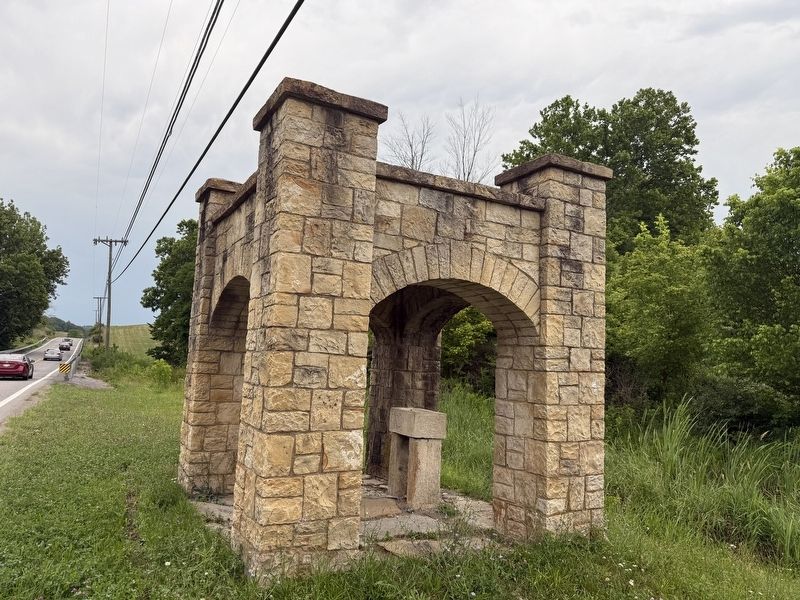
basin and adjoining horse trough were built first, in approximately 1915 by master stonemason, Frederick Sebastian Thornton. The hand-carved, limestone fountain and horse trough (situated a few feet from the fountain) were used to cool off travelers and their steeds. Later, the gravity fed spring water was also used in automobiles to prevent overheating. Construction also involved Mr. F.S. Thornton laying pipes that carried the water from the springs flowing from Little Mountain, located east of the fountain. This would be Thornton's last project, as the labor of pipe laying took a toll on his body.
The sandstone cover was added around the 1930's. Frederick's son, Robert Craig Thornton, helped build the cover. Viewing the fountain, one will notice the stones comprising the cover are laid in a more decorative style than the utility-built fountain. Visit the fountain to view the keystone at the top of each arch with the smaller rocks laid into the ceiling above the cut stones. This part of the fountain is a result of the Works Progress Administration, founded by the Franklin D. Roosevelt administration in 1935. It was an American New
Photographed by Devry Becker Jones (CC0), July 4, 2026
2. Old Stone Fountain Marker
Deal agency that employed millions of job seekers during the Great Depression to carry out public works projjects, including construction of parks, public buildings, bridges, schools, and roads. Many projects were completed under this administration until it was dissolved on June 30, 1943.
Mark and Darrin Francis worked with Vernessa Pontius, of the Monroe County Historical Society, to compile information about this important project of our past. Pontius' information was used for this display along with Lisa Stansell Galitz's story shared in the June 25, 2018, edition of the WV Explorer Magazine. There are many historical attractions within Monroe County. For more information, please visit www.travelmonroe.com. The Rotary Club of Peterstown, WV meets on the first, third and fourth Thursdays a 6:30 pm at the Peterstown Volunteer Fire Department.
Photographed by Devry Becker Jones (CC0), July 4, 2026
3. Old Stone Fountain Marker
series lists. A significant historical date for this entry is June 30, 1943.
Location. 37° 25.085′ N, 80° 44.5′ W. Marker is near Peterstown, West Virginia, in Monroe County. It is on Seneca Trail South (Route 219) east of Park Drive, on the right when traveling north. Touch for map. Marker is at or near this postal address: 3959 Seneca Trail S, Peterstown WV 24963, United States of America. Touch for directions.

Regionally, this marker is in the Southern Coalfields. It is also in the American South, specifically in the Upper South, in Appalachia, and specifically in Southern Appalachia. Globally, it is in North America, the Western Hemisphere, the Western World, and the Anglosphere. Historically, it finds itself in what was once the territory of the Mississippian Culture.
Credits. This page was last revised on July 10, 2026. It was originally submitted on July 10, 2026, by Devry Becker Jones of Washington, District of Columbia. This page has been viewed 6 times since then. Photos:1, 2, 3. submitted on July 10, 2026, by Devry Becker Jones of Washington, District of Columbia.