New Castle in Craig County, Virginia — The American South (Mid-Atlantic)
Craig Valley Branch Railroad
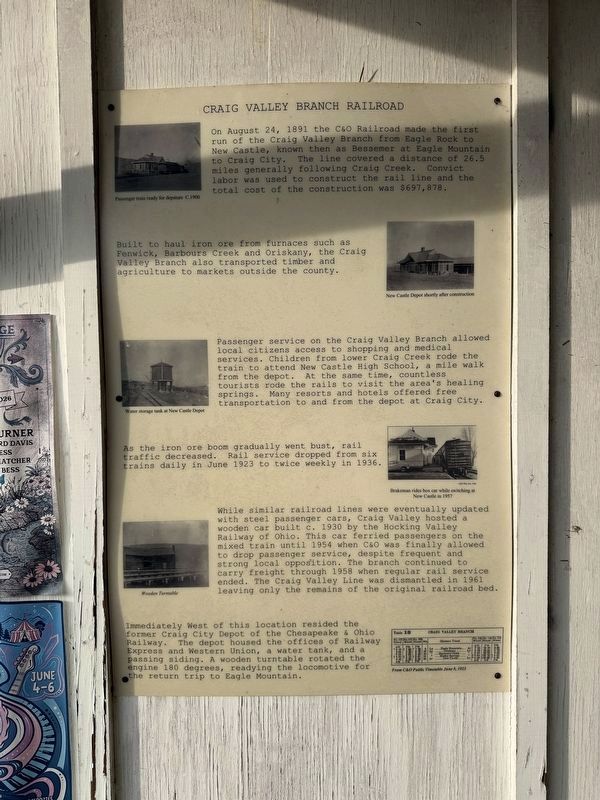
On August 24, 1891 the C&O Railroad made the first run of the Craig Valley Branch from Eagle Rock to New Castle, known then as Bessemer at Eagle Mountain to Craig County. The line covered a distance of 26.5 miles generally following Craig Creek. Convict labor was used to construct the rial line and the total cost of the construction was $697,878.
Built to haul iron ore from furnaces such as Fenwick, Barbours Creek and Oriskany, the Craig Valley Branch also transported timber and agriculture to markets aoutside the county.
Passenger service on the Craig Valley Branch allowed local citizens access to shopping and medical services. Chidlren from lower Craig Creek rode the train to attend New Castle High School, a mile walk from the depot. At the same time, countless tourists rode the rails to visit the area's healing springs. Many resorts and hotels offered free transportation to and from the depot at Craig City.
As the iron ore boom gradually went bust, rail traffic decreased. Rail service dropped from six trains daily in June 1923 or twice weekly in 1936.
While similar railroad lines were eventually updated
this page online
Immediately West of this location resided the former Craig City Depot of the Chesapeake & Ohio Railway. The depot housed the offices of Railway Express and Western Union, a water tank, and a passing siding. A wooden turntable rotated the engine 180 degrees, readying the locomotive for the return trip to Eagle Mountain.
Topics. This historical marker is listed in these topic lists: Education • Industry & Commerce • Law Enforcement • Railroads & Streetcars. A significant historical month for this entry is June 1923.
Location. 37° 30.59′ N, 80° 6.011′ W. Marker is in New Castle, Virginia, in Craig County. It is at the intersection of Commerce Avenue and 3rd Street, on the right
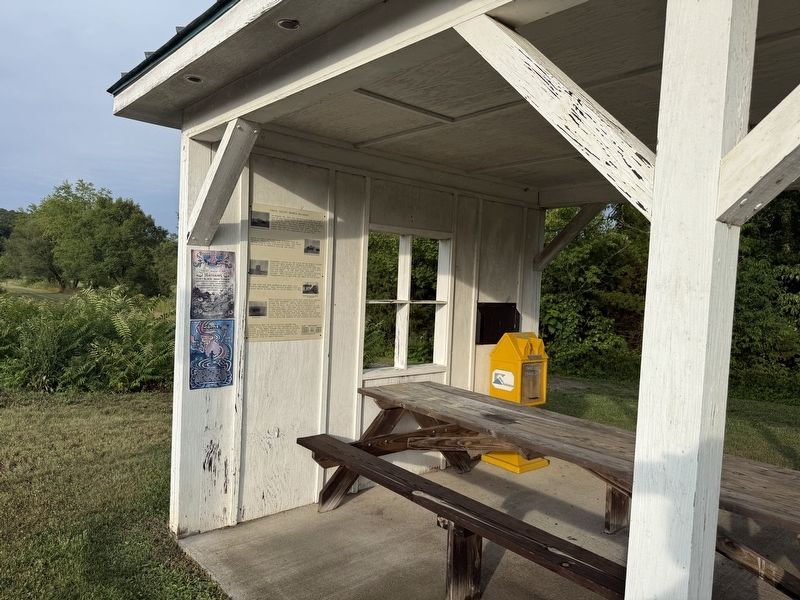

Regionally, this marker is in the Mountain Region and in Southwest Virginia. It is also in the American South, specifically in the Upper South, in Appalachia, and specifically in Southern Appalachia. Globally, it is in North America, the Western Hemisphere, the Western World, and the Anglosphere. Historically, it finds itself in what was once the territory of the Mississippian Culture, one of the original Thirteen Colonies, one of the Confederate States of America, and the Antebellum South.
Other nearby markers. At least 8 other markers are within 8 miles of this marker, measured as the crow flies: Holstine House (approx. 0.6 miles away); Craig County Confederate Monument (approx. 0.7 miles away); Craig County World War Memorial (approx. 0.7 miles away); Craig County Veterans Monument (approx. 0.7 miles away); Craig County World War II Memorial (approx. 0.7 miles away); Revolutionary War Patriots (approx. 0.7 miles away); New Castle (approx. 0.8 miles away); Great Eastern Divide (approx. 7.7 miles away). Touch for a list and map of all markers in New Castle.
Also see . . . Convict Leasing article on the site for the Virginia Museum of History & Culture. This article examines the history of convict labor leasing in Virginia. Imposed overwhelmingly on African Americans in the post-Civil War South, the system operated as a form of forced labor until it was finally dismantled during the Franklin D. Roosevelt administration. (Submitted on July 10, 2026, by Devry Becker Jones of Washington, District of Columbia.)
Additional keywords. debt slavery; enslaved labor
Credits. This page was last revised on July 10, 2026. It was originally submitted on July 10, 2026, by Devry Becker Jones of Washington, District of Columbia. This page has been viewed 22 times since then. Photos: 1, 2. submitted on July 10, 2026, by Devry Becker Jones of Washington, District of Columbia.
