Des Moines Township near Jackson in Jackson County, Minnesota — The American Midwest (Upper Plains)
Birds of a Feather
April 13, 2026
1. Birds of a Feather Marker, Side One
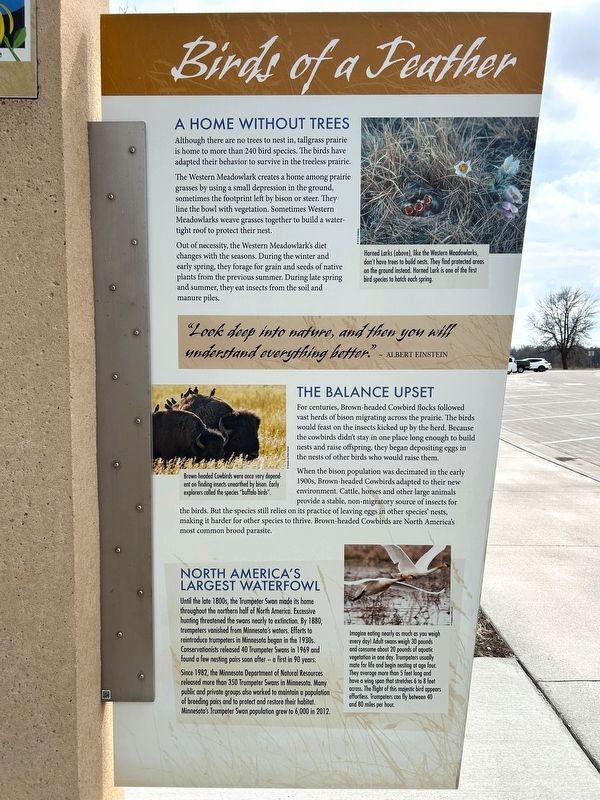
A Home Without Trees
Although there are no trees to nest in, tallgrass prairie is home to more than 240 bird species. The birds have adapted their behavior to survive in the treeless prairie.
The Western Meadowlark creates a home among prairie grasses by using a small depression in the ground, sometimes the footprint left by bison or steer. They line the bowl with vegetation. Sometimes Western Meadowlarks weave grasses together to build a watertight roof to protect their nest.
Out of necessity, the Western Meadowlarks' diet changes with the seasons. During the winter and early spring, they forage for grain and seeds of native plants from the previous summer. During late spring and summer, they eat insects from the soil and manure piles.
Horned Larks (above), like the Western Meadowlarks, don't have trees to build nests. They find protected areas on the ground instead. Horned Lark is one of the first bird species to hatch each spring.
"Look deep into nature, and then you will understand everything better." ~ Albert Einstein
The Balance Upset
For centuries, Brown-headed Cowbird flocks followed vast herds
this page online
When the bison population was decimated in the early 1900s, Brown-headed Cowbirds adapted to their new environment. Cattle, horses and other large animals provide a stable, non-migratory source of insects for the birds. But the species still relies on its practice of leaving eggs in other species' nests, making it harder for other species to thrive. Brown-headed Cowbirds are North America's most common brood parasite.
Brown-headed Cowbirds were once very dependent on finding insects unearthed by bison. Early explorers called the species "buffalo birds".
North America's Largest Waterfowl
Until the late 1800s, the Trumpeter Swan made its home throughout the northern half of North America. Excessive hunting threatened the swans nearly to extinction. By 1880, trumpeters vanished from Minnesota's waters. Efforts to reintroduce trumpeters in Minnesota began in the
April 13, 2026
2. Birds of a Feather Marker, Side Two
Since 1982, the Minnesota Department of Natural Resources released more than 350 Trumpeter Swans in Minnesota. Many public and private groups also worked to maintain a population of breeding pairs and to protect and restore their habitat. Minnesota's Trumpeter Swan population grew to 6,000 in 2012.
Imagine eating nearly as much as you weigh every day! Adult swans weight 30 pounds and consume about 20 pounds of aquatic vegetation in one day. Trumpeters usually mate for life and begin nesting at age four. They average more than 5 feet long and have a wing span that stretches 6 to 8 feet across. The flight of this majestic bird appears effortless. Trumpeters can fly between 40 and 80 miles per hour.
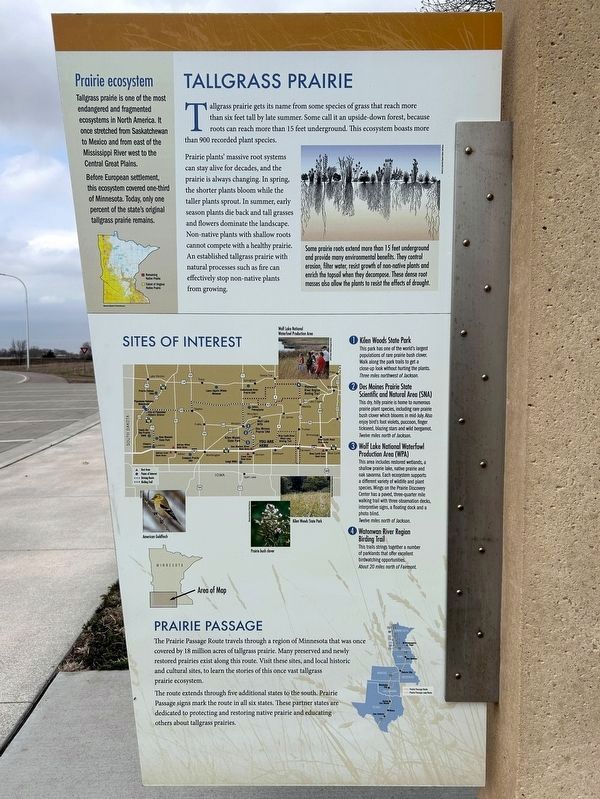
Tallgrass Prairie
Tallgrass prairie gets its name from some species of grass that reach more than six feet tall by late summer. Some call it an upside-down forest, because roots can reach more than 15 feet underground. This ecosystem boasts more than 900 recorded plant species.
Prairie plants' massive root
April 13, 2026
3. Birds of a Feather Marker
Some prairie roots extend more than 15 feet underground and provide many environmental benefits. They control erosion, filter water, resist growth of non-native plants and enrich the topsoil when they decompose. These dense root masses also allow the plants to resist the effects of drought.
Prairie ecosystem
Tallgrass prairie is one of the most endangered and fragmented ecosystems in North America. It once stretched from Saskatchewan to Mexico and from east of the Mississippi River west to the Central Great Plains.
Before European settlement, this ecosystem covered one-third of Minnesota. Today, only one percent of the state's original tallgrass prairie remains.
Sites of Interest
(1) Kilen Woods State Park
This park has one of the world's largest populations of rare prairie bush clover. Walk along the park trails to get a close-up look without hurting the plants.
Three miles northwest of Jackson.
(2) Des Moines Prairie State Scientific and Natural Area (SNA)
This dry, hilly prairie is home to numerous prairie plant species, including rare prairie bush clover which blooms in mid-July. Also enjoy bird's foot violets, puccoon, finger tickseed, blazing stars and wild bergamot.
Twelve miles north of Jackson.
(3) Wolf Lake National Waterfowl Production Area (WPA)
This area includes restored wetlands, a shallow prairie lake, native prairie and oak savanna. Each ecosystem supports a different variety of wildlife and plant species. Wings on the Prairie Discovery Center has a paved, three-quarter mile walking trail with three observation decks, interpretive signs, a floating dock and a photo blind.
Twelve miles north of Jackson.
(4) Watonwan River Region Birding Trail
This trails strings together a number of parklands that offer excellent birdwatching opportunities.
About 20 miles north of Fairmont.
Prairie Passage
The
April 13, 2026
4. Birds of a Feather Marker
The route extends through five additional states to the south. Prairie Passage signs mark the route in all six states. These partner states are dedicated to protecting and restoring native prairie and educating others about tallgrass prairies.
Topics. This historical marker is listed in these topic lists: Animals • Environment. A significant historical year for this entry is 1969.
Location. 43° 38.451′ N, 95° 1.238′ W. Marker is near Jackson, Minnesota, in Jackson County. It is in Des Moines Township. It can be reached from Interstate 90 at milepost 72, 1½ miles west of U.S. 71, on the right when traveling west. Located at the westbound Des Moines River Rest Area. Touch for map. Marker is in this post office area: Jackson MN 56143, United States of America. Touch for directions.

Regionally, this marker is in Southwest Minnesota. It is also in the American Midwest, in the Corn Belt, and on the Great Plains. Globally, it is in North America, the Western Hemisphere, the Western World, and the Anglosphere. Historically, it finds itself in what was once Rupert’s Land, the territory of the Mississippian Culture, and the Louisiana Purchase.
Other nearby markers. At least 8 other markers are within 13 miles of this marker, measured as the crow flies: Government Ditches (within shouting distance of this marker); Wood Brothers Trading Post (approx. 1.8 miles away); Olson-Slaabakken Cabin (approx. 2 miles away); Olson Slaabakken Cabin / The Jackson County Massacre Monument (approx. 2 miles away); Jackson County Massacre Monument (approx. 2 miles away); History in the Soil (approx. 3.1 miles away); State Line Congregation (approx. 11½ miles away in Iowa); Marble Cabin (approx. 12.6 miles away in Iowa). Touch for a list and map of all markers in Jackson.
Also see . . . Trumpeter swan restoration project | Minnesota DNR.
Excerpt: "Since the first trumpeter swan releases in 1987, the Nongame Wildlife Program has released more than 350 swans. Similar work to restore trumpeter swans in South Dakota, Iowa, Wisconsin, Michigan, Ohio and Ontario has brought North America's interior population to over 63,000."(Submitted on July 10, 2026.)
Credits. This page was last revised on July 11, 2026. It was originally submitted on July 10, 2026. This page has been viewed 14 times since then. Photos: 1, 2, 3, 4. submitted on July 10, 2026.
