Eastside in Riverside in Riverside County, California — The American West (Pacific Coastal)
Riverside Substation
Riverside Public Utilities

Photographed by Volt Craft, June 24, 2026
1. Riverside Substation: What’s Behind This Wall?
What’s Behind This Wall?
In 1895, Riverside built one of the first municipally owned electric utilities in California, including a 20-mile transmission line to carry power from a hydroelectric plant in the mountains down to the city. That early investment helped power Riverside's growth, and the system we use today still follows the same basic principle.
A substation is where high-voltage electricity from transmission lines is transformed to lower voltage so it can be safely delivered to homes and businesses. Electricity travels long distances of high voltage (typically tens of thousands of volts) because it's more efficient and reduces energy loss. But that voltage is too powerful to use directly.
Inside this substation, transformers reduce the voltage to safer levels for local distribution. From here, power flows through underground or overhead lines, into neighborhoods and buildings, and ultimately into outlets and appliances. Modern substations also include circuit breakers, protective relays, and control systems that help maintain reliability and safety-automatically isolating parts of the system if there's
this page online
This site is one small but critical part of a network that powers Riverside every day.
How Does it Work?
The substation receives electricity at 69,000 volts, also called 69kV. High-voltage lines like these are used to move electricity over long distances because it's more efficient and cost- effective. At substations, the voltage is lowered so it can be safely delivered to homes, businesses, and industries in Riverside. At Riverside Substation, 69kV electricity is reduced to 12kV. This 12kV power travels through underground cables and overhead wires to reach neighborhoods. There, smaller transformers reduce it further to 120/240 volts, the amount we use for lights, appliances, and air conditioning. If you look at the overhead wires, you'll see that Riverside Substation is a key hub. Some lines bring in power from the source, while others send it out to other substations across the city.
1. Electricity enters the substation through overhead 69kV transmission lines, which are supported

Photographed by Volt Craft, June 24, 2026
2. Riverside Substation: How Does It Work?
2. After entering the substation, electricity flows through a disconnect switch and into metal conductors called "bus work," mounted on insulators. At the top of the structure, surge arresters help protect the system by blocking lightning strikes and voltage surges from entering through power lines and damaging equipment.
3. Gas Circuit Breakers (GCBs) and Vacuum Circuit Breakers (VCBs) shut off electricity to certain parts of the substation for maintenance or emergencies. This keeps workers safe while making sure the rest of the system keeps running.
4. The 69kV bus work is like a highway for electricity. It connects one substation to another through 69kV transmission lines and also sends electricity to different parts of the substation, like the transformers. The electricity travels through strong metal wires held up by insulators to keep it from going where it shouldn't.
5. The transformer lowers the voltage from 69kV to 12kV so it's safe to send to homes and businesses. It has

Photographed by Volt Craft, June 24, 2026
3. Riverside Substation: How Is It Different Today?
6. Once converted, the 12kV electricity flows through additional substation equipment such as protective circuit breakers and monitoring meters. From there, it enters underground cables and overhead lines that deliver power safely to Riverside's homes and businesses.
How is it Different Today?
Riverside Substation may have a brick wall reminiscent of the original brick Riverside Light Department headquarters, but in many important ways, it is very different from its forerunners.
Traditionally, Riverside's substations have consisted of many tall metal structures where the electricity from transmission lines is delivered to transformers that convert it from 69,000 volts to 12,000 volts for distribution throughout the city.
Riverside Substation was renovated in 1996, from the traditional high-profile maze of poles, structures, and wires to a new, lower-profile

Photographed by Volt Craft, June 24, 2026
4. Riverside Substation Markers
A few metal poles have replaced numerous transmission poles and grey wires of the past. Inside the substation, much of the equipment is designed low to the ground so it's concealed by the substation wall.
This renovation, part of a needed upgrade to Riverside Substation, was undertaken at the same time as a major revitalization of this part of historic downtown Riverside. Constructing low-profile facilities that blend in with the surrounding community is an essential part of Riverside Public Utilities' policy of being a good neighbor.
Riverside Substation
City of Riverside Public Utilities Department
Originally Constructed 1907 * Reconstructed 1994
Topics. This historical marker is listed in these topic lists: Industry & Commerce • Science & Medicine. A significant historical year for this entry is 1895.
Location. 33° 58.699′ N, 117° 22.173′ W. Marker is in Riverside, California, in Riverside County. It is in Eastside. It is at the intersection of Vine Street and 9th Street, on the right when traveling south on Vine Street. Touch for map. Marker is at or near this postal address: 3850
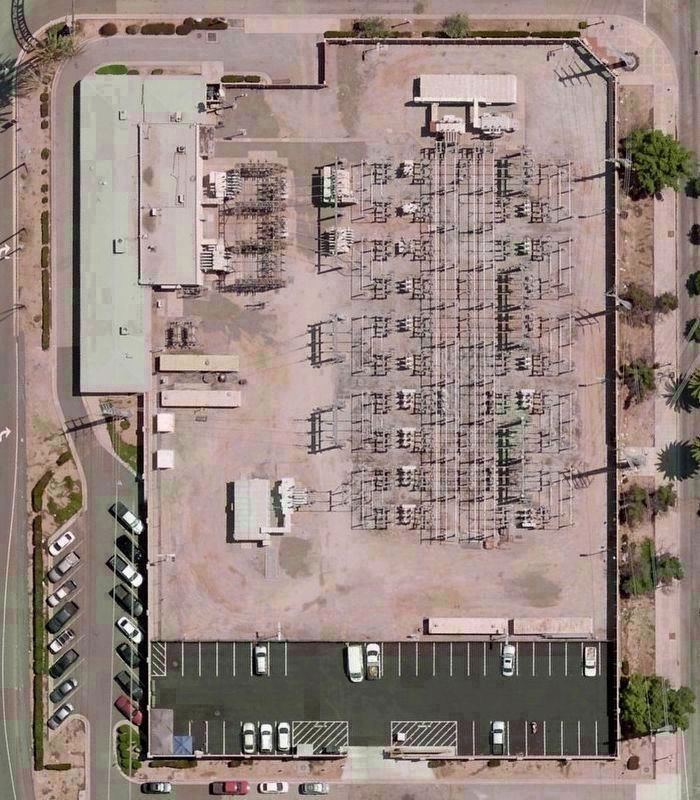
from ESRI World Imagery
5. Riverside Substation and Markers
The markers are located at top right.

Regionally, this marker is in Greater Los Angeles, in the Inland Empire, and in the Peninsular Ranges. It is also in the American Southwest. Globally, it is in North America, on the Ring of Fire, on the Pacific Rim, in the Western Hemisphere, in the Western World, and in the Anglosphere. Historically, it finds itself in what was once New Spain and also Mexico’s Alta California.
Other nearby markers. At least 8 other markers are within walking distance of this marker: San Pedro, Los Angeles, and Salt Lake Railroad Depot (about 600 feet away, measured in a direct line); John W. North Park (about 700 feet away); Santa Fe Depot (about 700 feet away); The Sutherland Fruit Co. (approx. 0.2 miles away); Veterans Park Gold Star Memorial (approx. 0.2 miles away); Robert M. Howie (approx. ¼ mile away); Riverside Art Center and Museum (approx. ¼ mile away); Riverside Municipal Auditorium (approx. ¼ mile away). Touch for a list and map of all markers in Riverside.
Regarding Riverside Substation. Three markers describe the electrical power station infrastructure at this location and its history. This is intended as an interactive exhibit to look into the substation at different features. There are three windows behind the exhibit to see the substation. These were originally transparent, but were changed to the grates you see today most likely due to vandalism. You can still see through the grates to observe the substation. The gray pole next to the sign on the right has siting tubes to see named objects in the substation.
Credits. This page was last revised on August 14, 2026. It was originally submitted on July 12, 2026, by Volt Craft of Riverside, California. This page has been viewed 25 times since then. Photos: 1, 2, 3, 4, 5. submitted on July 12, 2026, by Volt Craft of Riverside, California. • Andrew Ruppenstein was the editor who published this page.
