
James Island in Secessionville in Charleston County, South Carolina — The American South (South Atlantic)
Battery Number 5
Photographed by Bill Coughlin, August 6, 2013
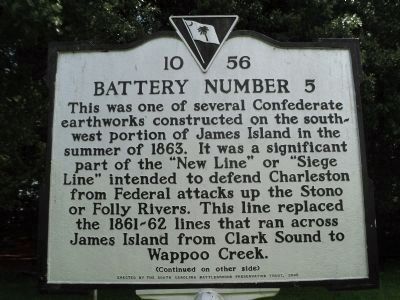
1. Battery Number 5 Marker (Side 1)
This was one of several Confederate earthworks constructed on the southwest portion of James Island in the summer of 1863. It was a significant part of the “New Line” or “Siege Line” intended to defend Charleston from Federal attacks up the Stono or Folly Rivers. This line replaced the 1861-62 lines that ran across James Island from Clark Sound to Wappoo Creek.
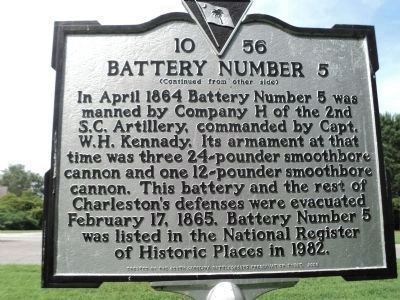
In April 1864 Battery Number 5 was manned by Company H of the 2nd S.C. Artillery, commanded by Capt. W.H. Kennady. Its armament at that time was three 24-pounder smoothbore cannon and one 12-pounder smoothbore cannon. This battery and the rest of Charleston’s defenses were evacuated February 17, 1865. Battery Number 5 was listed in the National Register of Historic Places in 1982.
Erected 2008 by South Carolina Department of Archives and History, sponsored by The South Carolina Battleground Preservation Trust. (Marker Number 10-56.)
Topics and series. This historical marker is listed in this topic list: War, US Civil. In addition, it is included in the South Carolina Historical Markers series list. A significant historical date for this entry is February 17, 1865.
Location. 32° 42.473′ N,
this page online

Regionally, this marker is in Historic Charleston and in the Lowcountry. It is also in the American South, specifically in the Deep South, and on the Eastern Seaboard. Globally, it is in the North Atlantic Region, North America, the Western Hemisphere, the Western World, and the Anglosphere. Historically, it finds itself in what was once the territory of the Mississippian Culture, one of the original Thirteen Colonies, one of the Confederate States of America, and the Antebellum South.
Other nearby markers. At least 8 other markers are within 2 miles of this marker, measured as the crow flies: Secessionville (approx. half a mile away); Battle of Secessionville (approx. half a mile away); Battery Reed (approx. ¾ mile away); Riversville / Battle of Secessionville (approx. 0.9
Photographed by Bill Coughlin, August 6, 2013
2. Battery Number 5 Marker (Side 2)
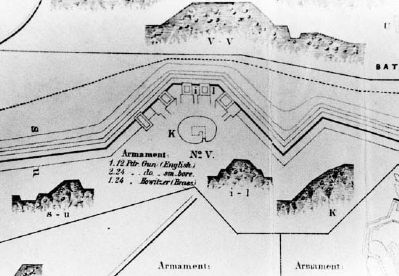
Regarding Battery Number 5. Like its sister batteries, LeRoy and Battery Number 1, Battery Number 5 was part of Beauregard’s James Island Siege Line built in 1863 to replace General J.C. Pemberton’s faulty defense line. As part of this important siege line, Battery Number 5 was designed to protect against an infantry attack via the Secessionville region of southern James Island. Battery Number 5 also supplemented the firepower of the Secessionville batteries and was kept in good order, mounting four guns in 1865. Battery Number 5 is the eastern terminus of the James Island Siege Line. It overlooks Seaside Creek and Secessionville on the southern edge of James Island. The battery is an earth redan with its right and left faces measuring about 200 feet and the center face about 100 feet. The parapet is approximately 10 feet high. The powder magazine has been destroyed. Listed in the
South Carolina Department of Archives and History
3. Battery Number 5 Map
Photographed by Mike Stroud, April 6, 2010
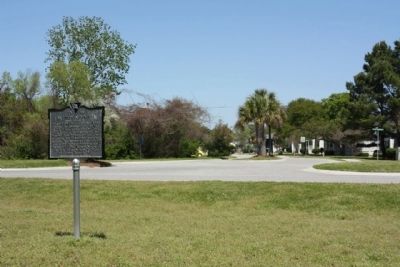
4. Battery Number 5 Marker
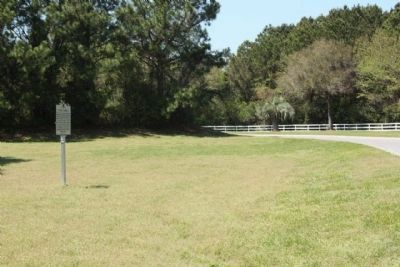
Photographed by Mike Stroud, April 6, 2010
5. Battery Number 5 Marker
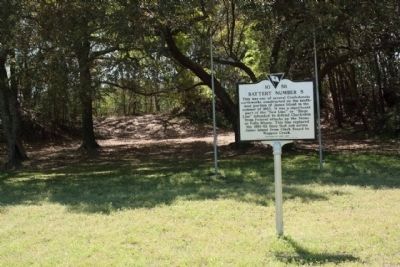
Photographed by Mike Stroud, April 6, 2010
6. Battery Number 5 Marker with remains of the earth redan seen today
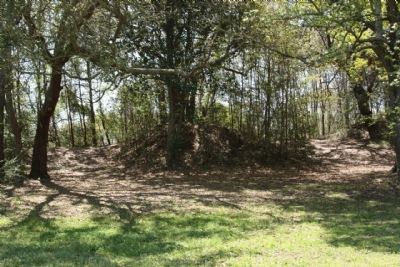
Photographed by Mike Stroud, April 6, 2010
7. Battery Number 5 , section of visible earthen redan
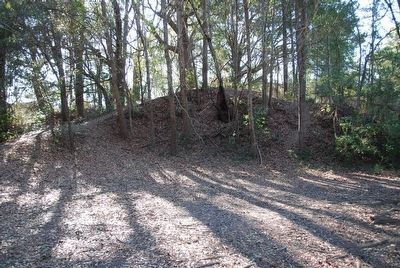
Photographed by Brandon Fletcher, February 20, 2010
8. Battery Number 5
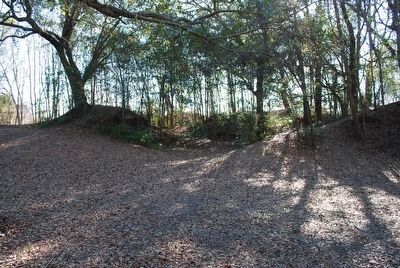
Photographed by Brandon Fletcher, February 20, 2010
9. Battery Number 5
Credits. This page was last revised on January 19, 2026. It was originally submitted on May 10, 2010, by Mike Stroud of Bluffton, South Carolina. This page has been viewed 27,494 times since then and 180 times this year. Photos: 1, 2. submitted on August 6, 2013, by Bill Coughlin of Woodland Park, New Jersey. 3, 4, 5, 6, 7. submitted on May 10, 2010, by Mike Stroud of Bluffton, South Carolina. 8, 9. submitted on August 11, 2015, by Brandon Fletcher of Chattanooga, Tennessee.
