Near Haivana Nakya in Pima County, Arizona — The American Mountains (Southwest)
The 2.1 Meter (84 Inch) and 0.9 Meter (36 Inch) Coudé Auxilliary Feed Telescopes
Photographed by Daniel Barriball, May 25, 2026
1. The 2.1 Meter (84 Inch) And 0.9 Meter (36 Inch) Coudé Auxilliary Feed Telescopes Marker
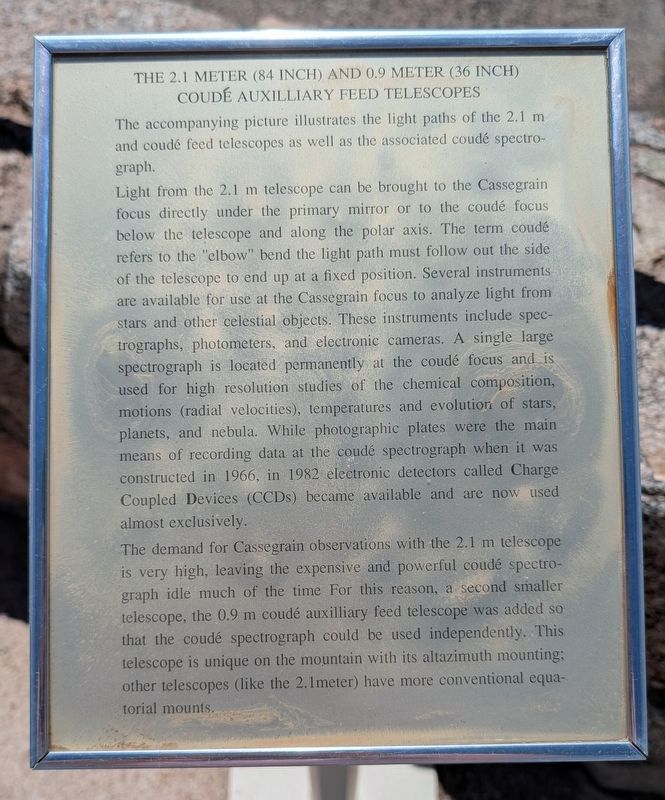
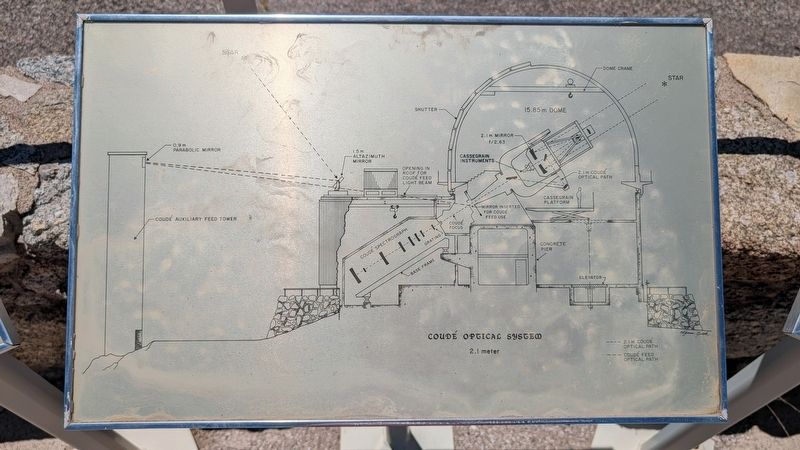
The accompanying picture illustrates the light paths of the 2.1 m and coudé feed telescopes as well as the associated coudé spectrograph.
Light from the 2.1 m telescope can be brought to the Cassegrain focus directly under the primary mirror or to the coudé focus below the telescope and along the polar axis. The term coudé refers to the "elbow" bend the light path must follow out the side of the telescope to end up at a fixed position. Several instruments are available for use at the Cassegrain focus to analyze light from stars and other celestial objects. These instruments include spectrographs, photometers, and electronic cameras. A single large spectrograph is located permanently at the coudé focus and is used for high resolution studies of the chemical composition, motions (radial velocities), temperatures and evolution of stars, planets, and nebula. While photographic plates were the main means of recording data at the coudé spectrograph when it was constructed in 1966, in 1982 electronic detectors called Charge Coupled Devices (CCDs) became available and are now used almost exclusively.
The demand for Cassegrain
this page online
Erected by Kitt Peak National Observatory.
Topics. This historical marker is listed in these topic lists: Air & Space • Exploration • Science & Medicine. A significant historical year for this entry is 1966.
Location. 31° 57.483′ N, 111° 35.884′ W. Marker is near Haivana Nakya, Arizona, in Pima County. It can be reached from State Highway 386 12 miles south of State Highway 86, on the right when traveling south. This marker stands in the plaza outside the 2.1 meter telescope at Kitt Peak National Observatory. Touch for map. Marker is in this post office area: Sells AZ 85634, United States of America. Touch for directions.

Regionally, this marker is in the Sky Islands, in the Sonoran Desert,
Photographed by Daniel Barriball, May 25, 2026
2. The 2.1 Meter (84 Inch) And 0.9 Meter (36 Inch) Coudé Auxilliary Feed Telescopes Marker in context
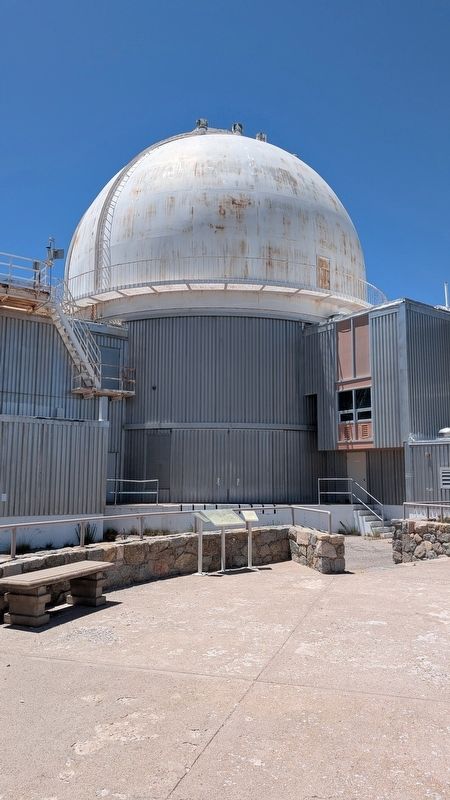
The marker is the left panel. The telescope illustration panel is in the middle and an identical marker is to the right. The dome of the 2.1 meter telescope is in the background.
Other nearby markers. At least 8 other markers are within walking distance of this marker: The McMath Solar Telescope (here, next to this marker); Kitt Peak National Observatory (about 400 feet away, measured in a direct line); The WIYN Observatory (about 600 feet away); The 1.3-meter Telescope (about 600 feet away); a different marker also named WIYN Observatory (about 700 feet away); The Concrete Donut (about 800 feet away); The Vacuum Telescope (approx. 0.2 miles away); Steward Observatory (approx. 0.3 miles away). Touch for a list and map of all markers in Haivana Nakya.
More about this marker. There is an identical marker a few feet to the right on the other side of the illustration.
Also see . . . KPNO 2.1-meter Telescope. Official website
The Observatory’s 2.1-Meter Telescope was one of the earliest Kitt Peak telescopes and is used for both imaging and spectroscopy. It is paired with the Coudé Tower, which enables spectroscopic work to be performed independently of the main telescope, effectively making the 2.1-meter telescope a dual observing facility.(Submitted on July 23, 2026, by Daniel Barriball of Chesterton, Indiana.)
Photographed by Daniel Barriball, May 25, 2026
3. Coudé Optical System 2.1 Meter
This is the telescope illustration between the markers.
Credits. This page was last revised on October 15, 2026. It was originally submitted on July 23, 2026, by Daniel Barriball of Chesterton, Indiana. This page has been viewed 9 times since then. Photos: 1, 2, 3. submitted on July 23, 2026, by Daniel Barriball of Chesterton, Indiana. • Devry Becker Jones was the editor who published this page.
