Near Haivana Nakya in Pima County, Arizona — The American Mountains (Southwest)
The McMath-Pierce Solar Telescope
Photographed by Daniel Barriball, May 25, 2026
1. The McMath-Pierce Solar Telescope Marker
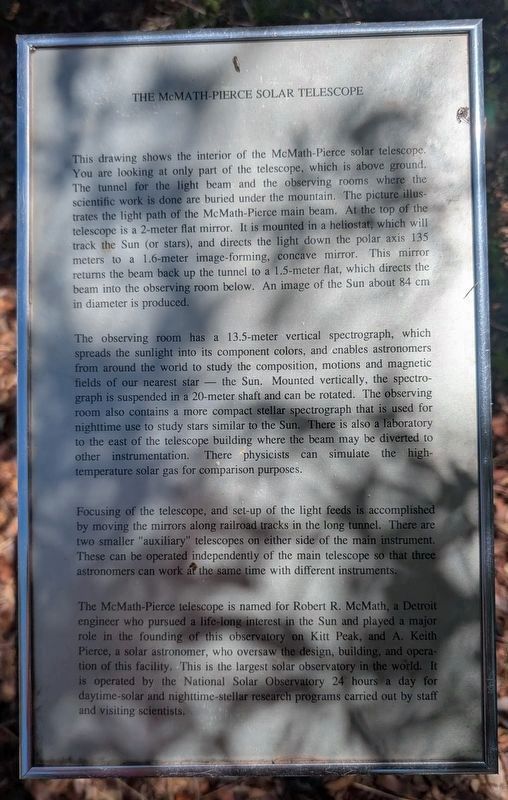
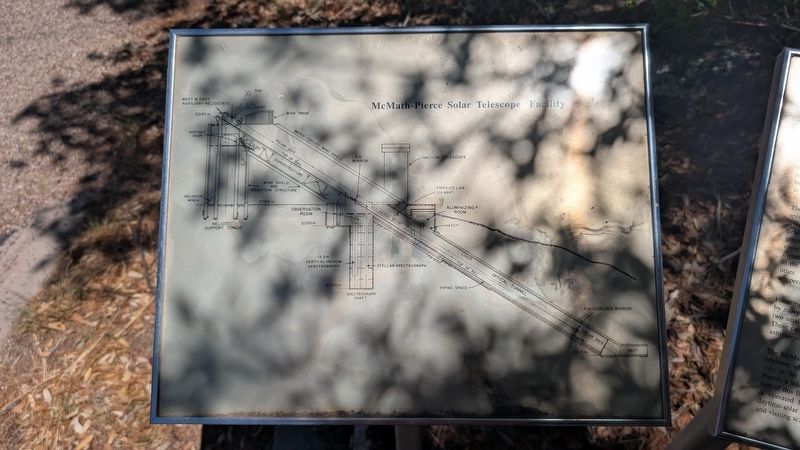
This drawing shows the interior of the McMath-Pierce solar telescope. You are looking at only part of the telescope, which is above ground. The tunnel for the light beam and the observing rooms where the scientific work is done are buried under the mountain. The picture illustrates the light path of the McMath-Pierce main beam. At the top of the telescope is a 2-meter flat mirror. It is mounted in a heliostat, which will track the Sun (or stars), and directs the light down the polar axis 135 meters to a 1.6-meter image-forming, concave mirror. This mirror returns the beam back up the tunnel to a 1.5-meter flat, which directs the beam into the observing room below. An image of the Sun about 84 cm in diameter is produced.
The observing room has a 13.5-meter vertical spectrograph, which spreads the sunlight into its component colors, and enables astronomers from around the world to study the composition, motions and magnetic fields of our nearest star the Sun. Mounted vertically, the spectrograph is suspended in a 20-meter shaft and can be rotated. The observing room also contains a more compact stellar spectrograph that is used for nighttime use to study stars similar to the Sun. There is also a laboratory to the east of the telescope building where the beam may be diverted to other instrumentation. There physicists can simulate the high-temperature solar gas for comparison purposes.
Focusing of the telescope, and set-up of the light feeds is accomplished by moving the mirrors along railroad tracks in the long tunnel. There are two smaller "auxiliary" telescopes on either side of the main instrument. These can be operated independently of the main telescope so that three astronomers can work at the same time with different instruments.
The McMath-Pierce telescope is named for Robert R. McMath, a Detroit engineer
this page online
Erected by Kitt Peak National Observatory.
Topics. This historical marker is listed in these topic lists: Charity & Public Work • Science & Medicine.
Location. 31° 57.519′ N, 111° 35.793′ W. Marker is near Haivana Nakya, Arizona, in Pima County. It can be reached from Arizona Route 386 12 miles south of Highway 86, on the left when traveling south. This marker stands along the road to the McMath-Pierce Solar Telescope at Kitt Peak National Observatory. Touch for map. Marker is in this post office area: Sells AZ 85634, United States of America. Touch for directions.

Regionally, this marker is in the Sky Islands, in the Sonoran Desert,
Photographed by Daniel Barriball, May 25, 2026
2. The McMath-Pierce Solar Telescope Marker in context
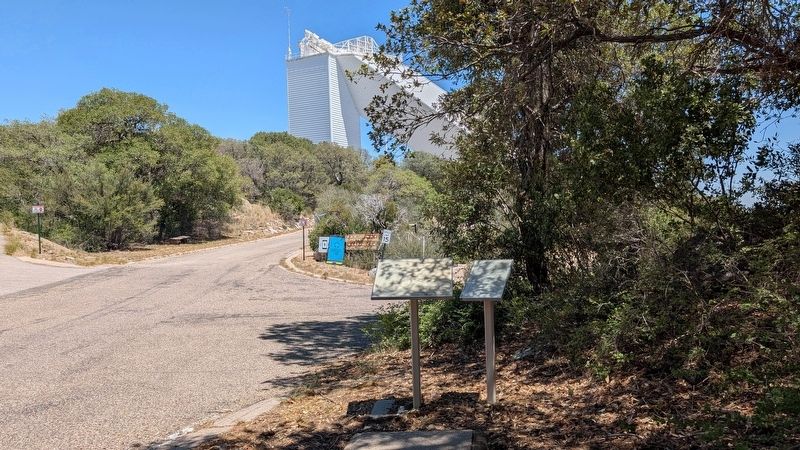
The above-ground portion of the McMath-Pierce telescope is behind the marker and telescope illustration.
Other nearby markers. At least 8 other markers are within walking distance of this marker: The Vacuum Telescope (about 400 feet away, measured in a direct line); Kitt Peak National Observatory (about 500 feet away); The 2.1 Meter (84 Inch) And 0.9 Meter (36 Inch) Coudé Auxilliary Feed Telescopes (about 500 feet away); The 2.1 Meter (84 Inch) and 0.9 Meter (36 Inch) Coudé Auxilliary Feed Telescopes (about 500 feet away); The McMath Solar Telescope (about 500 feet away); The 1.3-meter Telescope (about 700 feet away); The Concrete Donut (approx. 0.2 miles away); WIYN Observatory (approx. 0.2 miles away). Touch for a list and map of all markers in Haivana Nakya.
Regarding The McMath-Pierce Solar Telescope. The McMath-Pierce Solar Telescope was decommissioned in 2017 and
Photographed by Daniel Barriball, May 25, 2026
3. McMath-Pierce Solar Telescope Facility
This is the accompanying telescope diagram.
Also see . . .
1. NSF McMath-Pierce Solar Telescope. Official website
For many years the largest solar telescope in the world, the NSF McMath-Pierce Solar Telescope, was a triple instrument. In addition to the primary 1.61-meter mirror fed by the 2.03-meter heliostat, there are a pair of telescopes fed by 0.81-meter heliostats mounted beside the main heliostat. These two instruments have 1.07-meter and 0.91-meter primary mirrors. The telescope used the heliostat at the top of its main tower to direct the Sun's light down a long shaft to the primary mirrors. The distinctive diagonal shaft continues underground, where the telescope's primary mirror is located.(Submitted on July 23, 2026, by Daniel Barriball of Chesterton, Indiana.)
2. Robert Raynolds McMath. Wikipedia
McMath was an adviser to the National Science Foundation in its early years and he chaired the panel that advised NSF on the need for a national observatory. A site on Kitt Peak, Arizona was finally chosen for the Kitt Peak National Observatory (KPNO). McMath, along with the eminent astronomer Keith Pierce, built a new, larger solar telescope on Kitt Peak called the McMath–Pierce solar telescope.(Submitted on July 23, 2026, by Daniel Barriball of Chesterton, Indiana.)
3. Keith Pierce. Wikipedia
Kitt Peak National Observatory was chosen for the site, so in 1958 Pierce and his family relocated to Tucson, Arizona. Upon its completion in 1962 the McMath Solar Telescope was the largest solar telescope in the world. Pierce was appointed Associate Director of Kitt Peak in charge of the Solar Division, a position he held for its first 16 years.(Submitted on July 23, 2026, by Daniel Barriball of Chesterton, Indiana.)
Credits. This page was last revised on November 10, 2026. It was originally submitted on July 23, 2026, by Daniel Barriball of Chesterton, Indiana. This page has been viewed 7 times since then. Photos: 1, 2, 3. submitted on July 23, 2026, by Daniel Barriball of Chesterton, Indiana. • Devry Becker Jones was the editor who published this page.
