Bedford in Bedford County, Virginia — The American South (Mid-Atlantic)
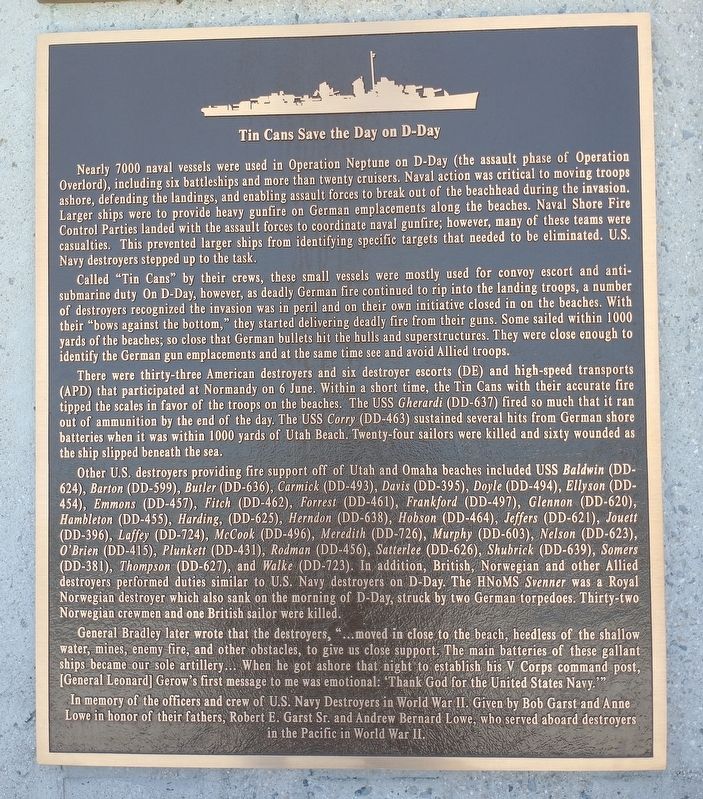
Tin Cans Save the Day on D-Day
Photographed by Tom Bosse, July 3, 2026
1. Tin Cans Save the Day on D-Day Marker
Called “Tin Cans” by their crews, these small vessels were mostly used for convoy escort and anti-submarine duty on D-Day, however, as deadly German fire continued to rip into the landing troops, a number of destroyers recognized the invasion was in peril and on their own initiative closed in on the beaches. With their “bows against the bottom”, they started delivering deadly fire from their guns. Some sailed within 1000 yards of the beaches; so close
this page online
There were thirty-three American destroyers and six destroyer escorts (DE) and high-speed transports (APD) that participated at Normandy on 6 June. Within a short time, the Tin Cans with their accurate fire tipped the scales in favor of the troops on the beaches. The USS Gherardi (DD-637) fired so much that it ran out of ammunition by the end of the day. The USS Corry (DD-463) sustained several hits from German shore batteries when it was within 1000 yards of Utah Beach. Twenty-four sailors were killed and sixty wounded as the ship slipped beneath the sea.
Other U.S. destroyers providing fire support off of Utah and Omaha beaches included USS Baldwin (DD-624), Barton (DD-599), Butler (DD-636), Carmick (DD-493), David (DD-395), Doyle (DD-494), Ellyson (DD-454), Emmons (DD-457), Fitch (DD-462), Forrest (DD-461), Frankford (DD-497), Glennon (DD-620), Hambleton (DD-455), Harding (DD-625), Herndon (DD-638), Hobson (DD-464), Jeffers (DD-621), Jouett
Photographed by Tom Bosse, July 3, 2026
2. Tin Cans Save the Day on D-Day Marker
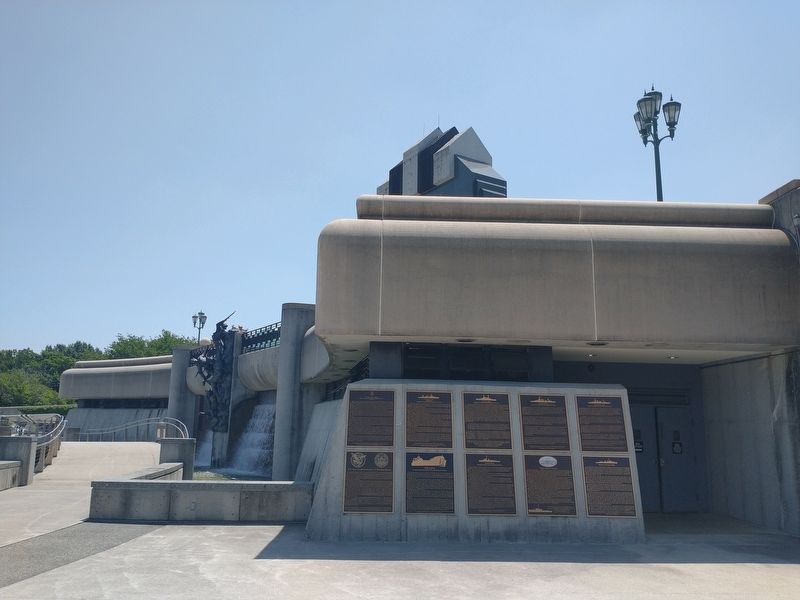
Marker is located on the bottom right of the group of ten markers.
General Bradley later wrote that the destroyers, “…moved in close to the beach, heedless of the shallow water, mines, enemy fire, and other obstacles, to give us close support. The main batteries of these gallant ships became our sole artillery…When he got ashore that night to establish his V Corps command post, [General Leonard] Gerow’s first message to me was emotional: ‘Thank God for the United States Navy’”.
In memory of the officers and crew of the U.S. Navy Destroyers in World War II. Given by Bob Garst and Anne Lowe in honor of their fathers Robert E. Garst
Photographed by Tom Bosse, July 3, 2026
3. Tin Cans Save the Day on D-Day Marker
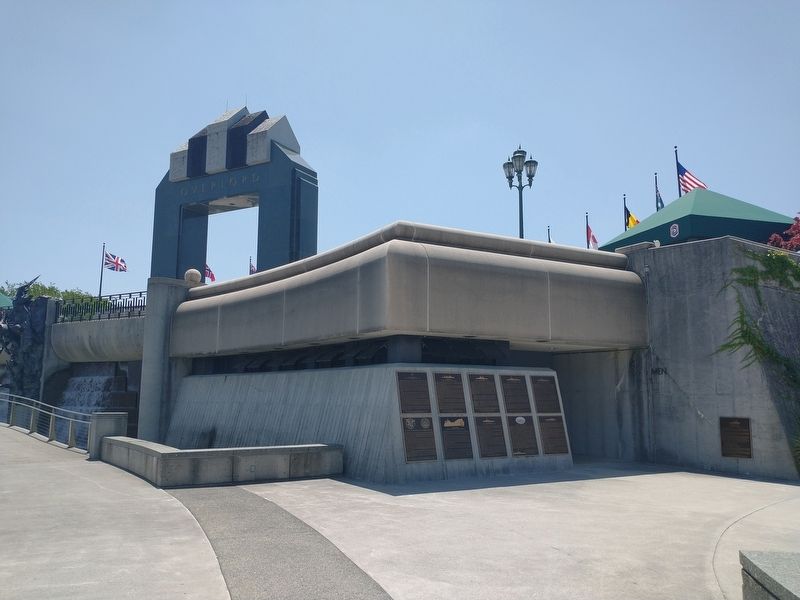
Marker is located on the bottom right of the group of ten markers.
Erected by National D-Day Memorial.
Topics. This historical marker is listed in these topic lists: War, World II • Waterways & Vessels.
Location. 37° 19.813′ N, 79° 32.177′ W. Marker is in Bedford, Virginia, in Bedford County. It can be reached from Overlord Circle, on the left when traveling south. Marker is located at the National D-Day Memorial. Touch for map. Marker is in this post office area: Bedford VA 24523, United States of America. Touch for directions.

Regionally, this marker is in Southwest Virginia. It is also in the American South and specifically in the Upper South. Globally, it is in North America, the Western Hemisphere, the Western World, and the Anglosphere. Historically, it finds itself in what was once the territory of the Mississippian Culture, one of the original Thirteen Colonies, one of the Confederate States of America, and the Antebellum South.
Other nearby markers. At least 8 other markers are within walking distance of this marker: USS Osprey, AM-56 (here, next to this marker); USS Arkansas, BB-33 (a few steps from this marker); USS Texas, BB-35 (a few steps from this marker); USS Nevada, BB-36 (a few steps from this marker); USS Rich, DE-695 (a few steps from this marker); Mulberry Harbors at Normandy (a few steps from this marker); USS Augusta, CA-31 (a few steps from this marker); USS LST-5 (a few steps from this marker). Touch for a list and map of all markers in Bedford.
Also see . . . Destroyer. (Submitted on July 25, 2026, by Tom Bosse of Jefferson City, Tennessee.)
Credits. This page was last revised on August 4, 2026. It was originally submitted on July 25, 2026, by Tom Bosse of Jefferson City, Tennessee. This page has been viewed 20 times since then. Photos: 1, 2, 3. submitted on July 25, 2026, by Tom Bosse of Jefferson City, Tennessee. • Andrew Ruppenstein was the editor who published this page.
