William Penn Annex East in Philadelphia in Philadelphia County, Pennsylvania — The American Northeast (Mid-Atlantic)
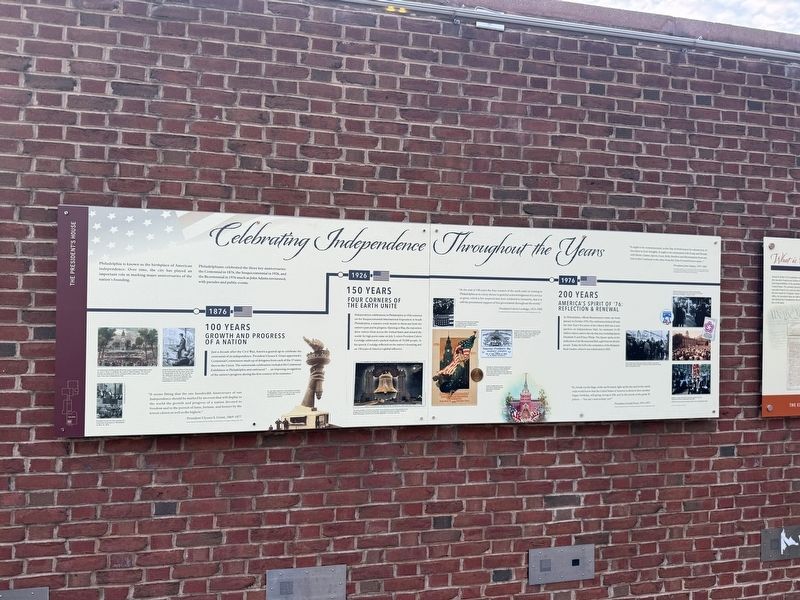
Celebrating Independence Throughout the Years
| — | The President's House | — |
Photographed by Devry Becker Jones (CC0), July 25, 2026
1. Celebrating Independence Throughout the Years Marker
"It ought to be commemorated, as the Day of Deliverance by solemn Acts of Devotion to God Almighty. It ought to be solemnized with Pomp and Parade, with Shews, Games, Sports, Guns, Bells, Bonfires and Illumionations from one End of this Continent to the other from this time forward forever more.."
- President John Adams, 1797 - 1801
From a letter dated July 3, 1776, written by John Adams, to his wife Abigail Adams, expressing the deep significance he attributed to the vote for Independence and the impending adoption of the Declaration of Independence.
Philadelphia is known as the birthplace of American independence. Over time, the city has played an important role in marking major anniversaries of the nation's founding.
Philadelphians celebrated the three key anniversaries: the Centennial in 1876, the Sesquicentennial in 1926, and the Bicentennial in 1976 much as John Adams envisioned, with parades and public events.
1876
100 Years
Growth and Progress of a Nation
Just a decade after the Civil War, America geared up to celebrate the centennial of its independence. President Ulysses S. Grant appointed a Centennial
this page online
"It seems fitting that the one hundredth Anniversary of our Independence should be marked by an event that will display to the world the growth and progress of a nation devoted to freedom and to the pursuit of fame, fortune, and honors by the lowest citizen as well as the highest."
- President Ulysses S. Grant, 1869-1877
From a Special Message from the President to both Houses of Congress, February 25, 1875
1926
150 Years
Four Corners of the Earth Unite
Independence celebrations in Philadelphia in 1926 centered on the Sesquicentennial International Exposition in South Philadelphia, a massive event meant to showcase both the nations' past and its progress. Opening in May, the exposition drew visitors from across the United States and around the world. Its high point came on July 5, when President Calvin Coolidge addressed a packed stadium of 35,000 people. In his
Photographed by Devry Becker Jones (CC0), July 25, 2026
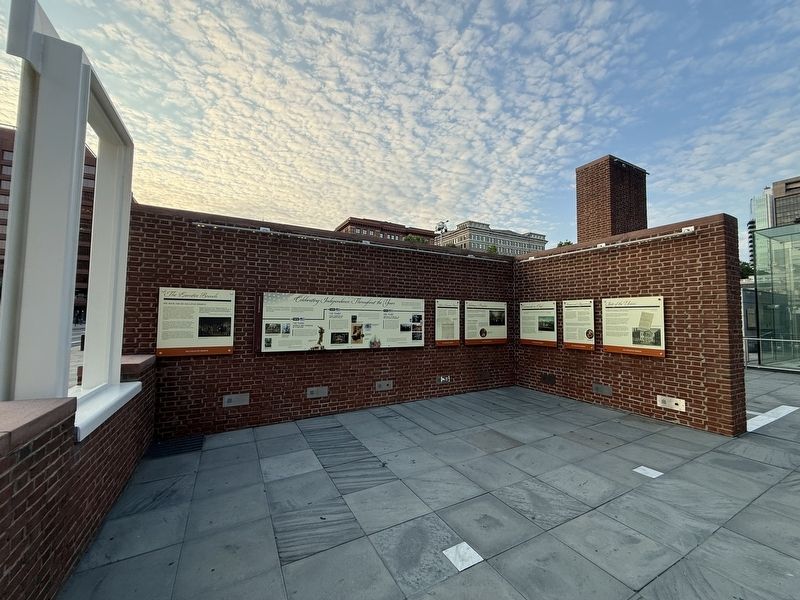
2. Markers on Display at Independence National Historical Park
"At the end of 150 years the four corners of the earth unite in coming to Philadelphia as to a holy shrine in grateful acknowledgement of a service so great, which a few inspired men here rendered to humanity, that it is still the preeminent support of free government throughout the world."
- President Calvin Coolidge, 1923 - 1929
From Speech given at the International Exposition in South Philadelphia, July 5, 1926
1976
200 Years
America's Spirit of '76: Reflection & Renewal
In Philadelphia, official Bicentennial events ran from January to October 1976. The celebration kicked off with the Near Year's Eve move of the Liberty Bell into a new pavilion on Independence Mall. An estimated 14-20 milliion visitors came to the city that year, including Queen Elizabeth II and Prince Philip. The Queen spoke at the dedication of the Bicentennial Bell, a gift from the British people. Today, the bell is the centerpiece of the Benjamin Rush Garden, where it was rededicated in 2025.
"So, break out the flags, strike up the band, light up the sky and let the whole wide world know that the United States of America is about to have another happy birthday, still going strong at 200, and in the words of the great Al Jolson — 'You ain't seen nothin' yet!'"
- President Gerald Ford, 1974 - 1977
From the Bicentennial Speech of Gerald Ford at the Honor America Program, July 4, 1976
[Captions:]
An estimated 50,000 people filled the square behind Independence Hall on July 4, 1876, to celebrate the nation's 100th birthday. The day also marked the dedication of the Centennial Bell, which still rings each hour from atop Independence Hall.
Richard Henry Lee, grandson of the signer of the Declaration by the same name, read the Declaration on the 4th of July during the celebration to the left. On June 7, 1776 it was his grandfather who introduced the resolution calling for independence from Great Britain.
President Grant formally opened the Centennial Exposition in Philadelphia on May 10, 1876.
For the 1876 Centennial International Exhibition in Philadelphia, France sent the arm and torch of the Statue of Liberty as a preview of the completed monument.
This postcard depicts the four-story-high Liberty Bell that served as the gateway to the Sesquicentennial International Exposition. Spanning Broad Street at Bigler Street in South Philadelphia and lined with 26,000 lightbulbs, it lit up the night sky.
President and First Lady Grace Coolidge at a baseball game. President Calvin Coolidge is the only president born on the Fourth of July.
President Coolidge delivered his Fourth of July speech on July 5, 1926. In it, he celebrated the 150th anniversary of the United States and reaffirmed the enduring power of the Declaration of Independence.
Although the Sesquicentennial celebration took place primarily in South Philadelphia, miles from Independence Hall and the Liberty Bell, these American icons appeared on everything from posters to souvenirs and commemorative coins.
Image of Independence Hall from official Sesquicentennial International Exposition letterhead.
Hundreds braved freezing rain to watch the Liberty Bell move from Independence Hall to its new home in the Liberty Bell Pavilion at midnight on January 1, 1976.
Before dedicating the Bicentennial Bell on behalf of the people of Great Britain, Queen Elizabeth II and Prince Philip visited the Liberty Bell and Independence Hall.
Middle: President Gerald Ford delivered a speech in front of Independence Hall on Independence Day, 1976.
Bottom: Parade passes the viewing stand in front of Independence Hall.
Erected 2026 by National Park Service, U.S. Department of the Interior.
Topics and series. This historical marker is listed in these topic lists: Notable Events • Patriots & Patriotism. In addition, it is included in the Former U.S. Presidents: #02 John Adams, the Former U.S. Presidents: #18 Ulysses S. Grant, the Former U.S. Presidents: #30 Calvin Coolidge, and the Former U.S. Presidents: #38 Gerald R. Ford, Jr. series lists. A significant historical date for this entry is February 25, 1875.
Location. 39° 57.031′ N, 75° 9.001′ W. Marker is in Philadelphia, Pennsylvania, in Philadelphia County. It is in William Penn Annex East. It is at the intersection of South 6th Street (County Road 2005) and Market Street (County Road 2004), on the left when traveling south on South 6th Street. Touch for map. Marker is at or near this postal address: 598 Market St, Philadelphia PA 19106, United States of America. Touch for directions.

Regionally, this marker is in Southeast Pennsylvania. It is also in the American Northeast and in the Mid-Atlantic. Globally, it is in North America, the Western Hemisphere, the Western World, and the Anglosphere. Historically, it finds itself in what was once the Haudenosaunee (Iroquois) Confederacy, New Netherland, and one of the original Thirteen Colonies.
Other nearby markers. At least 5 other markers are within walking distance of this marker: What is Executive Power? (here, next to this marker); a different marker also named The Executive Branch (here, next to this marker); Selecting a President (here, next to this marker); Commander in Chief (here, next to this marker); Treaties and Appointments (here, next to this marker). Touch for a list and map of all markers in Philadelphia.
Other markers no longer nearby. The Executive Branch (was here, next to this marker but has been permanently removed); Refuge in the country (was here, next to this marker but has been replaced with another marker now near it); A Day of Reciprocity (was here, next to this marker but has been replaced with another marker now near it); Promoting the Abolition of Slavery (was here, next to this marker but has been replaced with another marker now near it); Death Carts (was here, next to this marker but has been replaced with another marker now near it); The opener of the Way (was here, next to this marker but has been replaced with another marker now near it); "Burn this treaty to Hell!" (was here, next to this marker but has been replaced with another marker now near it); "We shall come to a civil war" (was here, next to this marker but has been permanently removed); "I am free now" (was here, next to this marker but has been permanently removed); "An Act respecting fugitives from Justice" (was here, next to this marker but has been replaced with another marker now near it); Suppressing the Opposition (was here, next to this marker but has been replaced with another marker now near it).
Additional commentary.
1. The marker as propaganda
This historical marker functions as propaganda by flattening complex history into a sanitized, nationalistic victory lap. By cherry-picking quotes from presidents and omitting the deep racial, political, and religious conflicts of each era—including John Adams’ own heterodox Unitarian rationalism, which would be seen as heretical today in most Evangelical churches—it presents American progress as smooth, divinely ordained, and unquestioned. Ultimately, it prioritizes patriotic myth-making and civic cheerleading over an honest, complete accounting of the nation's past.
— Submitted July 26, 2026, by Devry Becker Jones of Washington, District of Columbia.
Credits. This page was last revised on July 30, 2026. It was originally submitted on July 26, 2026, by Devry Becker Jones of Washington, District of Columbia. This page has been viewed 20 times since then. Photos: 1, 2. submitted on July 26, 2026, by Devry Becker Jones of Washington, District of Columbia.
