William Penn Annex East in Philadelphia in Philadelphia County, Pennsylvania — The American Northeast (Mid-Atlantic)
The President's House
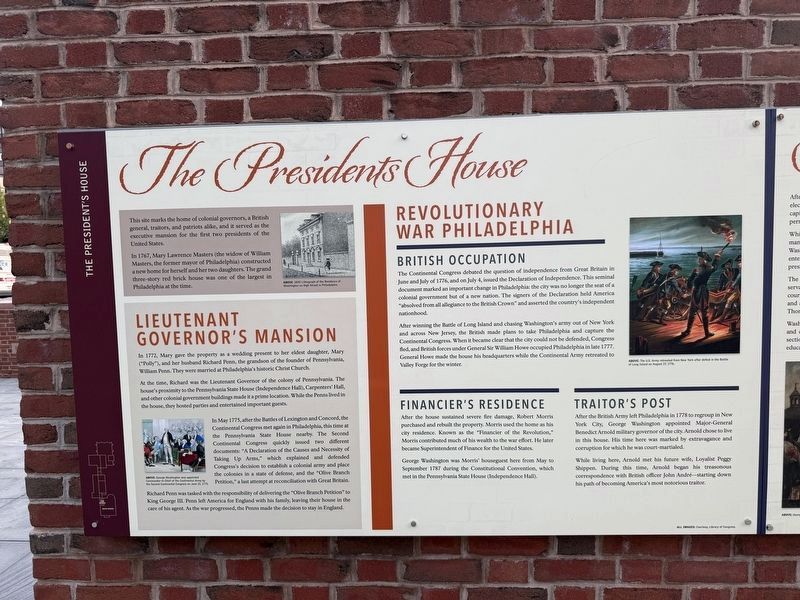
This site marks the home of colonial governors, a British general, traitors, and patriots alike, and it served as the executive mansion for the first two presidents of the United States.
In 1767, Mary Lawrence Masters (the widow of William Masters, the former mayor of Philadelphia) constructed a new home for herself and her two daughters. The grand three-story red brick house was one of the larest in Philadelphia at the time.
Lieutenant Governor's Mansion
In 1772, Mary gave the property as a wedding present to her eldest daughter, Mary ("Polly"), and her husband Richard Penn, the grandson of the founder of Pennsylvania, William Penn. They were married at Philadelphia's historic Christ Church.
At the time, Richard was the Lieutenant Governor of the colony of Pennsylvania. The house's proximity to the Pennsylvania State House (Independence Hall), Carpenters' Hall, and other colonial government buildings made it a prime location. While the Penns lived in the house, they hosted parties and entertained important guests.
In May 1775, after the Battles of Lexington and Concord, the Continental Congress met again
this page online
Richard Penn was tasked with the responsibility of delivering the "Olive Branch Petition" to King George III. Penn left America for England with his family, leaving their house in the care of his agent. As the war progressed, the Penns made the decision to stay in England.
Revolutionary War Philadelphia
British Occupation
The Continental Congress debated the question of independence from Great Britain in June and July of 1776, and on July 4, issued the Declaration of Independence. This seminal document marked an important change in Philadelphia: the city was no longer the seat of a colonial government but of a new nation. The signers of the Declaration held America "absolved from all allegiance to the British Crown" and

Photographed by Devry Becker Jones (CC0), July 25, 2026
2. Several markers on display on the grounds of Independence National Historical Park
After winning the Battle of Long Island and chasing Washington's army out of New York and across New Jersey, the British made plans to take Philadelphia and capture the Continental Congress. When it became clear that the city could not be defended, Congress fled, and British forces under General Sir William Howe occupied Philadelphia in late 1777. General Howe made the house his headquarters while the Continental Army retreated to Valley forge for the winter.
Financier's Residence
After the house sustained severe fire damage, Robert Morris purchased and rebuilt the property. Morris used the home as his city residence. Known as the "Financier of the Revolution," Morris contributed much of his wealth to the war effort. He later became Superintendent of Finance for the United States.
George Washington was Morris' houseguest here from May to September 1787 during the Constitutional Convention, which met in the Pennsylvania State Hosue (Independence Hall).
Traitor's Post
After the British Army left Philadelphia in 1778 to regroup in New York City, George Washington appointed Major-General Benedict Arnold military governor of the city. Arnold chose to live in this house. His time here was marked by extravagance and corruption for which he was court-martialed.
While living here, Arnold met his future wife, Loyalist Peggy Shippen. During this time, Arnold began his treasonous correspondence with British officer John André—starting down his path of becoming America's most notorious traitor.
[Captions:]
Above: 1830 Lithograph of the Residence of Washington on High Street in Philadelphia.
Above: George Washington was appointed Commander-in-Cheif of the Continental Army by the Second Continental Congress on June 15, 1775.
Above: The U.S. Army retreated from New York after defeat in the Battle of Long Island on August 27, 1776.
Erected 2026 by National Park Service, U.S. Department of the Interior.
Topics and series. This historical marker is listed in these topic lists: Colonial Era • Government & Politics • War, US Revolutionary. In addition, it is included in the Former U.S. Presidents: #01 George Washington series list. A significant historical month for this entry is May 1775.
Location. 39° 57.028′ N, 75° 9.002′ W. Marker is in Philadelphia, Pennsylvania, in Philadelphia County. It is in William Penn Annex East. It is at the intersection of South 6th Street (County Road 2005) and Market Street (County Road 2004), on the left when traveling south on South 6th Street. Touch for map. Marker is at or near this postal address: 598 Market St, Philadelphia PA 19106, United States of America. Touch for directions.

Regionally, this marker is in Southeast Pennsylvania. It is also in the American Northeast and in the Mid-Atlantic. Globally, it is in North America, the Western Hemisphere, the Western World, and the Anglosphere. Historically, it finds itself in what was once the Haudenosaunee (Iroquois) Confederacy, New Netherland, and one of the original Thirteen Colonies.
Other nearby markers. At least 6 other markers are within walking distance of this marker: The Executive Mansion (here, next to this marker); William Howe (here, next to this marker); History Lost & Found (here, next to this marker); Commander in Chief (here, next to this marker); Treaties and Appointments (here, next to this marker); Selecting a President (here, next to this marker). Touch for a list and map of all markers in Philadelphia.
Other markers no longer nearby. The Dirty Business of Slavery (was here, next to this marker but has been permanently removed); The House & the People Who Worked & Lived In It (was here, next to this marker but has been permanently removed); "I will fear no Evil" (was here, next to this marker but has been replaced with another marker now near it); Washington's Death and a Renewed Hope for Freedom (was here, next to this marker but has been replaced with another marker now near it); Suppressing the Opposition (was here, next to this marker but has been replaced with another marker now near it); The Keeper of the House (was here, next to this marker but has been replaced with another marker now near it); "An Act respecting fugitives from Justice" (was here, next to this marker but has been replaced with another marker now near it); "We shall come to a civil war" (was here, next to this marker but has been permanently removed); "I am free now" (was here, next to this marker but has been permanently removed); "Burn this treaty to Hell!" (was here, next to this marker but has been replaced with another marker now near it).
Credits. This page was last revised on July 27, 2026. It was originally submitted on July 27, 2026, by Devry Becker Jones of Washington, District of Columbia. This page has been viewed 18 times since then. Photos: 1, 2. submitted on July 27, 2026, by Devry Becker Jones of Washington, District of Columbia.
