William Penn Annex East in Philadelphia in Philadelphia County, Pennsylvania — The American Northeast (Mid-Atlantic)
Abigail Adams
1744 - 1818
| — | Second First Lady of the United States 1797-1800 | — |
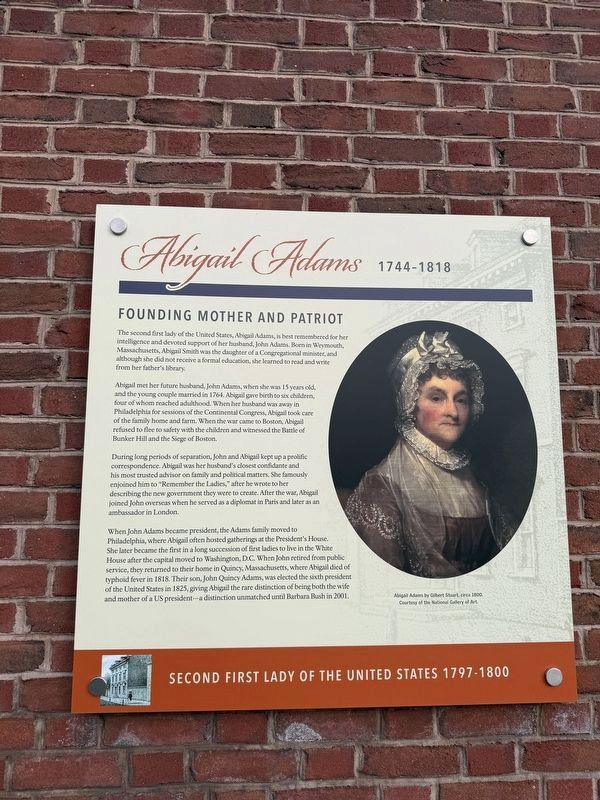
Founding Mother and Patriot
The second first lady of the United States, Abigail Adams, is best remembered for her intelligence and devoted support of her husband, John Adams. Born in Weymouth, Massachusetts, Abigail Smith was the daughter of a Congregational minister, and although she did not receive a formal education, she learned to read and write from her father’s library.
Abigail met her future husband, John Adams, when she was 15 years old, and the young couple married in 1764. Abigail gave birth to six children, four of whom reached adulthood. When her husband was away in Philadelphia for sessions of the Continental Congress, Abigail took care of the family home and farm. When the war came to Boston, Abigail refused to flee to safety with the children and witnessed the Battle of Bunker Hill and the Siege of Boston.
During long periods of separation, John and Abigail kept up a prolific correspondence. Abigail was her husband’s closest confidante and his most trusted advisor on family and political matters. She famously enjoined him to “Remember the Ladies,” after he wrote to her describing the new government
this page online
When John Adams became president, the Adams family moved to Philadelphia, where Abigail often hosted gatherings at the President’s House. She later became the first in a long succession of first ladies to live in the White House after the capital moved to Washington, D.C. When John retired from public service, they returned to their home in Quincy, Massachusetts, where Abigail died of typhoid fever in 1818. Their son, John Quincy Adams, was elected the sixth president of the United States in 1825, giving Abigail the rare distinction of being both the wife and mother of a U.S. president—a distinction unmatched until Barbara Bush in 2001.
Topics and series. This historical marker is listed in these topic lists: Government & Politics • War, US Revolutionary • Women. In addition, it is included in the Former U.S. Presidents: #02 John Adams, and the Former U.S. Presidents: #06 John Quincy Adams series lists. A significant historical year for this entry is 1764.
Location. 39° 57.032′ N, 75° 8.998′ W.
Photographed by Devry Becker Jones (CC0), July 25, 2026
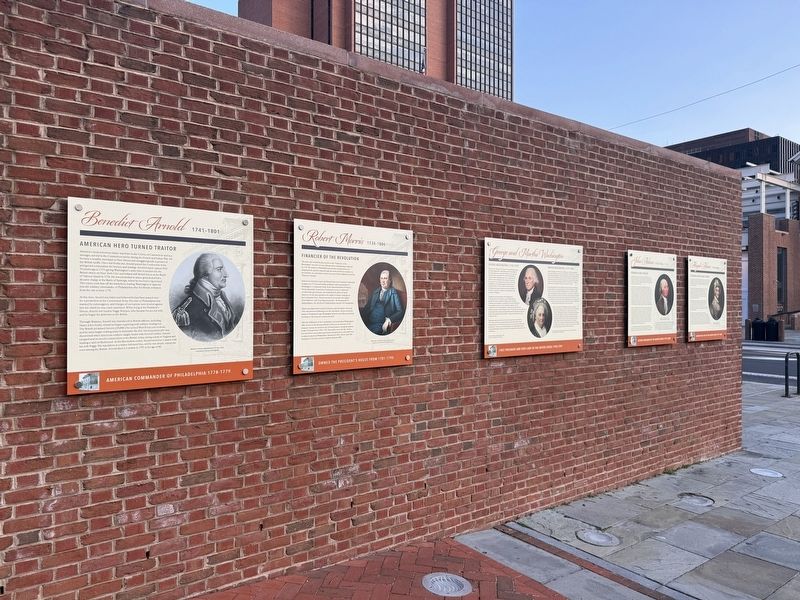
2. Several markers on display on the grounds of Independence National Historical Park

Regionally, this marker is in Southeast Pennsylvania. It is also in the American Northeast and in the Mid-Atlantic. Globally, it is in North America, the Western Hemisphere, the Western World, and the Anglosphere. Historically, it finds itself in what was once the Haudenosaunee (Iroquois) Confederacy, New Netherland, and one of the original Thirteen Colonies.
Other nearby markers. At least 6 other markers are within walking distance of this marker: A different marker also named The Executive Branch (here, next to this marker); Celebrating Independence Throughout the Years (here, next to this marker); What is Executive Power? (here, next to this marker); Selecting a President (here, next to this marker); John Adams (here, next to this marker); Commander in Chief (here, next to this marker). Touch for a list and map of all markers in Philadelphia.
Other markers no longer nearby. Death Carts (was here, next to this marker but has been replaced with another marker now near it); Refuge in the country (was here, next to this marker but has been replaced with another marker now near it); The Executive Branch (was here, next to this marker but has been permanently removed); Promoting the Abolition of Slavery (was here, next to this marker but has been replaced with another marker now near it); A Day of Reciprocity (was here, next to this marker but has been replaced with another marker now near it); The opener of the Way (was here, next to this marker but has been replaced with another marker now near it); "Burn this treaty to Hell!" (was here, next to this marker but has been replaced with another marker now near it); "I am free now" (was here, next to this marker but has been permanently removed); "We shall come to a civil war" (was here, next to this marker but has been permanently removed); "An Act respecting fugitives from Justice" (was here, next to this marker but has been replaced with another marker now near it).
Credits. This page was last revised on July 27, 2026. It was originally submitted on July 27, 2026, by Devry Becker Jones of Washington, District of Columbia. This page has been viewed 16 times since then. Photos: 1, 2. submitted on July 27, 2026, by Devry Becker Jones of Washington, District of Columbia.
