Atlantic City in Atlantic County, New Jersey — The American Northeast (Mid-Atlantic)
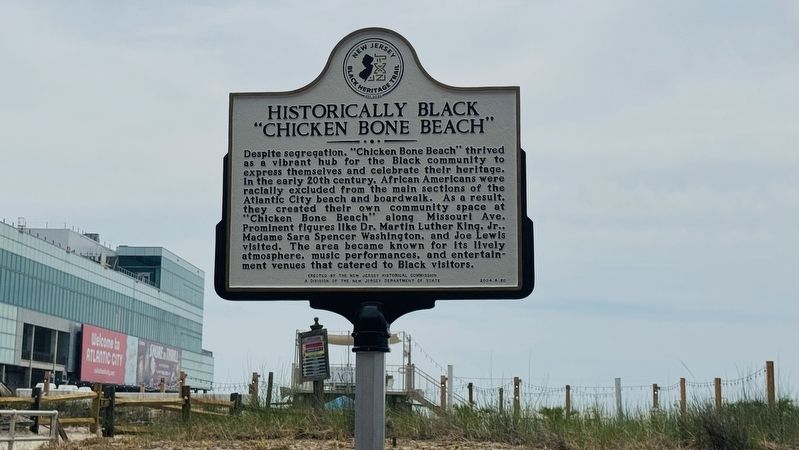
Historically Black "Chicken Bone Beach"
Photographed by New Jersey Black Heritage Trail, June 25, 2026
1. Historically Black "Chicken Bone Beach" Marker
Despite segregation, "Chicken Bone Beach" thrived as a vibrant hub for the Black community to express themselves and celebrate their heritage. In the early 20th century, African Americans were racially excluded from the main sections of the Atlantic City beach and boardwalk. As a result, they created their own community space at "Chicken Bone Beach" along Missouri Ave. Prominent figures like Dr. Martin Luther King, Jr., Madam Sara Spencer Washington, and Joe Lewis visited. The area became known for its lively atmosphere, music performances, and entertainment venues that catered to Black visitors.
Erected 2026 by New Jersey Historical Commission. (Marker Number 2024.A.20.)
Topics. This historical marker is listed in these topic lists: African Americans • Parks & Recreational Areas.
Location. 39° 21.267′ N, 74° 26.076′ W. Marker is in Atlantic City, New Jersey, in Atlantic County. It is at the intersection of Missouri Avenue and Boardwalk when traveling south on Missouri Avenue. Located on the Boardwalk in Atlantic City. Touch for map. Marker is at or near this
this page online

Regionally, this marker is on New Jersey’s Jersey Shore. It is also in the American Northeast, in the Mid-Atlantic, and on the Eastern Seaboard. Globally, it is in the North Atlantic Region, North America, the Western Hemisphere, the Western World, and the Anglosphere. Historically, it finds itself in what was once New Netherland and also one of the original Thirteen Colonies.
Other nearby markers. At least 8 other markers are within walking distance of this marker: Chicken Bone Beach (within shouting distance of this marker); Spanish War Memorial (about 600 feet away); Home of the Miss America Pageant (about 600 feet away); Howard Persina (about 800 feet away); World War II Memorial (approx. 0.2 miles away); Walter P. Reuther (approx. 0.2 miles away); A. Phillip Randolph (approx. 0.2 miles away); Atlantic City Workers Monument (approx. 0.2 miles away). Touch for a list and map of all markers in Atlantic City.
Another marker is no longer nearby. How Chicken Bone Beach Got Its Name (was about 300 feet away,
Photographed by New Jersey Black Heritage Trail, June 25, 2026
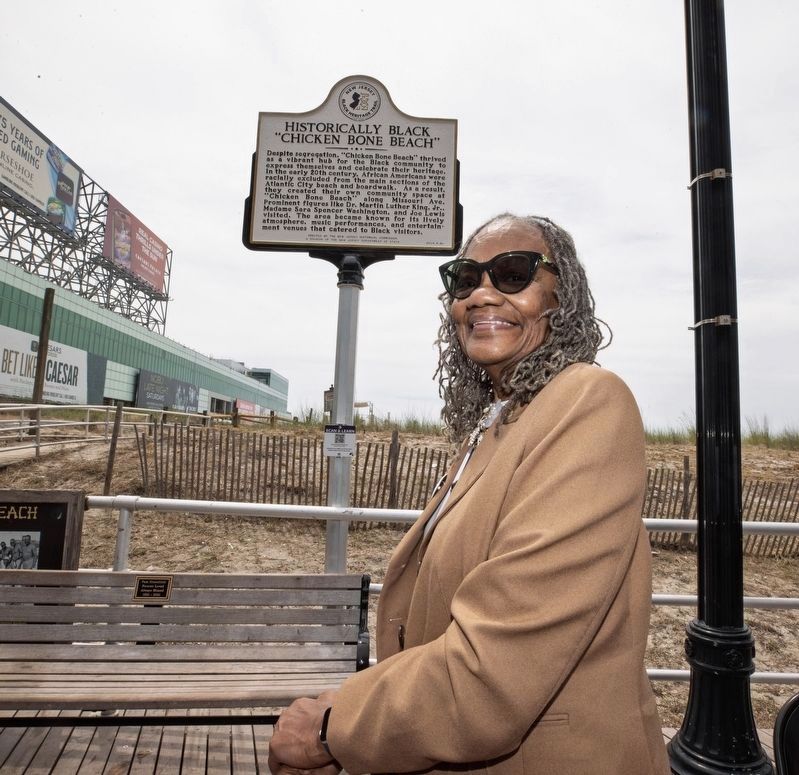
2. Historically Black "Chicken Bone Beach" Marker
On June 25, 2026, the New Jersey Historical Commission unveiled the marker on the Boardwalk at the Missouri Avenue Beach.
Regarding Historically Black "Chicken Bone Beach". Chicken Bone Beach was the segregated section for African Americans on Atlantic City's beach area. Between 1900 and the early 1950s, African Americans were socially restricted to use the Missouri Avenue Beach Area. Since many vacationing Black families arrived with chicken-laden hampers, the strip became affectionately named “Chicken Bone Beach.”
Also see . . .
1. Chicken Bone Beach Historical Foundation. (Submitted on July 29, 2026, by New Jersey Black Heritage Trail of Trenton, New Jersey.)
2. Chicken Bone Beach (Wikipedia).
Missouri Avenue Beach, often referred to as "Chicken Bone Beach," is a lifeguarded beach on the Jersey Shore. It was an early and mid-twentieth-century Black resort destination and racially segregated section of the Atlantic Ocean beach near the Northside neighborhood of Atlantic City, New Jersey (between Missouri and Mississippi Avenues).(Submitted on August 5, 2026, by Michael Herrick of Southbury, Connecticut.)
John W. Mosley Photograph Collection, Charles L. Blockson Afro-American Collection,Temple University
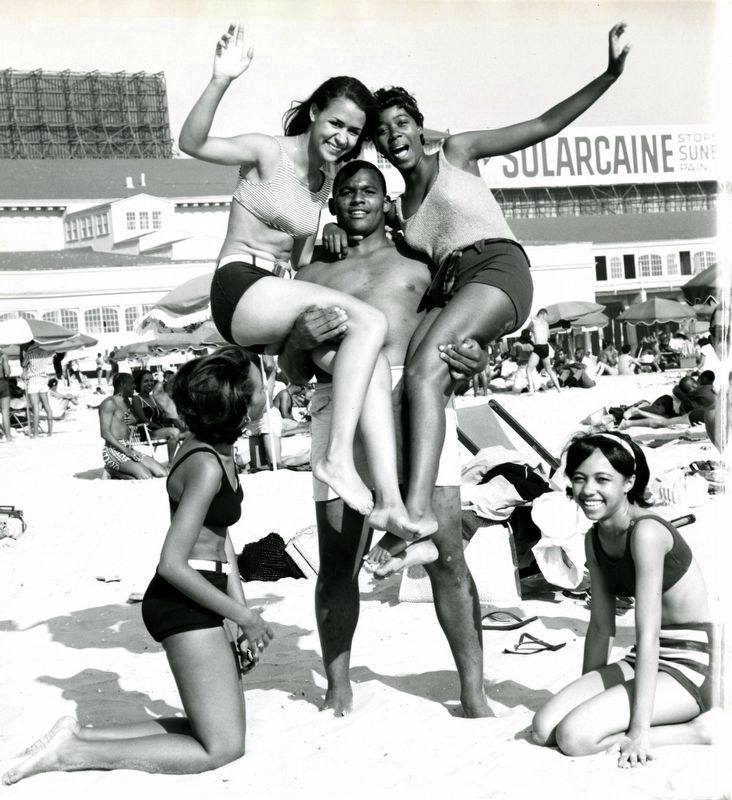
3. Butch Williams posed holding Gloria Phillis and Cheryl Steele in his arms on Chicken Bone Beach
John W. Mosley Photograph Collection, Charles L. Blockson Afro-American Collection,Temple University
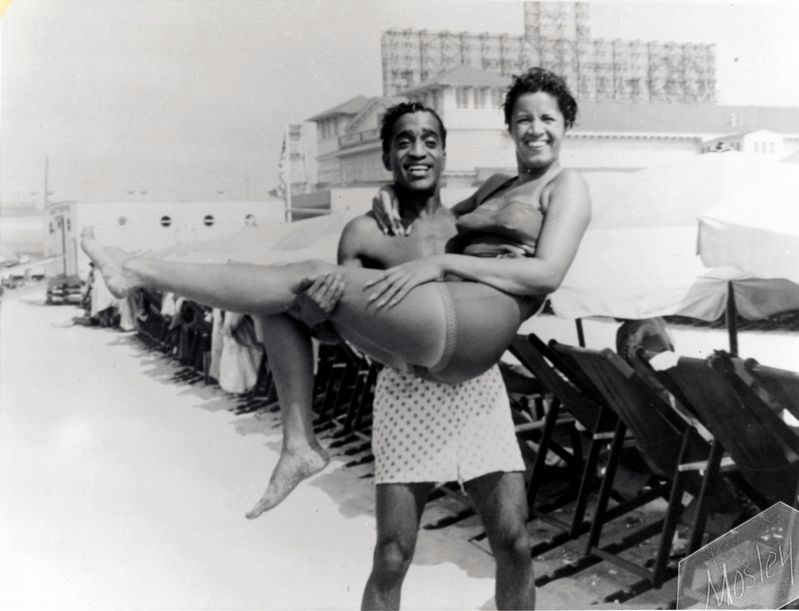
4. Entertainer Sammy Davis, Jr. holding a woman in his arms on Chicken Bone Beach in Atlantic City, NJ.
Sammy Davis Jr. was an actor and musician famous for being a part of the famed "Rat Pack" in the 1950s and 1960s.
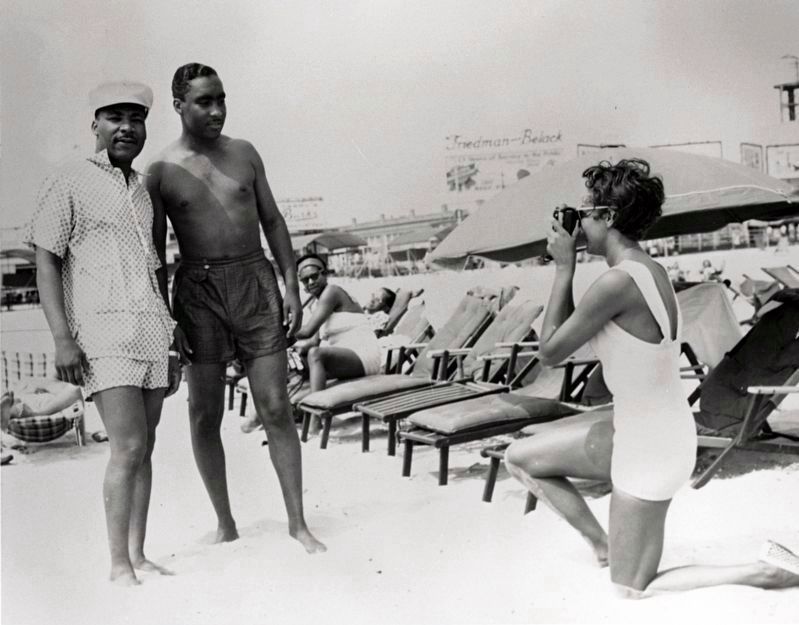
John W. Mosley Photograph Collection, Charles L. Blockson Afro-American Collection,Temple University
5. Civil rights leader Martin Luther King, Jr. (left) posed for a snapshot
Civil rights leader Martin Luther King, Jr. (on left) posed for a snapshot while relaxing on segregated Chicken Bone Beach in Atlantic City, New Jersey.
Credits. This page was last revised on August 5, 2026. It was originally submitted on July 29, 2026, by New Jersey Black Heritage Trail of Trenton, New Jersey. This page has been viewed 21 times since then. Photos: 1, 2, 3, 4, 5. submitted on July 29, 2026, by New Jersey Black Heritage Trail of Trenton, New Jersey. • Michael Herrick was the editor who published this page.
