Louvre - Tuileries in Paris, Île-de-France, France — Western Europe
Le Louvre et les Tuileries
⎯⎯⎯
The Louvre and the Tuileries
| — | Parcours Révolution / Revolutionary Route | — |
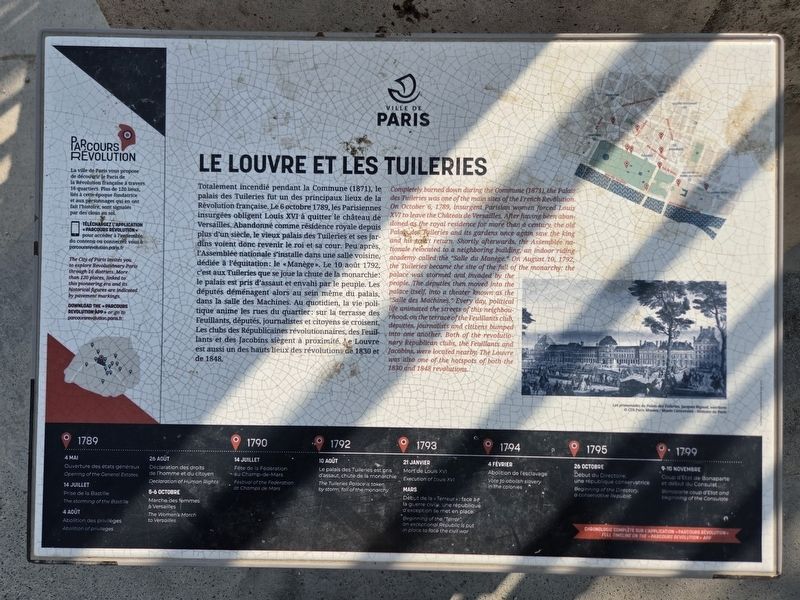
Photographed by James Hulse, July 30, 2026
1. Le Louvre et les Tuileries / The Louvre and the Tuileries Marker

Totalement incendié pendant la Commune (1871), le palais des Tuileries fut un des principaux lieux de la Révolution française. Le 6 octobre 1789, les Parisiennes insurgées obligent Louis XVI à quitter le château de Versailles. Abandonné comme résidence royale depuis plus d’un siècle, le vieux palais des Tuileries et ses jardins voient donc revenir le roi et sa cour. Peu après, l’Assemblée nationale s’installe dans une salle voisine, dédiée à l’équitation : le « Manège ». Le 10 août 1792, c’est aux Tuileries que se joue la chute de la monarchie : le palais est pris d’assaut et envahi par le peuple. Les députés déménagent alors au sein même du palais, dans la salle des Machines. Au quotidien, la vie politique anime les rues du quartier : sur la terrasse des Feuillants, députés, journalistes et citoyens se croisent. Les clubs des Républicaines révolutionnaires, des Feuillants et des Jacobins siègent à proximité. Le Louvre est aussi un des hauts lieux des révolutions de 1830 et de 1848.
1789
4 mai - Ouverture des États généraux
14 juillet - Prise de la Bastille
4 août - Abolition des privilèges
26 août - Déclaration
this page online
5–6 octobre - Marche des femmes à Versailles
1790
14 juillet - Fête de la Fédération au Champ-de-Mars
1792
10 août -'Le palais des Tuileries est pris d’assaut, chute de la monarchie
1793
21 janvier - Mort de Louis XVI
Mars
Début de la « Terreur » : face à la guerre civile, une république d’exception se met en place.
1794
4 février - Abolition de l’esclavage
1795
26 octobre - Début du Directoire, une république conservatrice
1799
9–10 novembre - Coup d’État de Bonaparte et début du Consulat
Les promenades du palais des Tuileries, Jacques Rigaud, eau-forte. CC0 Paris Musées / Musée Carnavalet – Histoire de Paris
La Ville de Paris vous propose de découvrir le Paris de la Révolution française à travers 16 quartiers. Plus de 120 lieux, liés à cette époque fondatrice et aux personnages qui en ont fait l’histoire, sont signalés par des clous au sol.
Téléchargez l’application « Parcours Révolution » pour accéder à l’ensemble du contenu, ou connectez-vous à parcoursrevolution.paris.fr.
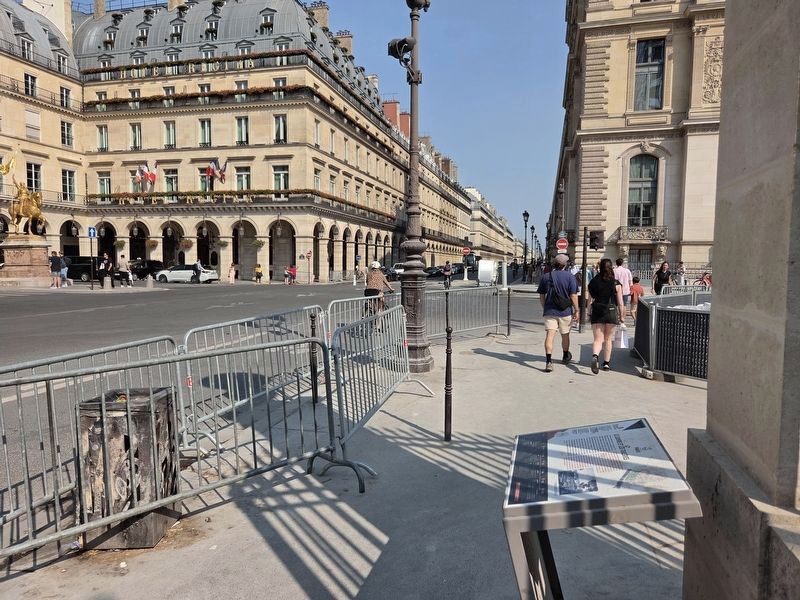
Photographed by James Hulse, July 30, 2026
2. Le Louvre et les Tuileries / The Louvre and the Tuileries Marker
The marker is located outside the entrance gate to the park along the street.
1789
May 4 - Opening of the Estates-General
July 14 - The Storming of the Bastille
August 4 - Abolition of Privileges
August 26 - Declaration of the
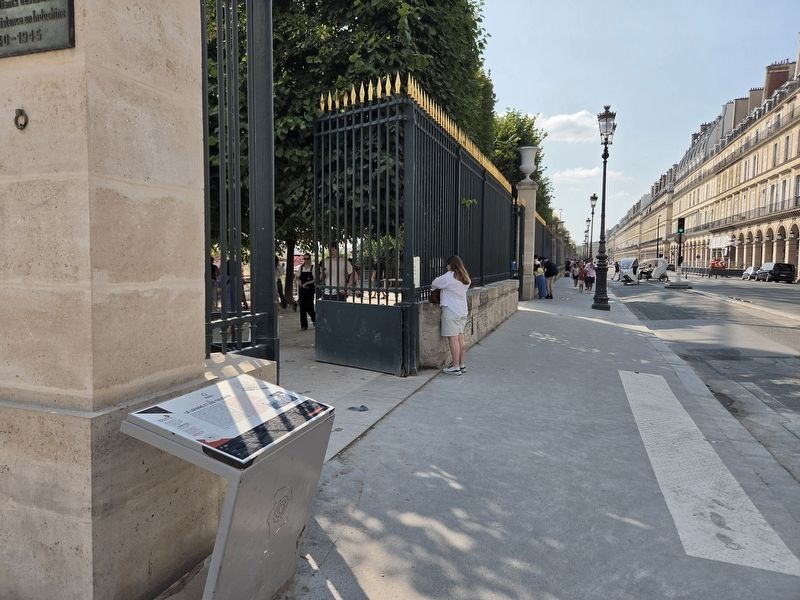
Photographed by James Hulse, July 30, 2026
3. Le Louvre et les Tuileries / The Louvre and the Tuileries Marker
The view of the marker along the street looking towards the west.
October 5–6 - The Women’s March on Versailles
1790
July 14 - Festival of the Federation on the Champ-de-Mars
1792
August 10 - The Tuileries Palace is stormed, fall of the monarchy
1793
January 21 - Execution of Louis XVI
March
Beginning of the “Terror”: an exceptional republic is established in response to the civil war.
1794
February 4 - Vote to abolish slavery in the colonies
1795
October 26 - Beginning of the Directory, a conservative republic
1799
November 9–10 - Bonaparte’s coup d’état and the beginning of the Consulate
The Walkways of the Tuileries Palace, Jacques Rigaud, etching. CC0 Paris Musées / Musée Carnavalet – History of Paris
The City of Paris invites you to explore Revolutionary Paris through 16 districts. More than 120 places linked to this foundational era and its historical figures are indicated by pavement markers.
Download the “Parcours Révolution” app to access all the content, or visit parcoursrevolution.paris.fr.
Erected by City of Paris.
Topics. This historical marker is listed in these topic lists: Government & Politics • Notable Events. A significant historical date for this entry is August 10, 1792.
Location. 48° 51.826′ N, 2° 19.906′ E. Marker is in Paris, Île-de-France. It is in Louvre - Tuileries. It is at the intersection of Rue de Rivoli and Place des Pyramides, on the left when traveling west on Rue de Rivoli. Touch for map. Marker is at or near this postal address: 1 Pl des Pyramides, Paris, Île-de-France 75001, France. Touch for directions.

Regionally, it is in the North Atlantic Region, Europe, the European Union, Atlantic Europe, the Schengen Area, Western Europe, a coastal Mediterranean country, and the Western World. Historically, it finds itself in what was once a French colony and also the Roman Empire.
Other nearby markers. At least 8 other markers are within walking distance of this marker: Deuxième Guerre mondiale / Second World War (here, next to this marker); Ludovic Jacquinot (within shouting distance of this marker); Sébastien Le Prestre de Vauban (within shouting distance of this marker); La Ligue des Sociétés de la Croix-Rouge / League of the Societies of the Red Cross (within shouting distance of this marker); Antoine de Pluvinel (within shouting distance of this marker); Léon Tolstoï / Leo Tolstoy (about 120 meters away, measured in a direct line); Eglise Saint-Roch / Saint Roch Church (about 120 meters away); Jean de la Fontaine (about 150 meters away). Touch for a list and map of all markers in Paris.
Credits. This page was last revised on July 30, 2026. It was originally submitted on July 30, 2026, by James Hulse of Medina, Texas. This page has been viewed 27 times since then. Photos: 1, 2, 3. submitted on July 30, 2026, by James Hulse of Medina, Texas.
