Montevallo in Shelby County, Alabama — The American South (East South Central)
Almont Elementary School
Shelby County
Photographed by Jimmy Emerson, July 29, 2026
1. Almont Elementary School Marker
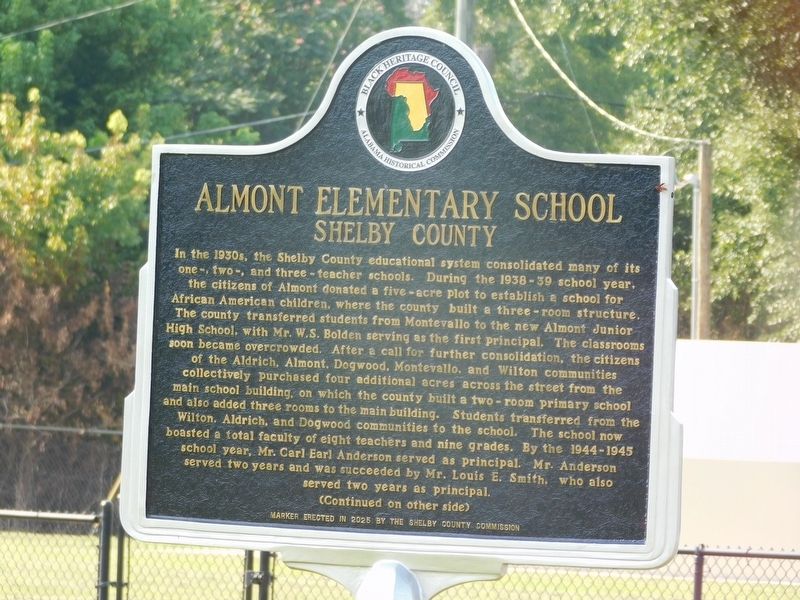
In the 1930s, the Shelby County educational system consolidated many of its one-, two-, and three-teacher schools. During the 1938-39 school year, the citizens of Almont donated a five-acre plot to establish a school for African American children, where the county built a three-room structure. The county transferred students from Montevallo to the new Almont Junior High School, with Mr. W.S. Bolden serving as the first principal. The classrooms soon became overcrowded. After a call for further consolidation, the citizens of the Aldrich, Almont, Dogwood, Montevallo, and Wilton communities collectively purchased four additional acres across the street from the main school building, on which the county built a two-room primary school and also added three rooms to the main building. Students transferred from the Wilton, Aldrich, and Dogwood communities to the school. The school now boasted a total faculty of eight teachers and nine grades. By the 1944-1945 school year, Mr. Carl Earl Anderson served as principal. Mr. Anderson served two years and was succeeded by Mr. Louis E. Smith, who also served two years as
this page online
(Reverse Side)
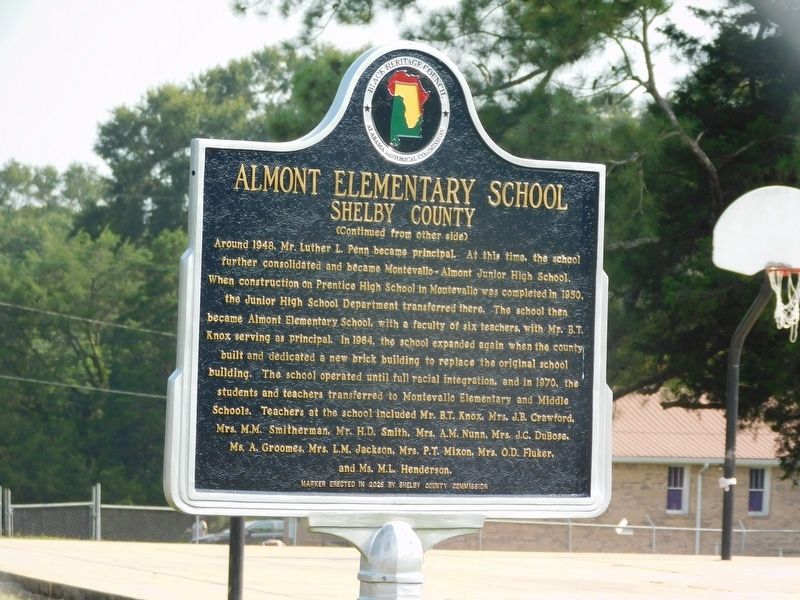
Around 1948, Mr. Luther L. Penn became principal. At this time, the school further consolidated and became Montevallo-Almont Junior High School. When construction on Prentice High School in Montevallo was completed in 1950, the Junior High School Department transferred there. The school then became Almont Elementary School, with a faculty of six teachers, with Mr. B.T. Knox serving as principal. In 1964, the school expanded again when the county built and dedicated a new brick building to replace the original school building. The school operated until full racial integration, and in 1970, the students and teachers transferred to Montevallo Elementary and Middle Schools. Teachers at the school included Mr. B.T. Knox, Mrs. J.B. Crawford, Mrs. M.M. Smitherman, Mr. H.D. Smith, Mrs. A.M. Nunn, Mrs. J.C. DuBose, Ms. A. Groomes, Mrs. L.M. Jackson, Mrs. P.T. Mixon, Mrs. O.D. Fluker, and Ms. M.L. Henderson.
Erected 2025 by Shelby County Commission, Black Heritage Council and Alabama Historical Commission.
Topics. This historical marker is listed in these topic lists: African Americans •
Photographed by Jimmy Emerson, July 29, 2026
2. Almont Elementary School Marker
Location. 33° 6.773′ N, 86° 52.54′ W. Marker is in Montevallo, Alabama, in Shelby County. It is at the intersection of Gilmore Nick Circle and Vassar Circle, on the left when traveling north on Gilmore Nick Circle. Touch for map. Marker is at or near this postal address: 340 Gilmore Nick Cir, Montevallo AL 35115, United States of America. Touch for directions.

Regionally, this marker is in the Birmingham Metropolitan Area. It is also in the American South and specifically in the Deep South. Globally, it is in North America, a Gulf of Mexico state, the Western Hemisphere, the Western World, and the Anglosphere. Historically, it finds itself in what was once New Spain, the territory of the Mississippian Culture, one of the Confederate States of America, and the Antebellum South.
Other nearby markers. At least 8 other markers are within one mile of this marker, measured as the crow flies: Pilgrim Rest Missionary Baptist Church (about 500 feet away, measured in a direct line); King House (approx. 0.9 miles away); University Of Montevallo National Historic District
Photographed by Jimmy Emerson, July 29, 2026
3. Almont Elementary School Marker
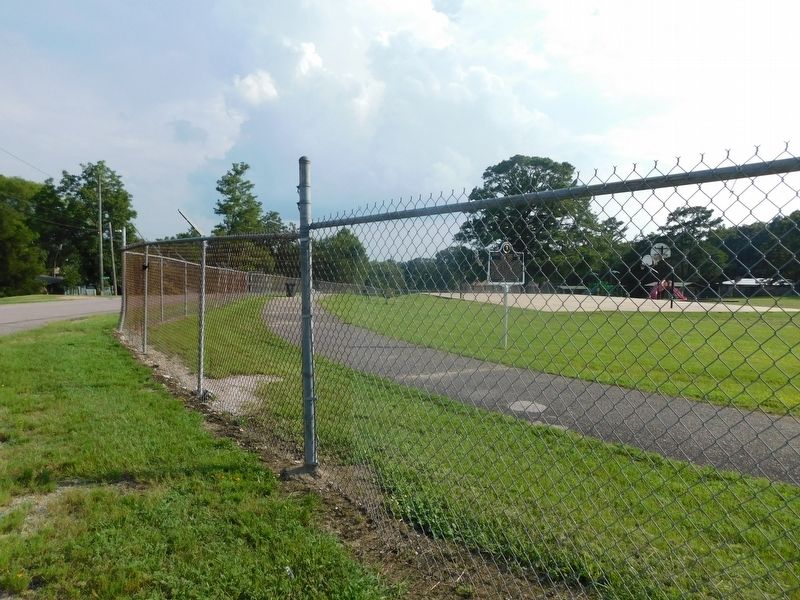
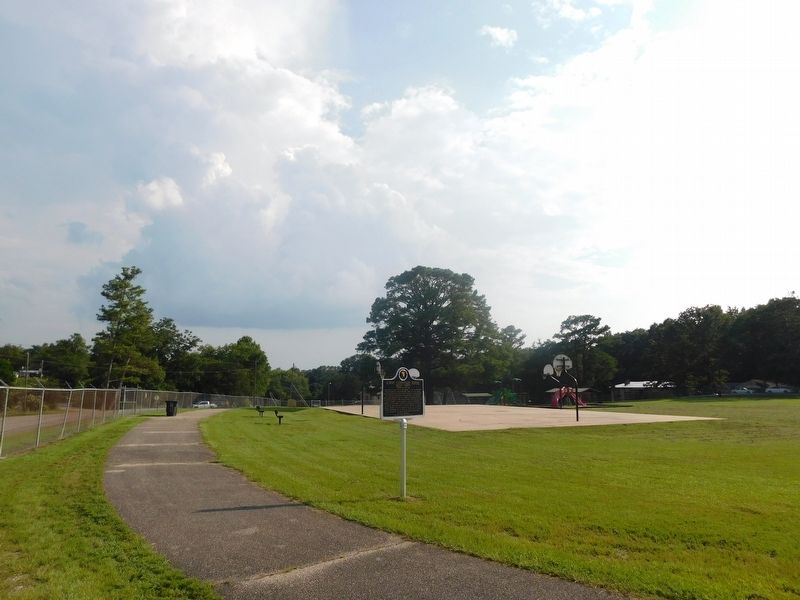
More about this marker. The marker is behind a chain link fence that surrounds the park that I assume is where the school had been located. It was dedicated October 19, 2025.
Photographed by Jimmy Emerson, July 29, 2026
4. Almont Elementary School Marker
Credits. This page was last revised on August 5, 2026. It was originally submitted on August 2, 2026, by Jimmy Emerson of Dalton, Georgia. This page has been viewed 21 times since then. Photos: 1, 2, 3, 4. submitted on August 2, 2026, by Jimmy Emerson of Dalton, Georgia. • James Hulse was the editor who published this page.
