Melton Mowbray in Leicestershire, England, United Kingdom — Northwestern Europe (the British Isles)
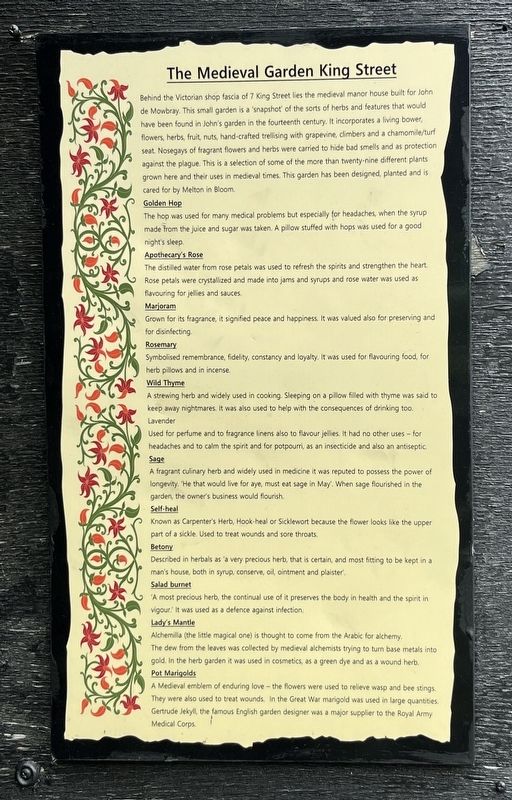
The Medieval Garden King Street
Photographed by Ray Gurganus, May 5, 2026
1. The Medieval Garden King Street Marker
Golden Hop
The hop was used for many medical problems but especially for headaches, when the syrup made from the juice and sugar was taken. A pillow stuffed with hops was used for a good night's sleep.
Apothecary's Rose
The distilled water from rose petals was used to refresh the spirits and strengthen the heart. Rose petals were crystallized and made into jams and syrups and rose water was used as flavouring for jellies and sauces.
Marjoram
Grown for its fragrance, it signified peace and happiness. It was valued also for preserving and for disinfecting.
Rosemary
Symbolised remembrance, fidelity, constancy and loyalty. It was used for flavouring food, for herb pillows and in incense.
Wild Thyme
A strewing herb and widely used in cooking. Sleeping on a pillow filled with thyme was said to keep away nightmares. It was also used to help with the consequences of drinking too.
Lavender
Used for perfume and to fragrance linens also to flavour jellies. It had no other uses - for headaches and to calm the spirit and for potpourri, as an insecticide and also an antiseptic.
Sage
A fragrant culinary herb and widely
this page online
Self-heal
Known as Carpenter's Herb, Hook-heal or Sicklewort because the flower looks like the upper part of a sickle. Used to treat wounds and sore throats.
Concretes
Described in herbals as 'a very precious herb, that is certain, and most fitting to be kept in a man's house, both in syrup, conserve, oil, ointment and plaister'.
Salad burnet
'A most precious herb, the continual use of it preserves the body in health and the spirit in vigour. It was used as a defence against infection.
Lady's Mantle
Alchemilla (the little magical one) is thought to come from the Arabic for alchemy.
The dew from the leaves was collected by medieval alchemists trying to turn base metals into gold. In the herb garden it was used in cosmetics, as a green dye and as a wound herb.
Pot Marigolds
A Medieval emblem of enduring love the flowers were used to relieve wasp and bee stings. They were also used to treat wounds. In the Great War marigold
Photographed by Ray Gurganus, May 5, 2026
2. The Medieval Garden King Street Marker
Topics. This historical marker is listed in these topic lists: Horticulture & Forestry • Science & Medicine.
Location. 52° 45.914′ N, 0° 53.163′ W. Marker is in Melton Mowbray, England, in Leicestershire. It is on St Mary’s Way near King Street, on the right when traveling north. Touch for map. Marker is at or near this postal address: 2A King Street, Melton Mowbray, England LE13 1XD, United Kingdom. Touch for directions.

Regionally, this marker is in the Midlands. Globally, it is on the Atlantic Ocean, in the North Atlantic Region, in Europe, in Atlantic Europe, on one of the British Isles, in the Western World, and in the Anglosphere. Historically, it finds itself in what was once the Roman Empire.
Other nearby markers. At least 8 other markers are within 16 kilometers of this marker, measured as the crow flies: King Street (a few steps from this marker); Hudson's Cottage (approx. 14.7 kilometers away); Fit for a King (approx. 15 kilometers away); Friends Meeting House - Oakham (approx. 15 kilometers away); Ancient Customs (approx. 15 kilometers away); Deer, Cattle, and Horses (approx. 15 kilometers away); Oakham Castle (approx. 15 kilometers away); Conquest & Castles (approx. 15 kilometers away).
Credits. This page was last revised on August 5, 2026. It was originally submitted on August 5, 2026, by Ray Gurganus of Washington, District of Columbia. This page has been viewed 10 times since then. Photos: 1, 2. submitted on August 5, 2026, by Ray Gurganus of Washington, District of Columbia. • Andrew Ruppenstein was the editor who published this page.
