Near Charleston in Charleston County, South Carolina — The American South (South Atlantic)
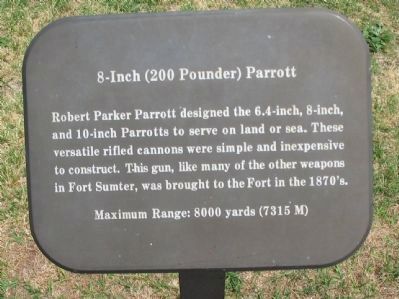
8-inch (200 Pounder) Parrott
Photographed by Craig Swain, May 3, 2010
1. 8-inch (200 Pounder) Parrott Marker
Maximum Range: 8000 yards (7315 M)
Topics. This historical marker is listed in this topic list: War, US Civil. A significant historical month for this entry is April 1861.
Location. 32° 45.139′ N, 79° 52.463′ W. Marker is near Charleston, South Carolina, in Charleston County. It can be reached from the Fort Sumter Ferry Terminal. Located at Fort Sumter National Monument and only reached by boat. See links below for more information about access to the site. Touch for map. Marker is in this post office area: Charleston SC 29412, United States of America. Touch for directions.

Regionally, this marker is in Historic Charleston and in the Lowcountry. It is also in the American South, specifically in the Deep South, and on the Eastern Seaboard. Globally, it is in the North Atlantic Region, North America, the Western Hemisphere, the Western World, and the Anglosphere.
this page online
Other nearby markers. At least 8 other markers are within walking distance of this marker: Major Robert Anderson (a few steps from this marker); Flags of the Fort (a few steps from this marker); Fort Moultrie (a few steps from this marker); The Columbiad (a few steps from this marker); Morris Island (a few steps from this marker); 6.4-Inch (100-Pounder) Parrott (within shouting distance of this marker); Rearming the Fort (within shouting distance of this marker); Charleston Besieged (within shouting distance of this marker). Touch for a list and map of all markers in Charleston.
Another marker is no longer nearby. Morris Island (was within shouting distance of this marker but has been replaced with another marker now near it).
Photographed by Craig Swain, May 3, 2010
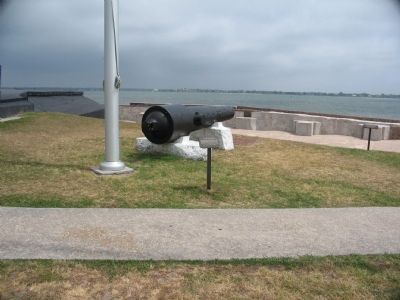
2. 8-inch Parrott and Marker
Photographed by Craig Swain, May 3, 2010
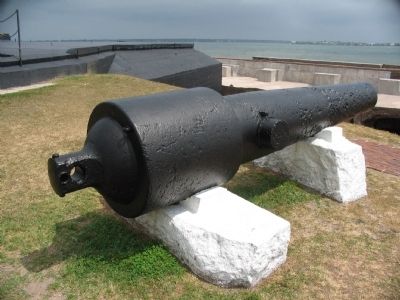
3. 8-inch (200 Pounder) Parrott
One of only eight surviving 8-inch Parrotts out of a production run of 91 for the Army and 87 for the Navy. All but the first examples were "cast hollow and cooled from the interior" using the technique perfected by Army officer T. J. Rodman. Note the breeching loop on the back of the gun. This allowed the same pattern to be used by both Army and Navy.
Photographed by Craig Swain, May 3, 2010
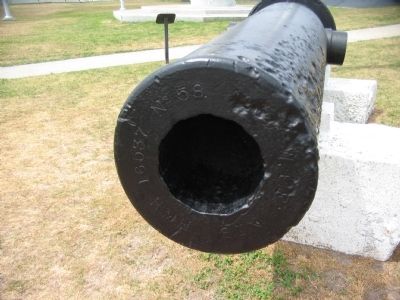
4. Muzzle Markings
Visible on the muzzle are the marks "No 58" indicating the registry number, 1864 for the year of manufacture, "W.P.F." for West Point Foundry where the gun was produced, "8 I.N." indicating the caliber, "R.M.H." for inspecting officer Richard Mason Hill, and 16537 as the listed weight in pounds at time of inspection. 8-inch Parrotts had 11-groove rifling.
Credits. This page was last revised on January 4, 2026. It was originally submitted on May 16, 2010, by Craig Swain of Leesburg, Virginia. This page has been viewed 1,440 times since then and 63 times this year. Photos: 1, 2, 3, 4. submitted on May 16, 2010, by Craig Swain of Leesburg, Virginia.
