Forest Avenue in Buffalo in Erie County, New York — The American Northeast (Mid-Atlantic)
Buffalo Asylum
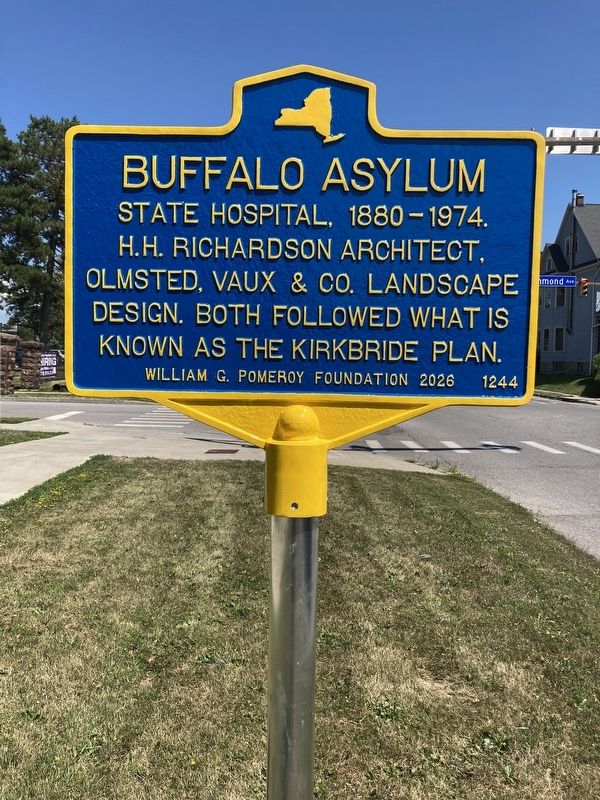
Photographed by Thomas Johnston, August 5, 2026
1. Buffao Asylum Marker
State Hospital 1880-1974.
H.H. Richardson Architect.
Olmsted, Vaux & Co. landscape design. Both followed what is known as the Kirkbride Plan.
Erected 2026 by William G. Pomeroy Foundation. (Marker Number 1244.)
Topics and series. This historical marker is listed in these topic lists: Architecture • Charity & Public Work • Science & Medicine. In addition, it is included in the William G. Pomeroy Foundation series list. A significant historical year for this entry is 1880.
Location. 42° 55.675′ N, 78° 52.872′ W. Marker is in Buffalo, New York, in Erie County. It is in Forest Avenue. It is on Forest Avenue, on the right when traveling west. Touch for map. Marker is at or near this postal address: 444 Forest Avenue, Buffalo NY 14213, United States of America. Touch for directions.

Regionally, this marker is in Upstate New York and specifically in Western New York. It is also in the American Northeast and in the Mid-Atlantic. Globally, it is in North America, on the Great Lakes, in the Western Hemisphere, in the Western World, and in the Anglosphere. Historically, it finds itself in what was once
this page online
Other nearby markers. At least 8 other markers are within walking distance of this marker: Buffalo Seminary (approx. 0.4 miles away); Memorial Dedicated to the Memory of John A. Boechat (approx. half a mile away); Historic Scajaquada Creek (approx. half a mile away); General Daniel Davidson Bidwell (approx. half a mile away); The Pan-American Exposition (approx. half a mile away); Lafayette High School (approx. half a mile away); NYS Building (approx. half a mile away); Highlights of Buffalo History (approx. 0.6 miles away). Touch for a list and map of all markers in Buffalo.
Also see . . . Richardson Olmsted Complex (Wikipedia). Overview:
The Richardson Olmsted Campus in Buffalo, New York, United States, was designated a National Historic Landmark in 1986. The site was designed by the American architect Henry Hobson Richardson in concert with the famed landscape team of Frederick Law Olmsted and Calvert Vaux in the late 1800s, incorporating a system of treatment for people with mental(Submitted on August 6, 2026.)illness developed by Dr. Thomas Story Kirkbride known as the Kirkbride Plan. Over the years, as mental health treatment changed and resources were diverted, the buildings and grounds began a slow deterioration. By 1974, the last patients were removed from the historic wards. On June 24, 1986, the former Buffalo State Asylum for the Insane was added to the National Historic Landmark registry. In 2006, the Richardson Center Corporation was formed to restore the buildings.Photographed by Andre Carrotflower (via Wikimedia Commons under CC 4.0 license), June 17, 20172. The Buffalo Asylum Admin buildingThe Administration Building of the former Buffalo State Hospital (Richardson-Olmsted Complex), now repurposed as 88-room luxury boutique hotel, Hotel Henry.

Credits. This page was last revised on August 6, 2026. It was originally submitted on August 6, 2026, by Thomas Johnston of Kenmore, New York. This page has been viewed 26 times since then. Photos: 1. submitted on August 6, 2026, by Thomas Johnston of Kenmore, New York. 2. submitted on August 6, 2026. • Andrew Ruppenstein was the editor who published this page.
