Quincy in Norfolk County, Massachusetts — The American Northeast (New England)
The Souther Tide Mill
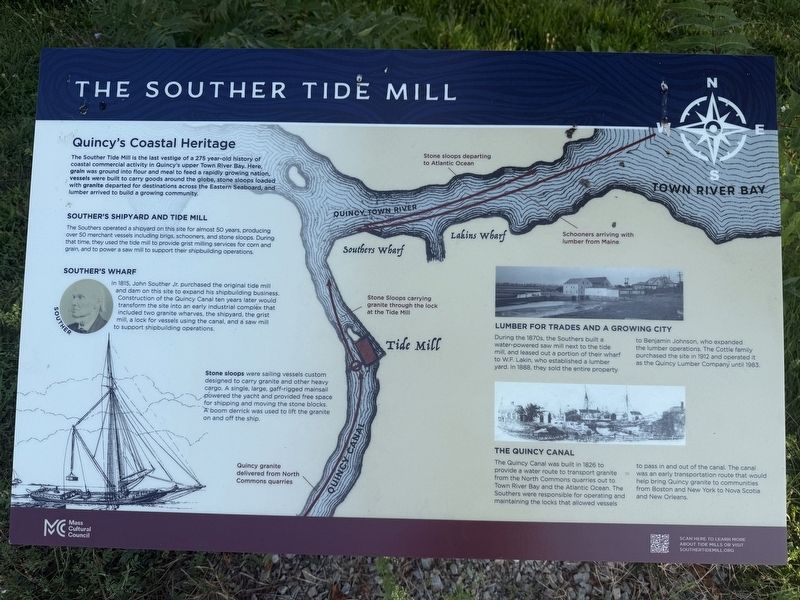
Quincy’s Coastal Heritage
Photographed by G.W.Bartlett, August 8, 2026
1. The Souther Tide Mill Marker
The Souther Tide Mill is the last vestige of a 275 year-old history of coastal commercial activity in Quincy's upper Town River Bay. Here, grain was ground into flour and meal to feed a rapidly growing nation. Vessels were built to carry goods around the globe, stone sloops loaded with granite departed for destinations across the Eastern Seaboard, and lumber arrived to build a growing community.
SOUTHER'S SHIPYARD AND TIDE MILL
The Southers operated a shipyard on this site for almost 50 years, producing over 50 merchant vessels including brigs, schooners, and stone sloops. During that time, they used the tide mill to provide grist milling services for corn and grain, and to power a saw mill to support their shipbuilding operations.
SOUTHER'S WHARF
In 1815, John Souther Jr. purchased the original tide mill and dam on this site to expand his shipbuilding business. Construction of the Quincy Canal ten years later would transform the site into an early industrial complex that included two granite wharves, the shipyard, the grist mill, a lock for vessels using the canal,
this page online
(illustration captions)
Stone sloops were sailing vessels custom-designed to carry granite and other heavy cargo. A single, large, gaff-rigged mainsail powered the yacht and provided free space for shipping and moving the stone blocks. A boom derrick was used to lift the granite on and off the ship.
Lumber for Trades and a Growing City
During the 1870s, the Southers built a water-powered saw mill next to the tide mill, and leased out a portion of their wharf to W.F. Lakin, who established a lumber yard. In 1888, they sold the entire property to Benjamin Johnson, who expanded the lumber operations. The Cottle family purchased the site in 1912 and operated it as the Quincy Lumber Company until 1983.
The Quincy Canal The Quincy Canal was built in 1826 to provide a water route to transport granite from the North Commons quarries out to Town River Bay and the Atlantic Ocean. The Southers were responsible for operating and maintaining the locks that allowed vessels to pass in and out of the canal. The canal was an early transportation route that would help bring Quincy granite
Photographed by G.W.Bartlett, August 8, 2026
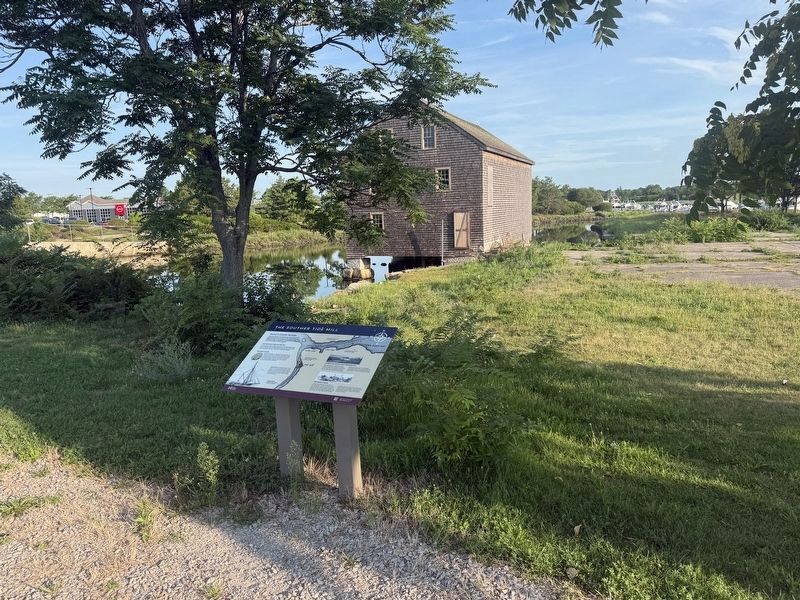
2. The Souther Tide Mill Marker (wide)
Erected by Massachusetts Culture Council (MCC).
Topics. This historical marker is listed in these topic lists: Industry & Commerce • Waterways & Vessels. A significant historical year for this entry is 1815.
Location. 42° 15.157′ N, 70° 59.336′ W. Marker is in Quincy, Massachusetts, in Norfolk County. It is on Southern Artery (Massachusetts Route 3A). Touch for map. Marker is at or near this postal address: 622 Southern Artery, Quincy MA 02169, United States of America. Touch for directions.

Regionally, this marker is in Historic Boston and specifically in Greater Boston. It is also in the American Northeast, in New England, and on the Eastern Seaboard. Globally, it is in the North Atlantic Region, North America, the Western Hemisphere, the Western World, and the Anglosphere. Historically, it finds itself in what was once one of the original Thirteen Colonies.
Other nearby markers. At least 8 other markers are within walking distance of this marker: A different marker also named The Souther Tide Mill (a few steps from this marker); Site of the Original Dunkin Donuts
Photographed by G.W.Bartlett, August 8, 2026
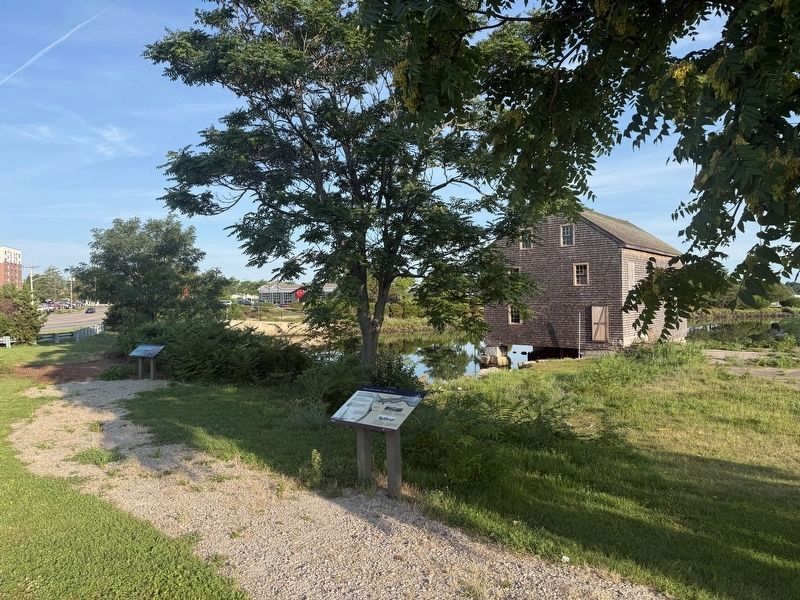
3. The Souther Tide Mill Marker (wide)
Both markers are visible in this photo. Southern Artery (Route 3A) visible in the background to the west.
Also see . . . Friends of Souther Tide Mill.
The Friends of Souther Tide Mill mission is to preserve the Souther Tide Mill, which stands on former Quincy Lumber Company site located on the Southern Artery in Quincy. We aim to promote public interest in and educational programs interpreting the grist mill, granite, lumber, ship building and maritime history of the city; to support present or future owners in maintaining the site and the buildings.(Submitted on August 8, 2026, by G.W.Bartlett of Hingham, Massachusetts.)
Photographed by G.W.Bartlett, August 8, 2026
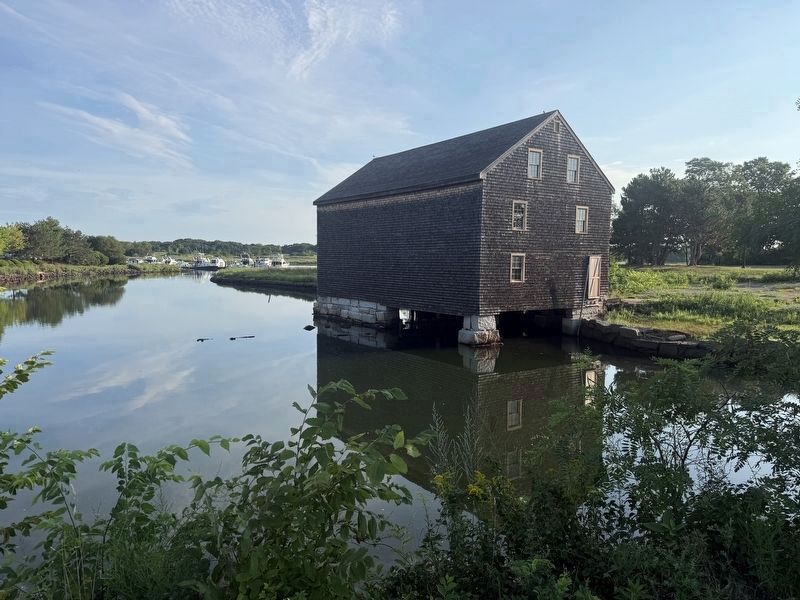
4. Quincy Canal
Quincy Canal leading to Town River. Town River leads to Weymouth Fore River (not visible).
Photographed by G.W.Bartlett, August 8, 2026
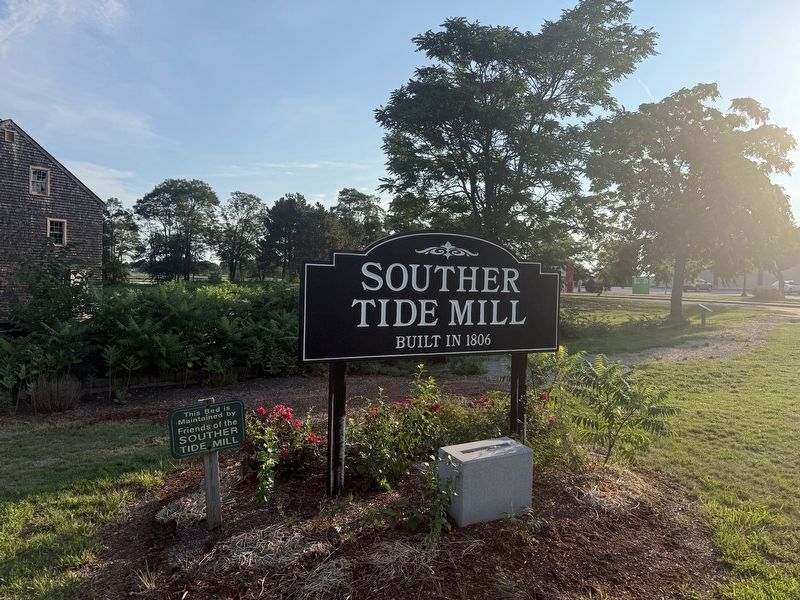
5. The Souther Tide Mill Sign & Marker
Credits. This page was last revised on August 13, 2026. It was originally submitted on August 8, 2026, by G.W.Bartlett of Hingham, Massachusetts. This page has been viewed 16 times since then. Photos: 1, 2, 3, 4, 5. submitted on August 8, 2026, by G.W.Bartlett of Hingham, Massachusetts. • Andrew Ruppenstein was the editor who published this page.
