Premier City of the Region
Million-Dollar Block
Dodge City entered a new period of growth and prosperity after 1900, when many of the business buildings currently standing in the downtown area were built. Also constructed in the community were new hospitals, a post office, a new city hall and county courthouse, schools, and brick-paved streets. It was a period of explosive expansion for the town just before hard times in the 1930s halted growth in the region.
The past twelve months have brought to Dodge City the greatest building program it has ever known… From a rough frontier town with only sod houses and frame shacks to a wheat center with mills, distributing plants, warehouses and fine residences, Dodge City has forged ahead with the determination and sagacity made possible only by pioneer ancestry.
—Dodge City Journal, January 1930
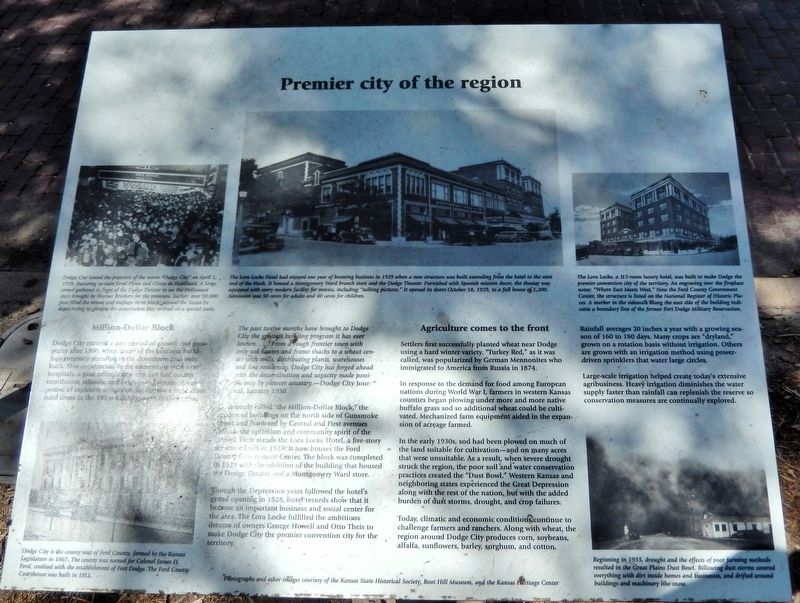
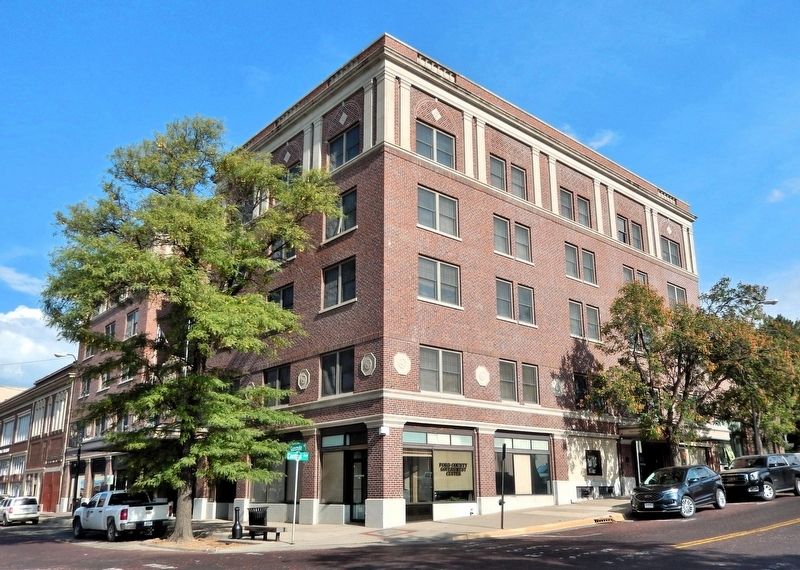
Commonly called “the Million-Dollar Block,” the section of buildings on the north side of Gunsmoke Street and bordered by Central and First avenues reflects the optimism and community spirit of the period. Here stands the Lora Locke Hotel, a five-story structure built in 1927. It now houses the Ford County Government
this page online
Though the Depression years followed the hotel’s grand opening in 1928, hotel records show that it became an important business and social center for the area. The Lora Locke fulfilled the ambitious dreams of owners George Howell and Otto Theis to make Dodge City the premier convention city for the territory.
Agriculture Comes to the Front
Settlers first successfully planted wheat near Dodge using a hard winter variety. “Turkey Red,” as it was called, was popularized by German Mennonites who immigrated to America from Russia in 1874.
In response to the demand for food among European nations during World War I, farmers in western Kansas counties began plowing under more and more native buffalo grass sod so additional wheat could be cultivated. Mechanized farm equipment aided in the expansion of acreage farmed.
In the early 1930s, sod had been plowed on much of the land suitable for cultivation — and on many acres that were unsuitable. As a result, when severe drought struck the region, the poor soil and

Today, climatic and economic conditions continue to challenge farmers and ranchers. Along with wheat, the region around Dodge City produces corn, soybeans, alfalfa, sunflowers, barley, sorghum, and cotton.
Rainfall averages 20 inches a year with a growing season of 160 to 180 days. Many crops are “dryland,” grown on a rotation basis without irrigation. Others are grown with an irrigation method using power-driven sprinklers that water large circles.
Large-scale irrigation helped create today’s extensive agribusiness. Heavy irrigation diminishes the water supply faster than rain fall can replenish the reserve so conservation measures are continually explored.
[photo captions]
• Dodge City hosted the premier of the movie “Dodge City” on April 1, 1939, featuring co-stars Errol Flynn and Olivia de Havilland. A large crowd gathered in front of the Dodge Theater to see the Hollywood stars brought by Warner Brothers
• The Lora Locke Hotel had enjoyed one year of booming business in 1929 when a new structure was built extending from the hotel to the west end of the block. It housed a Montgomery Ward branch store and the Dodge Theater. Furnished with Spanish mission decor, the theater was equipped with every modern facility for movies, including “talking pictures.” It opened its doors October 18, 1929, to a full house of 1,200. Admission was 50 cents for adults and 40 cents for children.
• The Lora Locke, a 115-room luxury hotel, was built to make Dodge the premier convention city of the territory. An engraving over the fireplace notes: “Where East Meets West.” Now the Ford County Government Center, the structure is listed on the National Register of Historic Places. A marker in the sidewalk along the east side of the building indicates a boundary line of the former Fort Dodge Military Reservation.
• Dodge City is the county seat of Ford County, formed by the Kansas Legislature

• Beginning in 1933, drought and the effects of poor farming methods resulted in the Great Plains Dust Bowl. Billowing dust storms covered everything with dirt inside homes and businesses and drifted around buildings and machinery like snow.
Topics and series. This historical marker is listed in these topic lists: Agriculture • Entertainment • Industry & Commerce • Settlements & Settlers. In addition, it is included in the National Register of Historic Places (NRHP) series list. A significant historical year for this entry is 1929.
Location. 37° 45.205′ N, 100° 1.026′ W. Marker is in Dodge City, Kansas, in Ford County. It is at the intersection of Gunsmoke Street and Central Avenue, on the right when traveling east on Gunsmoke Street. The marker is beside the sidewalk near the southwest corner of the intersection. Touch for map. Marker is at or near this postal address: 101 Gunsmoke Street, Dodge City KS 67801, United States of America. Touch for directions.

Regionally, this marker is in the American Midwest, in the Corn Belt, on the prairies, on the Great Plains, on the Southern Plains, on the High Plains, and on the Santa Fe Trail Corridor. Globally, it is in North America, the Western Hemisphere, the Western World, and the Anglosphere. Historically, it finds itself in what was once the Comanchería, the Dust Bowl, the Louisiana Purchase, and the Republic of Texas.
Other nearby markers. At least 8 other markers are within walking distance of this marker: Brig. General George Armstrong Custer (a few steps from this marker); Henry Fonda (within shouting distance of this marker); World Premier “Dodge City” Starring Errol Flynn (within shouting distance of this marker); "Doc" Holliday (within shouting distance of this marker); Dodge Theater Building (within shouting distance of this marker); Dodge City, a railroad town (within shouting distance of this marker); The 100th Meridian, Where East Meets West (within shouting distance of this marker); Wyatt Earp (within shouting distance of this marker). Touch for a list and map of all markers in Dodge City.
Regarding Premier City of the Region. The Lora Locke Hotel is listed in the National Register of Historic Places — № 85000012. It is also a contributing property in Dodge City Downtown Historic District, NRHP № 09000875.
From the National Register Nomination prepared by Richard J. Cawthon, 11/13/1984:
The Lora Locke Hotel is a five-story building of reinforced concrete construction faced with red brick and trimmed in Indiana limestone. It is located on the northwest corner of Central and Gunsmoke Streets in the central business district of Dodge City. It has a rectangular plan on the first two floors, with a frontage of 125 feet on Gunsmoke Street to the south and 115 feet on Central to the east. The upper three stories have a U-shaped plan arranged around a rectangular light well located in the middle of the south front of the building, opening toward Gunsmoke Street.In early 1927 George Howell, a prominent realtor and former mayor of Dodge City, and Otto Theis, a prosperous rancher, formed the Citizens Hotel Company for the purpose of building a grand hotel in Dodge City. The architectural firm of Ellis and Charles of Wichita provided the plans for the building, which was built by Eastergard and Bullard of McCook, NE. Excavation began in May, 1927, and the new hotel opened for business in March, 1928. It was given the name “Lora Locke,” combining Howell's wife's first name and Theis' wife' s maiden name.
The Lora Locke Hotel is architecturally significant as one of the most intact hotels in Kansas which remain from the 1920s. It is an excellent example of the urban hotels of that period, and one of the very few in the state to retain such a high degree of integrity.
Also see . . . Premier City of the Region (Visit Dodge City).
Excerpt: "Father Time has turned another page in his Book of Eternity and 1929 has joined the tired procession of ghost‑years trailing into oblivion. The old year is gone forever, but it has left its mark in Dodge City, old Cowboy Capital of the West, which fifty years ago had for its only thoroughfare the famous Front Street with its straggling shacks, rough buildings and swinging doors. The past twelve months have brought to Dodge City the greatest building program it has ever known, over one million dollars having been spent in the erection alone of new business buildings and dwelling houses here. The history of the fifty years which culminated in this million dollar achievement reads like an epic of progress and prosperity."(Submitted on August 12, 2026, by Cosmos Mariner of Cape Canaveral, Florida.)
—Dodge City Journal, January 1930
Credits. This page was last revised on August 12, 2026. It was originally submitted on August 9, 2026, by Cosmos Mariner of Cape Canaveral, Florida. This page has been viewed 13 times since then. Photos: 1, 2, 3, 4. submitted on August 11, 2026, by Cosmos Mariner of Cape Canaveral, Florida.
