The Hinkle House
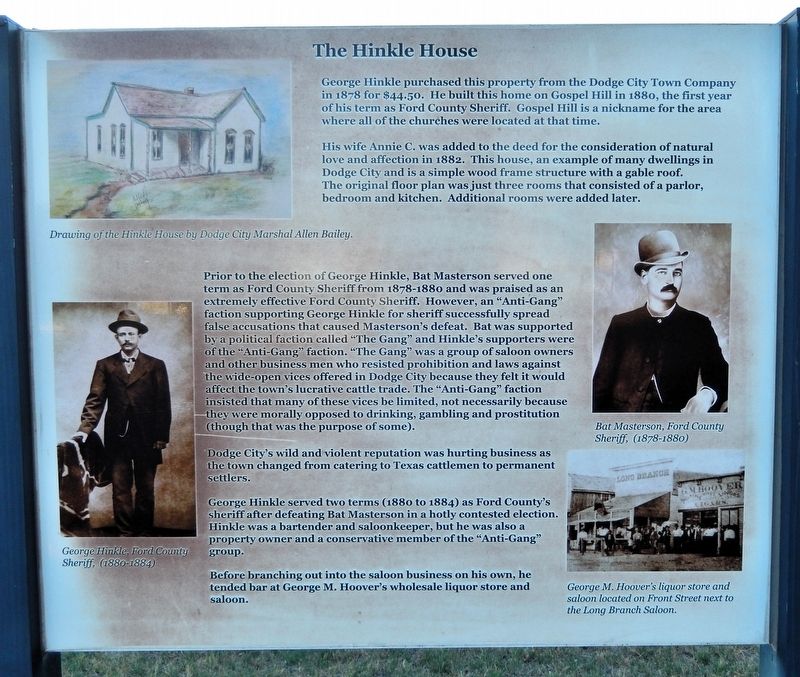
George Hinkle purchased this property from the Dodge City Town Company in 1878 for $44.50. He built this home on Gospel Hill in 1880, the first year of his term as Ford County Sheriff. Gospel Hill is a nickname for the area where all of the churches were located at that time.
His wife Annie C. was added to the deed for the consideration of natural love and affection in 1882. This house is an example of many dwellings in Dodge City and is a simple wood frame structure with a gable roof. The original floor plan was just three rooms that consisted of a parlor, bedroom and kitchen. Additional rooms were added later.
Prior to the election of George Hinkle, Bat Masterson served one term as Ford County Sheriff from 1878-1880 and was praised as an extremely effective Ford County Sheriff. However, an “Anti-Gang” faction supporting George Hinkle for sheriff successfully spread false accusations that caused Masterson's defeat. Bat was supported by a political faction called “The Gang” and Hinkle's supporters were of the “Anti-Gang” faction. “The Gang” was a group of saloon owners and other business men who resisted prohibition and
this page online
Dodge City's wild and violent reputation was hurting business as the town changed from catering to Texas cattlemen to permanent settlers.
George Hinkle served two terms (1880 to 1884) as Ford County's sheriff after defeating Bat Masterson in a hotly contested election. Hinkle was a bartender and saloonkeeper, but he was also a property owner and a conservative member of the “Anti-Gang” group.
Before branching out into the saloon business on his own, he tended bar at George M. Hoover's wholesale liquor store and saloon.
[photo captions]
• Drawing of the Hinkle House by Dodge City Marshal Allen Bailey
• George Hinkle, Ford County Sheriff, (1880-1884)
• Bat Masterson, Ford County Sheriff, (1878-1880)
• George M. Hoover’s liquor store and saloon located on Front Street next to the Long Branch Saloon.
Topics and series.

Location. 37° 45.329′ N, 100° 1.08′ W. Marker is in Dodge City, Kansas, in Ford County. It is at the intersection of West Vine Street and 1st Avenue, on the left when traveling east on West Vine Street. The Hinkle House and marker are at the northwest corner of the intersection. Touch for map. Marker is at or near this postal address: 801 1st Avenue, Dodge City KS 67801, United States of America. Touch for directions.

Regionally, this marker is in the American Midwest, in the Corn Belt, on the prairies, on the Great Plains, on the Southern Plains, on the High Plains, and on the Santa Fe Trail Corridor. Globally, it is in North America, the Western Hemisphere, the Western World, and the Anglosphere. Historically, it finds itself in what was once the Comanchería, the Dust Bowl, the Louisiana Purchase, and the Republic of Texas.
Other nearby markers. At least 8 other markers are within walking distance of this marker: St. Cornelius' Episcopal Church History (about 400 feet away, measured in a direct line); Gospel Hill (about 400 feet away); From 'Cattle Capital' to modern city (about 500 feet away); T. L. McCarty (about 500 feet away); Carnegie Library Building (about 500 feet away); The Reading Garden (about 500 feet away); “Bat” Masterson (about 600 feet away); Hugh O'Brian (about 600 feet away). Touch for a list and map of all markers in Dodge City.
Regarding The Hinkle House. The Hinkle House is a contributing property in Dodge City Downtown Historic District, National Register of Historic Places № 09000875.
From the National Register Nomination prepared by Christy Davis, 5/19/2009:
This single-family dwelling is a one-story frame structure with front gable and wing forming a “T”-shaped plan. A shed porch is located at southeast corner and at southwest corner. A second small shed bay has been added on the west side of the rear porch. The house has stucco walls and composition roof. A brick chimney is extant on the ridge of the front gable. Windows are 2/2 double-hung wood windows with pediment-shaped wood hoods and paneled surrounds. Aluminum storm windows have been installed. The first rear shed addition is stucco like the house. The west rear shed bay has horizontal Masonite siding.This house was built ca. 1880 by George Hinkle, who bought the property from the Dodge City Town Company in 1878. Hinkle was a bartender at the saloon and liquor store owned by George M. Hoover. In 1879, he beat out Bat Masterson to be elected sheriff of Dodge City. He served in this position from 1880 to 1884, during the time of the infamous Saloon War of 1883. In 1883, Hinkle sold the house to Lone Star Saloon proprietor Charles Heinz. In 1885, in accordance with the state prohibition law, Heinz changed the name of his saloon to the “Delmonico” restaurant. Jacob Collar, a local merchant and lender, took possession of the property through a mortgage foreclosure in 1891. His widow Jennie owned the house until her death in 1899 after which the estate sold the house to Tad A. Dalton for $600.
Also see . . . The Hinkle-Heinz House (Visit Dodge City).
Excerpt: The Hinkle-Heinz House is a small wood-frame home constructed in 1880. It is one of the oldest residences in Dodge City and represents a middle-income home from the late 19th century. The original floor plan included a parlor, kitchen, and bedroom. The covered porch was a common feature of that era. The home is a designated city landmark, listed on the Kansas Register of Historic Places, and a contributing property in Dodge City’s National Register Historic District.(Submitted on August 11, 2026, by Cosmos Mariner of Cape Canaveral, Florida.)The property is identified by its two early owners. George Hinkle was a bartender on Front Street at George Hoover’s Wholesale Liquors and Saloon. Hinkle defeated Bat Masterson in an election for Ford County Sheriff and served from 1880 to 1884. Hinkle sold the home to Charles Heinz, the owner of the Lone Star Saloon in 1883. Several other families lived in the residence, but eventually the property was abandoned, and the home was slated to be torn down. Local historians rallied to save the home and volunteer groups renovated the property through Interfaith Housing Services. The home is occupied as a private residence and not open for public viewing.
Credits. This page was last revised on August 11, 2026. It was originally submitted on August 9, 2026, by Cosmos Mariner of Cape Canaveral, Florida. This page has been viewed 13 times since then. Photos: 1, 2. submitted on August 11, 2026, by Cosmos Mariner of Cape Canaveral, Florida.
