Holborn in Camden in Greater London, England, United Kingdom — Northwestern Europe (the British Isles)
History of Red Lion Square Gardens 1660-1760
Photographed by Andrew Ruppenstein, April 24, 2026
1. History of Red Lion Square Gardens 1660-1760 Marker
Red Lion Fields
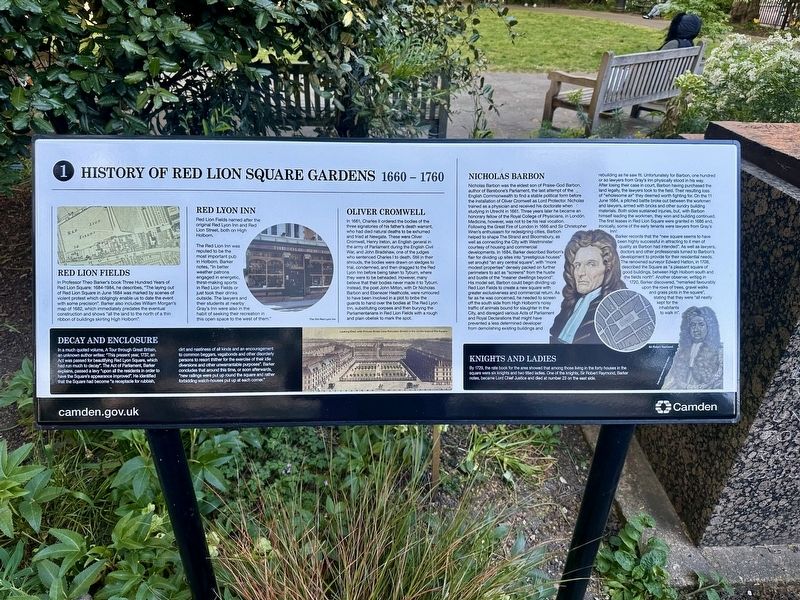
In Professor Theo Barker’s book Three Hundred Years of Red Lion Square: 1684-1984, he describes, "The laying out of Red Lion Square in June 1684 was marked by scenes of violent protest which obligingly enable us to date the event with some precision".
Barker also includes William Morgan's map of 1682, which immediately predates the eventual construction and shows "all the land to the north of a thin ribbon of buildings skirting High Holborn".
Red Lyon Inn
Red Lion Fields named after the original Red Lyon Inn and Red Lion Street, both on High Holborn.
The Red Lion Inn was reputed to be the most important pub in Holborn. Barker notes, "In better weather patrons engaged in energetic, thirst-making sports in Red Lion Fields or just took their drinks outside. The lawyers and their students at nearby Gray’s Inn were also in the habit of seeking their recreation in this open space to the west of them."
Oliver Cromwell
In 1661, Charles II ordered the bodies of the three signatories of his father's death warrant, who had died natural deaths to be exhumed and tried at Newgate. These were Oliver Cromwell,
this page online
Decay and Enclosure
In a much quoted volume, A Tour through Great Britain, an unknown author writes: "This present year, 1737, an Act was passed for beautifying Red Lyon Square, which had run much to decay". The Act of Parliament, Barker explains, passed a levy "upon all the residents in order to have the Square's appearance improved". He identified that the Square had become "a receptacle for rubbish, dirt and nastiness of
Photographed by Andrew Ruppenstein, April 24, 2026
2. History of Red Lion Square Gardens 1660-1760 Marker - wide view
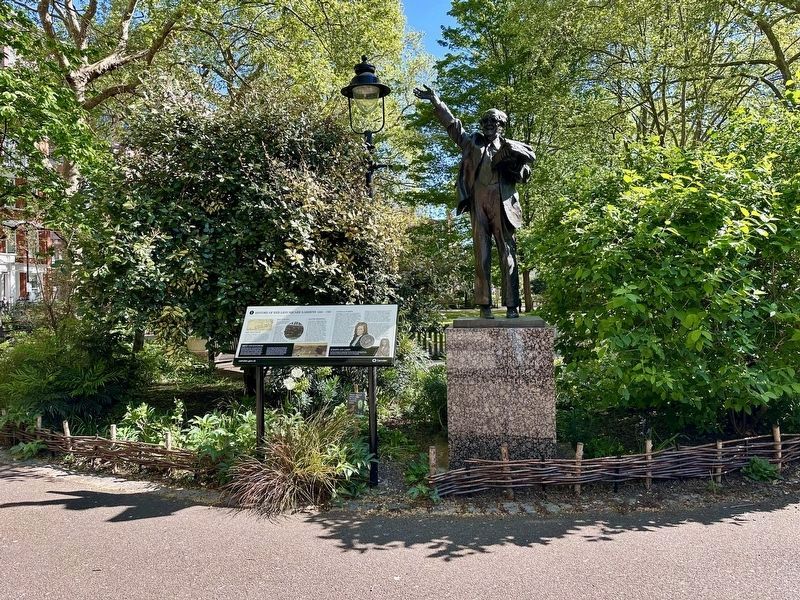
The marker is located directly next to the statue of Fenner (Lord) Brockway, visible as one enters the Gardens from Procter Street.
Nicholas Barbon
Nicholas Barbon was the eldest son of Praise-God Barbon, author of Barebone’s Parliament, the last attempt of the English Commonwealth to find a stable political form before the installation of Oliver Cromwell as Lord Protector. Nicholas trained as a physician and received his doctorate when studying in Utrecht in 1661. Three years later he became an honorary fellow of the Royal College of Physicians, in London. Medicine, however, was not to be his real vocation. Following the Great Fire of London in 1666 and Sir Christopher Wren's enthusiasm for redesigning cities, Barbon helped to shape The Strand and Bloomsbury, as well as connecting the City with Westminster courtesy of housing and commercial developments. In 1684, Barker described Barbon's flair for dividing up sites into "prestigious houses"set around "an airy central square", with "more modest properties" densely packed on further perimeters to act as "screens" from the hustle and bustle of the "meaner dwellings beyond". His model set, Barbon could begin dividing up Red Lion Fields to create a new square with greater exclusiveness and commercial return. As far as he was concerned, he needed to screen off the south side from High Holborn's noisy traffic of animals bound for slaughter in the City, and disregard various Acts of Parliament and Royal Declarations that might have prevented a less determined developer from demolishing existing buildings and rebuilding as he saw fit. Unfortunately for Barbon, one hundred or so lawyers from Gray's Inn physically stood in his way. After losing their case in court, Barbon having purchased the land legally, the lawyers took to the field. Their resulting loss of "wholesome air" they deemed worth fighting for. On the 11 June 1684, a pitched battle broke out between the workmen and lawyers, armed with bricks and other sundry building materials. Both sides sustained injuries, but, with Barbon. himself leading the workmen, they won and building continued. The first leases in Red Lion Square were granted in 1686 and, ironically, some of the early tenants were lawyers from Gray's Inn!
Barker records that the "new square seems to have been highly successful in attracting to it men of quality as Barbon had intended". As well as lawyers, doctors and other professionals turned to Barbon's development to provide for their residential needs. The renowned surveyor Edward Hatton, in 1708, described the Square as "a pleasant square of good buildings, between High Holborn south and the fields north". Another observer, writing in 1720, Barker discovered, "remarked favourably upon the rows of trees, gravel walks and grass plots in the square", stating that they were "all neatly kept for the inhabitants to walk in".
Knights and Ladies By 1729, the rate book for the area showed that among those living in the forty houses in the square were six knights and two titled ladies. One of the knights, Sir Robert Raymond, Barker notes, became Lord Chief Justice and died at number 23 on the east side.
Erected by Borough of Camden. (Marker Number 1.)
Topics. This historical marker is listed in these topic lists: Government & Politics • Parks & Recreational Areas • Settlements & Settlers. A significant historical month for this entry is June 1684.
Location. 51° 31.143′ N, 0° 7.164′ W. Marker is in Camden, England, in Greater London. It is in Holborn. It is on Red Lion Square near Red Lion Square. Touch for map. Marker is at or near this postal address: Procter Street, Camden, England WC1R 4SG, United Kingdom. Touch for directions.

Regionally, this marker is in London and in the Greater South East. Globally, it is on the Atlantic Ocean, in the North Atlantic Region, in Europe, in Atlantic Europe, on one of the British Isles, in the Western World, and in the Anglosphere. Historically, it finds itself in what was once the Roman Empire.
Other nearby markers. At least 8 other markers are within walking distance of this marker: History of Red Lion Square Gardens 1960 - Present (within shouting distance of this marker); History of Red Lion Square Gardens 1760-1860 (within shouting distance of this marker); John Harrison (within shouting distance of this marker); Fanny Wilkinson (within shouting distance of this marker); History of Red Lion Square Gardens 1860-1960 (within shouting distance of this marker); Rosetti, Morris, and Burne-Jones (about 90 meters away, measured in a direct line); William Richard Lethaby (about 90 meters away); Thomas Earnshaw (about 150 meters away). Touch for a list and map of all markers in Camden.
Credits. This page was last revised on August 12, 2026. It was originally submitted on August 11, 2026, by Andrew Ruppenstein of Lamorinda, California. This page has been viewed 15 times since then. Photos: 1, 2. submitted on August 11, 2026, by Andrew Ruppenstein of Lamorinda, California.
