Keyser in Mineral County, West Virginia — The American South (Appalachia)
Key Terrain
December 1944
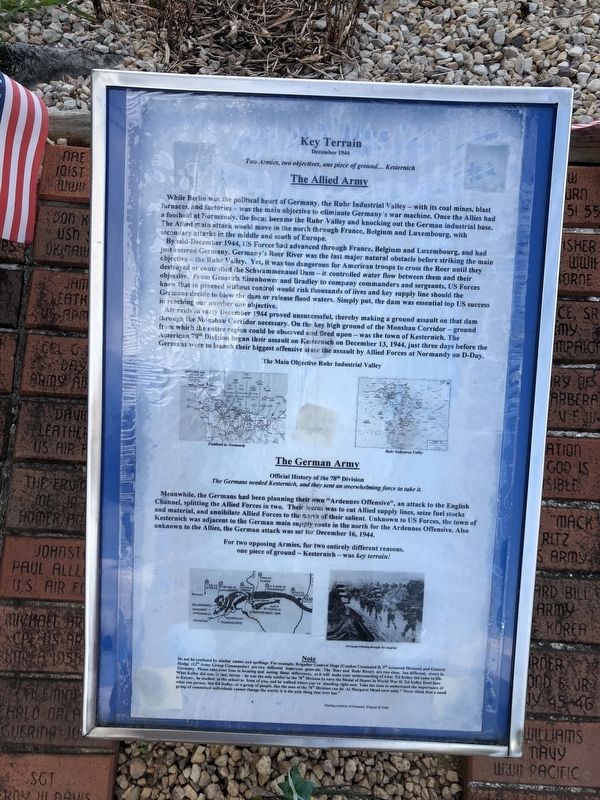
Two Armies, two objectives, one piece of ground... Kesternich
this page online
Air raids in early December 1944 proved unsuccessful, thereby making a ground assault on that dam through the Monshau Corridor necessary. On the key high ground of the Monshau Corridor — ground from which the entire region could be observed and fired upon — was the town of Kesternich. The American 78th Division began their assault on Kesternich on December 13, 1944, just three days before the Germans were to launch their biggest offensive since the assault by Allied Forces at Normandy on D-Day.
Official History of the 78th Division
The Germans needed Kesternich, and they sent an overwhelming force to take it.
Meanwhile, the Germans had been planning their own "Ardenne Offensive", an attack to the English Channel, splitting the Allied Forces in two. Their intent was to cut Allied supply lines, seize fuel stocks and material, and annihilate Allied Forces to the north of their salient. Unknown to US Forces, the town of Kesternich was adjacent to the German main supply route
July 12, 2020
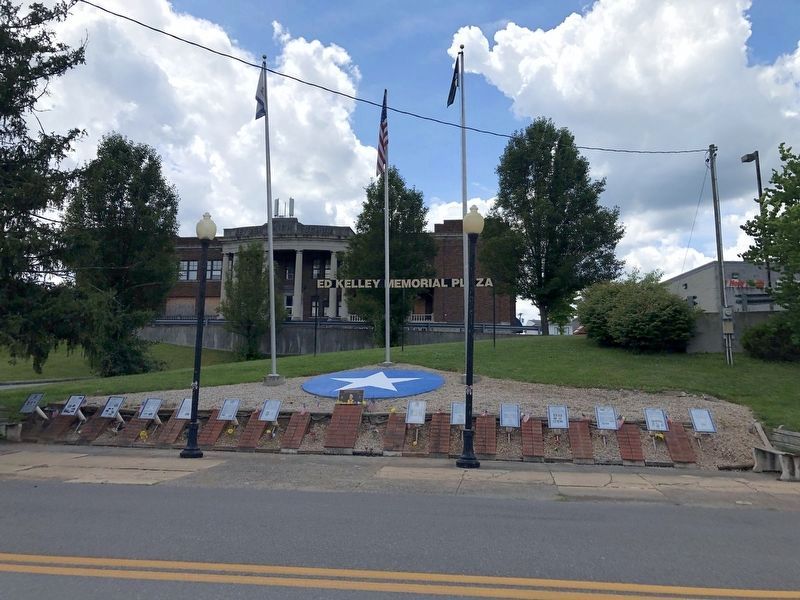
2. Ed Kelley Memorial Plaza
For two opposing Armies, for two entirely different reasons. one piece of ground — Kesternich — was key terrain!
Note Do not be confused by similar names and spellings. For example, Brigadier General Hoge (Combat Command B, 9th Armored Division) and General Hodge (12th Army Group Commander) are two different American generals. The Roer and Ruhr Rivers are two close, but different, rivers in Germany. Please take your time in locating and noting these differences, as it will make your understanding of what Ed Kelley did come to life. What Kelley did was, in fact, heroic — he was the only soldier in the 78th Division to earn the Medal of Honor in World War II. Ed Kelley lived here in Keyser, he studied in the school in front of you, and he walked where you're standing right now. Take the time to understand the importance of what one person, like Ed Kelley, or a group of people, like the men of the 78th Division can do. As Margaret Mead once said, "Never think that a small group of committed individuals cannot change the world; it is the only thing that ever has."
Topics and series.
Photographed by Craig Doda, August 1, 2026
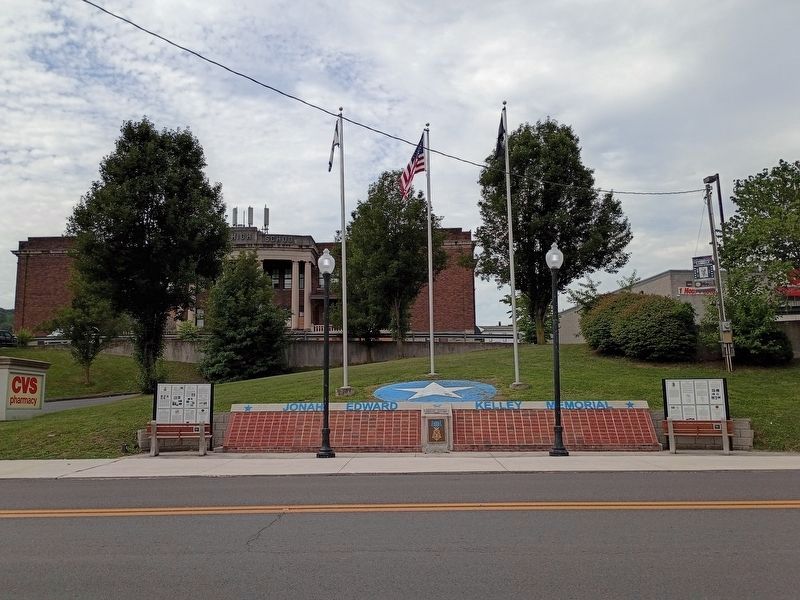
3. Key Terrain Marker Site
Location. This marker has been replaced by another marker nearby. It was located near 39° 26.382′ N, 78° 58.615′ W. Marker was in Keyser, West Virginia, in Mineral County. It was on West Piedmont Street (West Virginia Route 46) just west of North Davis Street, on the left when traveling west. Touch for map. Marker was at or near this postal address: 32 N Davis St, Keyser WV 26726, United States of America. Touch for directions.

Regionally, this marker was in the Eastern Panhandle. It was also in the American South, specifically in the Upper South, in Appalachia, and specifically in Northern Appalachia. Globally, it was in North America, the Western Hemisphere, the Western World, and the Anglosphere. Historically, it found itself in what was once the territory of the Mississippian Culture.
Other nearby markers. At least 3 other markers are within walking distance of this location: Jonah Edward Kelley (here, next to this marker); The Ed Kelley Memorial Plaza (here, next to this marker); a different marker also named The Medal of Honor (a few steps from this marker). Touch for a list and map of all markers in Keyser.
Other markers no longer nearby. The First Battle of Kesternich (was here, next to this marker but has been replaced with another marker now near it); The Battle of the Bulge (was here, next to this marker but has been replaced with another marker now near it); D-Day (was here, next to this marker but has been replaced with another marker now near it); World War II (was here, next to this marker but has been replaced with another marker now near it); Regaining the Initiative (was here, next to this marker but has been replaced with another marker now near it); Kelley Memorial Plaza (was here, next to this marker but has been replaced with another marker now near it); The Medal of Honor (was here, next to this marker but has been replaced with another marker now near it); The Battle for Kesternich (was here, next to this marker but has been replaced with another marker now near it); The Aftermath of Kesternich / Germans Retreat (was here, next to this marker but has been replaced with another marker now near it); The Bridge at Remagen (was a few steps from this marker but has been replaced with another marker now near it); a different marker also named The Bridge at Remagen (was a few steps from this marker but has been replaced with another marker now near it); a different marker also named The Bridge at Remagen (was a few steps from this marker but has been replaced with another marker now near it); Encircling the Nazi War Machine & German Capitulation (was a few steps from this marker but has been replaced with another marker now near it).
Credits. This page was last revised on August 12, 2026. It was originally submitted on July 14, 2020, by Devry Becker Jones of Washington, District of Columbia. This page has been viewed 310 times since then and 29 times this year. Last updated on August 12, 2026, by Craig Doda of Napoleon, Ohio. Photos: 1. submitted on July 14, 2020, by Devry Becker Jones of Washington, District of Columbia. 2. submitted on July 14, 2020. 3. submitted on August 12, 2026, by Craig Doda of Napoleon, Ohio.
