Holborn in Camden in Greater London, England, United Kingdom — Northwestern Europe (the British Isles)
History of Red Lion Square Gardens 1760-1860

Photographed by Andrew Ruppenstein, April 24, 2026
1. History of Red Lion Square Gardens 1760-1860 Marker
Shelley’s Grandfather
As the 18th century continued, Professor Theo Barker remarks that the Square "grew less fashionable" with some of the upper echelons of society moving away. For example, Sir Bysshe Shelley eventually moved away, and even built Castle Goring in Sussex, after living in the Square in 1753, where his wife gave birth to their son Timothy. (Timothy became the father of the poet Percy Bysshe Shelley). The Square, it seemed, was becoming rather dour with the obelisk, iron fence and watch houses giving a "gloomy look" and, according to Barker, a visitor in 1771 compared the latter to "four family vaults and the obelisk to 'the sad monument of a disconsolate widow for the loss of her first husband".
Cromwell’s Memorial?
At some point, a Latin inscription was added meaning "A foolish monument to a more foolish deception. Why are you looking at me, traveller? Go away." This suggests that the secret of the obelisk had been leaked, and royalists had attempted to write over this legend of Republicanism However, in August 1790, the Gentleman's Magazine reported that the "monument" had been recently removed
this page online
Sutton Nicholls, draughtsman and engraver, represented many of the squares in London for various surveys, such as John Bowles Prospects of the Most Noted Buildings in and about London (1724), London Described (1731) and the 1754 sixth edition of John Stow's Survey of London. Red Lion Square is typical of Nicholls' bird's eye panoramic style and shows the watch houses but not the elusive obelisk. Hampstead, Highgate and Islington are shown on the horizon further north.
A different perspective, by Richard Horwood, drawn up between 1792 and 1799 in his monumental survey of the whole of built-up London, offers no clarification as to the details of the Square's accoutrements, but it does identify a plan of the buildings surrounding the Square, complete with respective numbers.
Historian
Around the time of his marriage, in 1795, the historian Sharon Turner moved to No. 32 Red Lion Square and researched extensively at the British Museum to write his History of the Anglo-Saxons in four volumes.
James Cook’s Marine Chronometer
On
Photographed by Andrew Ruppenstein, April 24, 2026
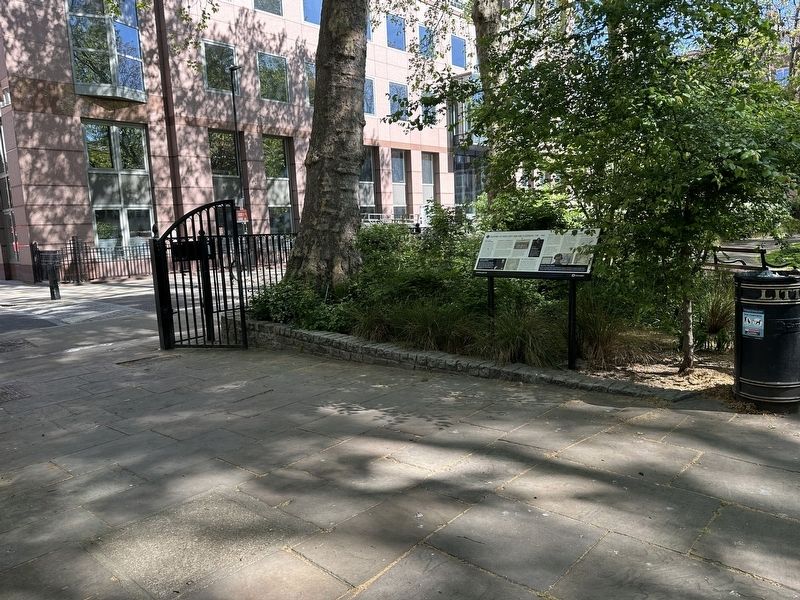
2. History of Red Lion Square Gardens 1760-1860 Marker - wide view
This is one of four different markers presenting the history of Red Lion Square Gardens and the immediate vicinity, with each placed at the each of the four entrance gates. This one is located at the north entrance.
The First Umbrella
At No. 23 Red Lion Square, midway between Lamb's Conduit Passage and Princes Street (now named Princeton Street), Jonas Hanway, philanthropist and traveller, lived until his death in 1786 when he was given a public funeral, according to Edwin Beresford Chancellor's 1907 edition of The History of the Red Lion squares of London. The public funeral was due to his "amelioration of the lot of poor children" as opposed to the other recorded detail of his life, "his being the first man to habitually carry an umbrella in the streets of London." In the late 1930s Hanway House was built at 27-31 Red Lion Square in his memory.
Dante Gabriel Rossetti and William Morris
Perhaps
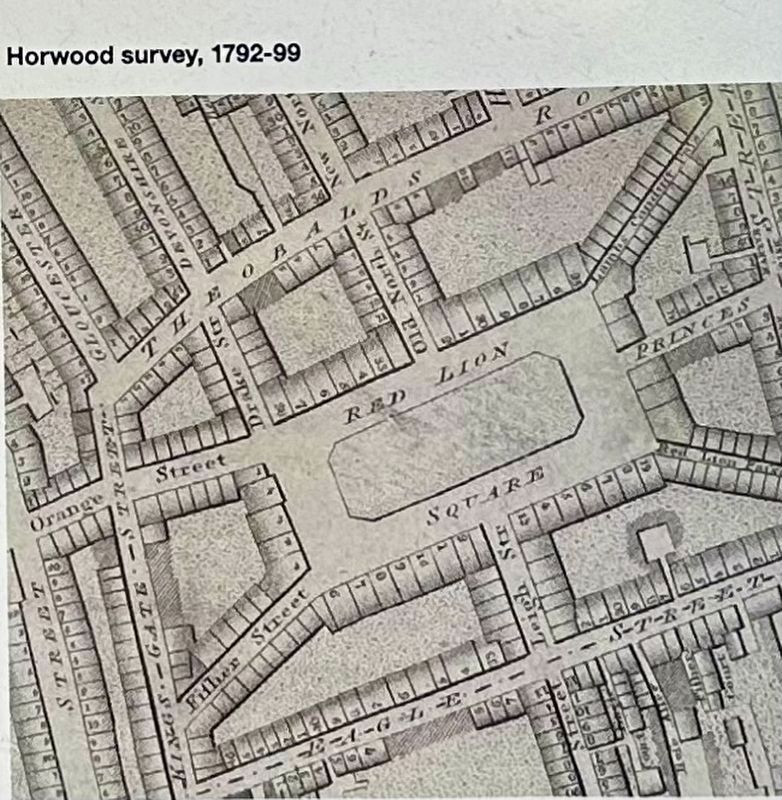
3. Marker illustration: showing the layout of Red Lion Square
In 1848, seven artists and critics formed the Pre-Raphaelite Brotherhood. On Dante Gabriel Rosetti's behalf, Thomas Woolner, the only sculptor of the Pre-Raphaelite Brothers, enquired about lodgings at No. 17 on the first floor. The three rooms were available at 20 shillings per week (roughly £70 today). There was a stipulation from the landlord, however, when he understood that artists were interested in his rooms, that the models were to be kept under "gentlemanly restraint" because in his opinion "some artists sacrifice the dignity of art to the baseness of passion". Stipulations considered, Rossetti and Deverell took up residency in 1851, and lived there for a brief spell of six months.
In 1856, Rossetti suggested to Edward Burne-Jones and William Morris, two of his fellow Mediaevalists and Arthurian Romanticists within the widening circle of the PRB, that they take his former lodgings at No. 17. For three years the two artists resided in Red Lion Square. During this time their maidservant, Mrs Mary Nicholson, became known as 'Red Lion Mary', and by all accounts put up with the bizarre and sometimes demanding behaviour of the two and their friends with great humour and loyalty.
In 1916, Max Beerbohm created a series of drawings and watercolours called Rossetti and His Friends and illustrated how he imagined William Morris, 'Topsy', and Edward, 'Ned', Burne-Jones amidst their own medieval themed designed furniture, in an otherwise sparsely decorated space. After leaving the Square in 1859, William Morris returned in 1861, to No. 8 Red. Lion Square, with some of the other Pre- Raphaelite Brotherhood members to establish the headquarters of what would eventually be known as Morris and Co, the hand crafted decorative arts movement.
After leaving the Square in 1859, William Morris returned in 1861, to No. 8 Red. Lion Square, with some of the other Pre- Raphaelite Brotherhood members to establish the headquarters of what would eventually be known as Morris and Co, the hand crafted decorative arts movement.
Helping the Needy
By 1822, No. 13 was the Headquarters of the Mendicity Society. According to the 1850 edition of the Hand-book of London: Past and Present, by Peter Cunningham, "The society gives meals and money, supplies mill and other work to applicants, investigates begging- letter cases, and apprehends vagrants and impostors. Each meal consists of ten ounces of bread, and one pint of good soup, or a quarter of a pound of cheese". Cunningham also records that "the affairs of the Society are administered by a Board of forty-eight managers".
(Marker Number 2.)
Topics. This historical marker is listed in these topic lists: Arts, Letters, Music • Charity & Public Work • Exploration • Parks & Recreational Areas. A significant historical month for this entry is August 1790.
Location. 51° 31.156′ N, 0° 7.133′ W. Marker is in Camden, England, in Greater London. It is in Holborn. It is on Red Lion Square near Old N Street, on the right when traveling east. The marker is located just inside the north entrance to the Gardens. Touch for map. Marker is at or near this postal address: 14 Red Lion Square, Camden, England WC1R 4QH, United Kingdom. Touch for directions.

Regionally, this marker is in London and in the Greater South East. Globally, it is on the Atlantic Ocean, in the North Atlantic Region, in Europe, in Atlantic Europe, on one of the British Isles, in the Western World, and in the Anglosphere. Historically, it finds itself in what was once the Roman Empire.
Other nearby markers. At least 8 other markers are within walking distance of this marker: Fanny Wilkinson (a few steps from this marker); History of Red Lion Square Gardens 1960 - Present (a few steps from this marker); History of Red Lion Square Gardens 1860-1960 (within shouting distance of this marker); John Harrison (within shouting distance of this marker); History of Red Lion Square Gardens 1660-1760 (within shouting distance of this marker); Rosetti, Morris, and Burne-Jones (within shouting distance of this marker); William Richard Lethaby (about 150 meters away, measured in a direct line); Bishop Richard Challoner (about 180 meters away). Touch for a list and map of all markers in Camden.
Credits. This page was last revised on August 13, 2026. It was originally submitted on August 12, 2026, by Andrew Ruppenstein of Lamorinda, California. This page has been viewed 19 times since then. Photos: 1, 2. submitted on August 12, 2026, by Andrew Ruppenstein of Lamorinda, California. 3. submitted on August 13, 2026, by Andrew Ruppenstein of Lamorinda, California.
