Dodge City in Ford County, Kansas — The American Midwest (Upper Plains)
Eisenhower Park Murals

Photographed by Cosmos Mariner, August 18, 2022
1. Eisenhower Park Murals Marker
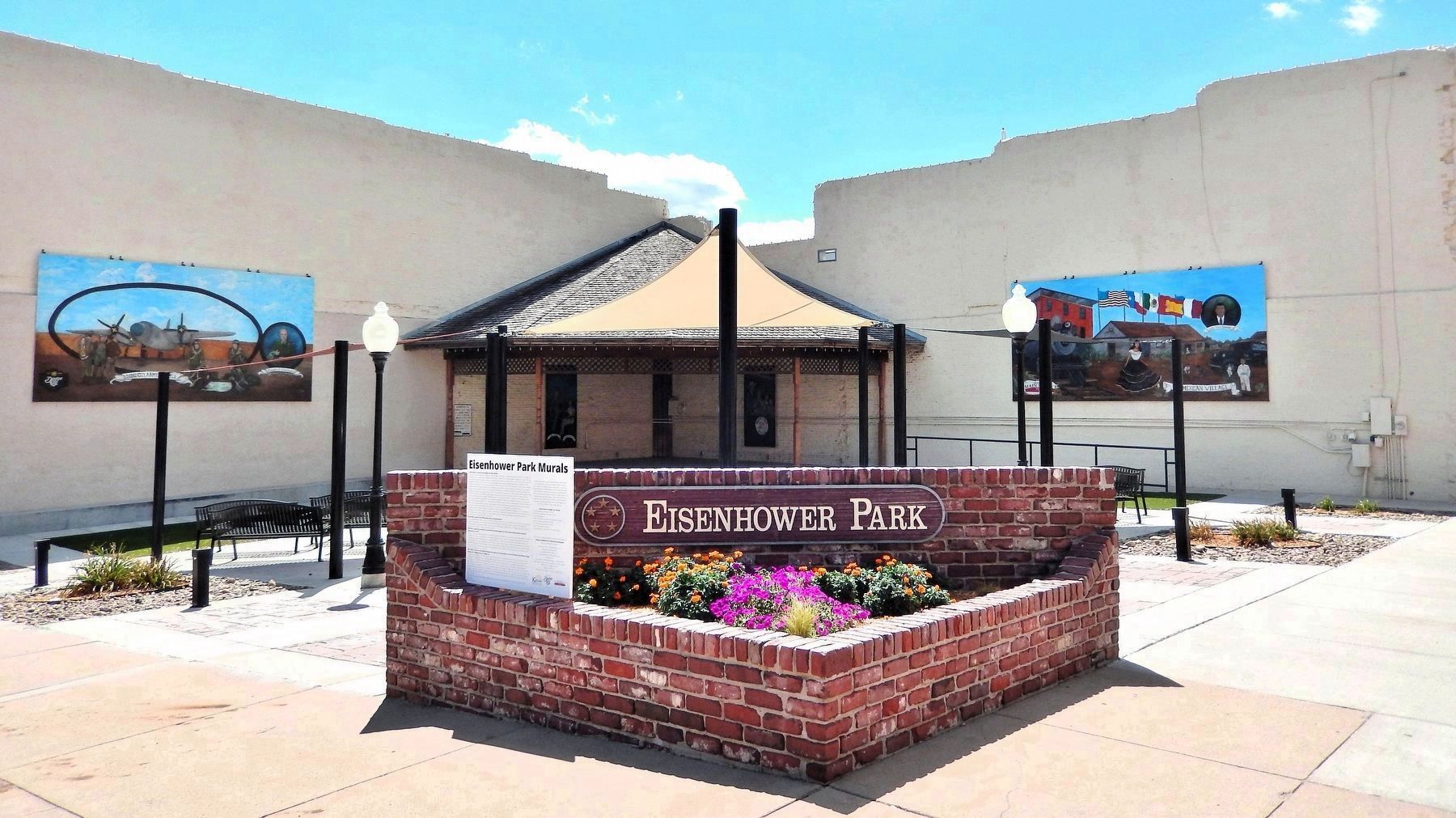
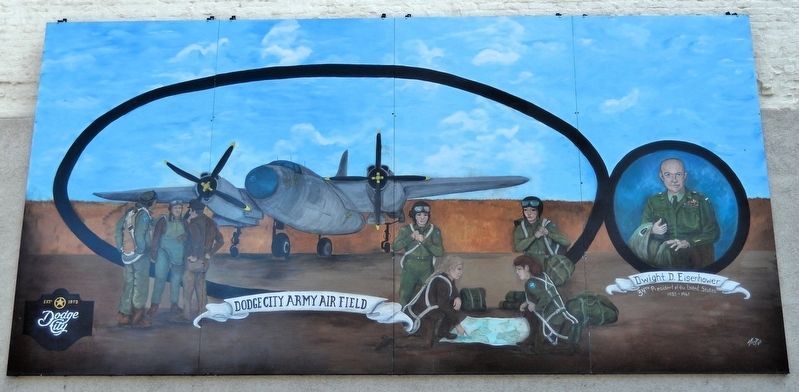
South Wall: A look into the Dodge City Army Airfield
After the outbreak of World War II and in early 1942, Dodge City Chamber of Commerce president and editor of the Dodge City Daily Globe, Jess C. Denious (Muncys father), lobbied the U.S. Government to locate an airfield in Dodge City as part of the Army Air Corps Pilot Training Program. He, along with Kansas' Lieutenant Governor, made numerous trips to Washington to meet with government officials. On June 10, 1942, the U.S. government announced plans to build an airfield west of Dodge City. They purchased 2,520 acres for $191,353, and construction started on August 5, 1942, and by December 31, 1942, construction was complete. Before the base was finished, the plans were to use the space for bomber training for the Royal Air Force. However, when the Army activated the airfield, it was designated to be Army Air Forces Advanced Flying School, and just days before its completion, the Army re-designated it to be “Army Air Forces Pilot School (Specialized 2-Engine), Dodge City Army Airfield (DCAA), Dodge City, Kansas.” The specialized 2-Engine bombers were also known as B-26
this page online
During World War II, Dwight D. Eisenhower served as Supreme Commander of the Allied Expeditionary Force in Europe, and achieved the five-star rank of General of the Army. He planned and supervised the invasion of North Africa in Operation Torch in 1942-1943 and the invasion of Normandy from the Western Front in 1944-1945. Eisenhower's role in WW2 serves as an interesting tie to a Dodge City’s history during WW2.
South Wall (under the awning): Betty Muncy and Jess Denious
Martha Elizabeth “Betty”
Photographed by Cosmos Mariner, August 18, 2022
2. Eisenhower Park Murals Marker and Eisenhower Park
The marker and Eisenhower Park are at the southwest corner of the Gunsmoke Street & 1st Avenue intersection. The murals are on the south and west walls in the background.
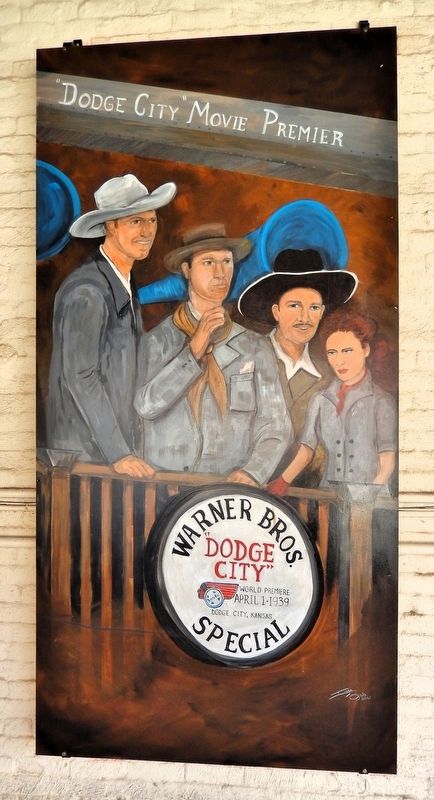
West Wall (under the awning): The cast from the movie Dodge City, the first-ever movie premier outside of Hollywood circa 1939
On April 1, 1939, Warner Brothers sent an entourage of over 200 cast members, crew, executives, and media people on a special 14-car train to Dodge City Kansas for the world premiere celebration of the movie “Dodge City.” The population of Dodge City (roughly 11,000) swelled five to ten times as 50,000-100,000 fans crowded the Santa Fe Depot and the streets of downtown Dodge City in hopes to catch a glimpse of the movie stars. A single theater in Dodge City was not large enough to accommodate the demand, so “Dodge City” was shown in three separate theaters. In addition to the premiere, the city also hosted a luncheon, a rodeo,
Photographed by Cosmos Mariner, August 18, 2022
3. Dodge City Army Airfield Mural
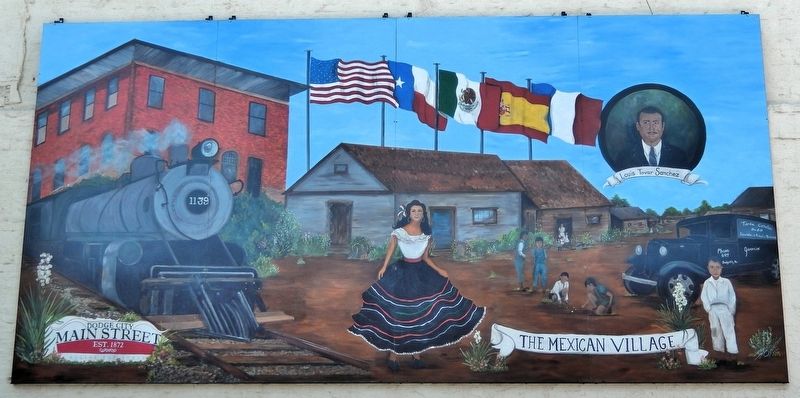
West Wall: A look into the Mexican Village and a portrait of Louis Sanchez, born and raised in the Mexican Village and the first Hispanic Mayor of Dodge City.
Five flags, those of Spain, France, Mexico, the Republic of Texas, and the United States, have flown over the area south of the river that remained Spanish territory, making Dodge City the territory of five flags. The area of Dodge City that lies north of the river and west of the 100th meridian was included in the Louisiana Purchase in 1803. From the beginning of the 20th century until 1955, a small ethnic community grew on the eastern outskirts of Dodge City. This tiny city within a city was called the “Mexican Village.” Depicted in this mural, you see a small look into the life inside the village, including a dancer showing off the culture and arts within the community, a portrait of Louis Sanchez — the first Hispanic mayor of Dodge City born and raised in the village, a portrait of Mr. Ceballos — a young entrepreneur that

Photographed by Cosmos Mariner, August 18, 2022
4. Betty Muncy & Jess Denious Mural
As a result of our rich history of diversity, Dodge City continues to remain a melting pot of cultures as a minority-majority community.
Artist — Inga Ojala
Annually, thousands of travelers relive the story of the Wild West by visiting the many attractions and events Dodge City has to offer. Dodge City's leadership has positioned the community to become the entertainment destination of Southwest Kansas, with Boot Hill Museum, Boot Hill Casino & Resort, United Wireless Arena, Boot Hill Casino & Resort Conference Center, Dodge City Raceway Park, Long Branch Lagoon Water Park, and Western State Bank Expo Center. With the addition of Boot Hill Distillery and Dodge City Brewing in historic downtown, Dodge City has even more to offer to visitors and locals alike.
Quick Facts on Dodge City, Kansas:
• 2020 population estimate of 27,788
• 61% of the population is Hispanic/Latino
• 31.5% Foreign Born
• 68% of residents are high school graduates or higher
• $46,770 Median Household income
• 1,477 jobs are supported by tourism
• $133 million spent on tourism
• Visitor spending ranked 8th in the State of Kansas
Erected by Kansas Department of Commerce, City of Dodge City, Dodge City Main Street.
Topics and series. This historical marker is listed in these topic lists: Air & Space • Charity & Public Work • Hispanic Americans • War, World II. In addition, it is included in the Former U.S. Presidents: #34 Dwight D. Eisenhower series list.
Location. 37° 45.205′ N, 100° 1.091′ W. Marker is in Dodge City, Kansas, in Ford County. It is at the intersection of 1st Avenue
Photographed by Cosmos Mariner, August 18, 2022
5. Dodge City Movie Premier Mural

Regionally, this marker is in the American Midwest, in the Corn Belt, on the prairies, on the Great Plains, on the Southern Plains, on the High Plains, and on the Santa Fe Trail Corridor. Globally, it is in North America, the Western Hemisphere, the Western World, and the Anglosphere. Historically, it finds itself in what was once the Comanchería, the Dust Bowl, the Louisiana Purchase, and the Republic of Texas.
Other nearby markers. At least 8 other markers are within walking distance of this marker: Buck Taylor (here, next to this marker); Roger Ewing (a few steps from this marker); First Public School of the Western Frontier (a few steps from this marker); “Chalk” Beeson (a few steps from this marker); Amanda Blake (within shouting distance of this marker); "Big Nose Kate" (within shouting distance of this marker); Dodge Theater Building (within shouting distance of this marker); Bruce Boxleitner (within shouting distance of this marker). Touch for a list and map of all markers in Dodge City.
Also see . . . Dodge City Army Air Field (Wikipedia).
Excerpt: Dodge City Army Airfield, also known as Ford County Airport and Dodge City Municipal Airport, is an abandoned airfield located in Ford County, Kansas, 6 miles northwest of Dodge City. The principal construction of the facility consisted of building a cantonment, airdrome, roads, and facilities. The arrangement was standard rectangular, with building exteriors consisting of wood sheeting covered with 15-pound felt and asbestos-siding shingles.(Submitted on August 12, 2026, by Cosmos Mariner of Cape Canaveral, Florida.)Housing was prepared for close to 4,000 men, while the hospital had a capacity of 177 beds. Warehousing was built to provide 71,186 square feet of space, and the airdrome could accommodate 165 aircraft. Four runways (150 feet wide and 6,500 feet in length) were constructed, while six 75-foot taxiways connected the parking apron (600 x 5,300 feet) with the runway system. Work on the main construction project, begun on 5 August 1942, was completed by 31 December. Three or four days prior to completion of the main project, work was begun on the second most important project (principally concerned with completion of the runway system), which was finished by 31 March 1943. In addition to the main base and airfield, there are at least four auxiliary fields that were also constructed for emergency and training use in the area along with the use of Dodge City Municipal Airport.Photographed by Cosmos Mariner, August 18, 20226. Mexican Village MuralThere is little left of the World War II Dodge City Army Airfield. The unused facility slowly deteriorated over the years, and in the early 1990s, the concrete runways and taxiways were progressively removed for farming. Agricultural fields have largely replaced the
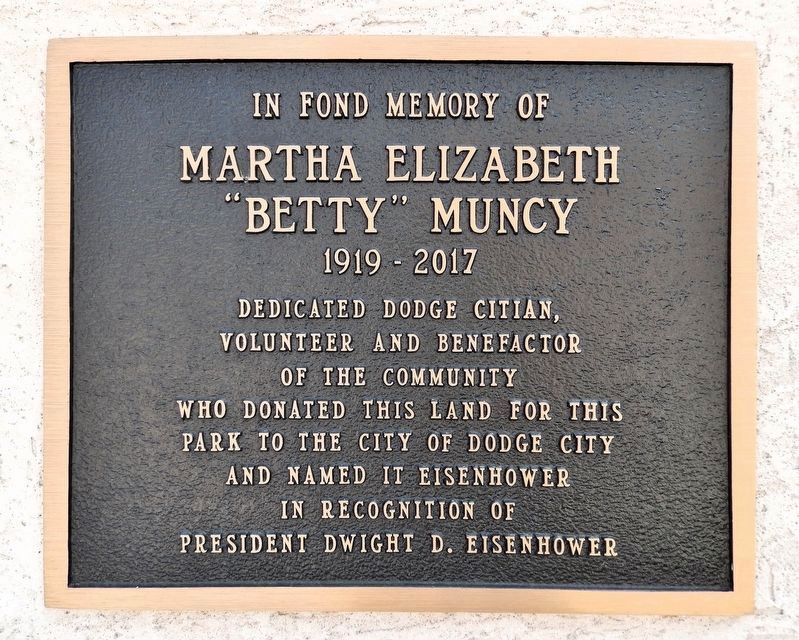
airfield. The administrative/technical site is gated by the present owner and is on private property, not accessible to the general public.Photographed by Cosmos Mariner, August 18, 20227. “Betty” Muncy Memorial PlaqueIn fond memory of Dedicated Dodge Citian, volunteer and benefactor of the community who donated this land for this park to the city of Dodge City and named it Eisenhower in recognition of President Dwight D. Eisenhower
Martha Elizabeth “Betty” Muncy
1919-2017
Credits. This page was last revised on August 12, 2026. It was originally submitted on August 12, 2026, by Cosmos Mariner of Cape Canaveral, Florida. This page has been viewed 15 times since then. Photos: 1, 2, 3, 4, 5, 6, 7. submitted on August 12, 2026, by Cosmos Mariner of Cape Canaveral, Florida.
