Cherry in Bureau County, Illinois — The American Midwest (Great Lakes)
Cherry Mine Disaster
Photographed by Cldisme, October 8, 2010
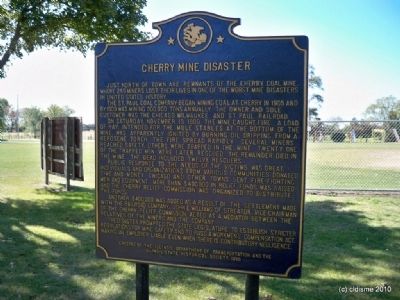
1. Cherry Mine Disaster Marker
Just north of town are remnants of the Cherry Coal Mine, where 259 miners lost their lives in one of the worst mine disasters in United States history.
The St. Paul Coal Company began mining coal at Cherry in 1905 and by 1909 was mining 300,000 tons annually. The owner and sole customer was the Chicago, Milwaukee, and St. Paul Railroad.
On Saturday, November 13, 1909, the mine caught fire. A load of hay, intended for the mule stables at the bottom of the mine, was apparently ignited by burning oil dripping from a kerosene torch. The fire spread rapidly. Several miners reached safety; others were trapped in the mine. Twenty-one of the trapped men were later rescued. The remainder died in the mine. The dead included twelve rescuers.
Public response to the needs of the victims was great. Individuals and organizations from various communities donated time and money. Chicago and other towns sent fire-fighting men and equipment. More than $400,000 in relief funds was raised, and the Cherry Relief Commission was organized to distribute the funds.
Another $400,000 was added as a result of the settlement made with
this page online
The disaster prompted the state legislature to establish stricter regulations for mine safety and to pass a Workmen's Compensation Act, making an employer liable even when there is contributory negligence.
Erected 1986 by Illinois Department of Transportation and The Illinois State Historical Society.
Topics and series. This historical marker is listed in these topic lists: Disasters • Industry & Commerce • Labor Unions • Railroads & Streetcars. In addition, it is included in the Illinois State Historical Society series list. A significant historical date for this entry is November 13, 1942.
Location. 41° 25.778′ N, 89° 12.802′ W. Marker is in Cherry, Illinois, in Bureau County. It is on Main Street (State Highway 89), on the right when traveling south. Marker is located at the Cherry Village Park. Touch for map. Marker is in this post office area: Arlington IL 61312, United States of America. Touch for directions.

Regionally, this marker is in Northern Illinois
Photographed by Cldisme, October 8, 2010
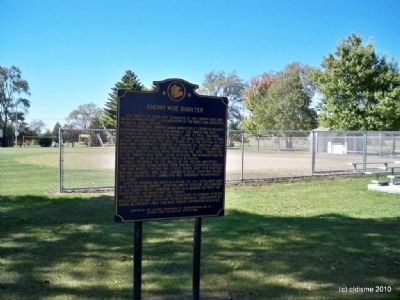
2. Cherry Mine Disaster Marker
Other nearby markers. At least 8 other markers are within 8 miles of this marker, measured as the crow flies: We of Cherry Honor Our Service Personnel (here, next to this marker); Cherry Miner's Memorial / Afterward-at-Cherry (approx. 0.2 miles away); U.M.W. Cherry Mine Disaster Memorial (approx. half a mile away); Isam W. Seaton (1823-1903) and James H. Seaton (1828-1913) (approx. 5.6 miles away); John Mitchell (approx. 7.1 miles away); James Butler "Wild Bill" Hickok (approx. 7.2 miles away); Vietnam Monument (approx. 7.2 miles away); Korea Monument (approx. 7.2 miles away). Touch for a list and map of all markers in Cherry.
More about this marker. The original Cherry Mine Disaster marker was erected on May 15th, 1971.
Also see . . .
1. 1909 Newspaper Articles Reporting the Mine Disaster.
Photographed by Matthew Stevens, September 6, 2026
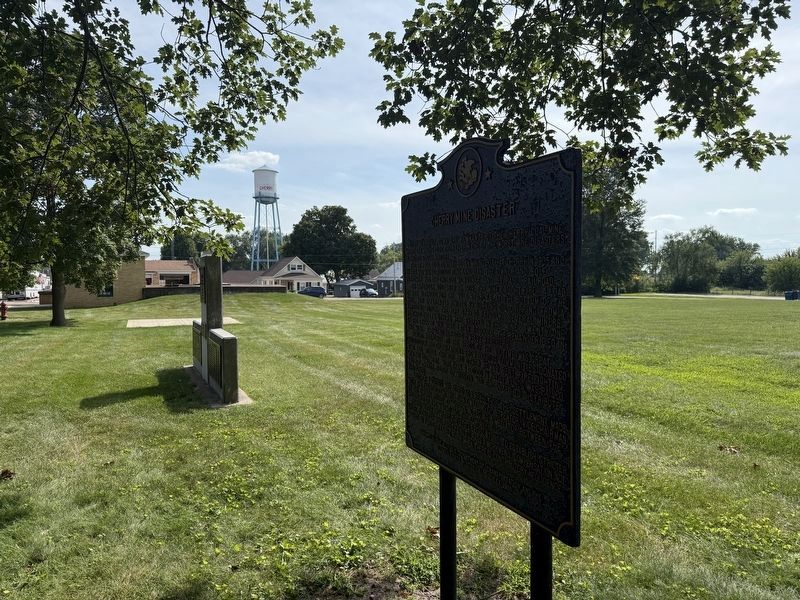
3. Cherry Mine Disaster Marker & Veterans Memorial
2. Report on the Cherry Mine Disaster 1910. See this original report from the State of Illinois Bureau of Labor Statistics about the Cherry Mine Disaster.
Excerpt: "The appalling loss of human life caused by the fire in the coal mine at Cherry, 111., calls for something more than a mere recital of the number and names of those who perished. Experience prepares us to expect death at any moment in the mines. Its dangers are so obvious, and seemingly inevitable, that the results in dead and disabled, can be figured almost with mathematical precision. [...] Here at least is one sphere where the rules of immunity have no application. The record shows that with every so many tons of coal, there is lifted to the sunlight the bruised or lifeless bodies of men."(Submitted on September 8, 2026, by Matthew Stevens of Washington, Illinois.)
3. JSTOR - Tragedy in November: The Cherry Mine Disaster.
Photographed by Matthew Stevens, September 6, 2026
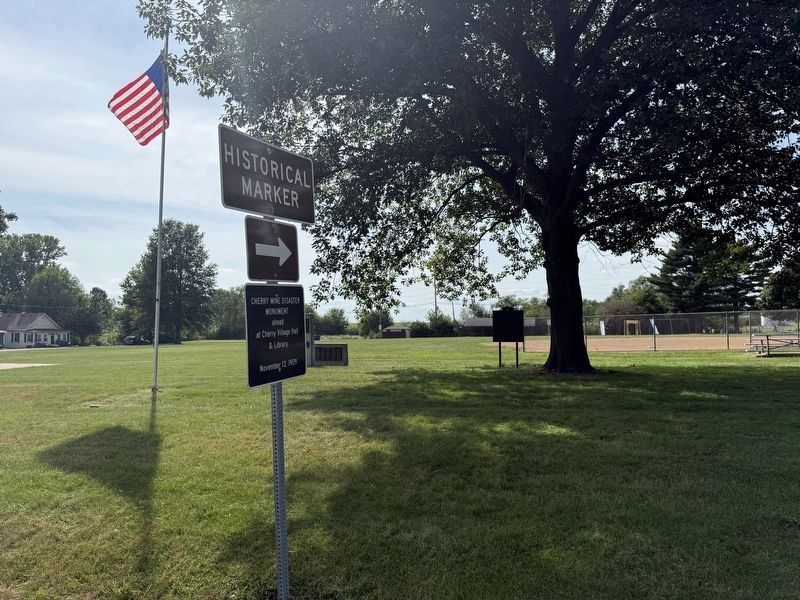
4. Cherry Mine Disaster Marker & Road Sign
Cherry Mine Disaster Monument ahead at Cherry Village Hall & Library
November 13, 1909
Excerpt: "The Village of Cherry lies in eastern Bureau County approximately one hundred miles southwest of Chicago. When mining experts arrived in 1905 to sink a shaft into prairie,¹ they had no inkling that four years later the mine would be the site of one of the worst disasters in United States mining history. As a result of a fire on November 13, 1909, some 259 miners lost their lives."(Submitted on September 8, 2026, by Matthew Stevens of Washington, Illinois.)
4. UIUC Significant Illinois Fires: Cherry Mine Disaster. See this webpage from the University of Illinois that features a short summary by Adam Groves and several different resources to learn more about the Cherry Mine Disaster.
Excerpt: "In 1905, the St. Paul Mine Company began mining coal in Cherry, Illinois. Believed to be the largest coal shaft in the United States, the Cherry Mine produced over 1,500 tons of coal a day for its first few years. In addition to being profitable, the mine was also considered to be among(Submitted on September 8, 2026, by Matthew Stevens of Washington, Illinois.)the most safe and modern mines, in terms of construction and equipment, operating in the country. To demonstrate their prestige, the St. Paul Mine Company outfitted the entire mine with electric lights and even declared it fireproof."Photographed by Matthew Stevens, September 6, 20265. Cherry Mine Disaster Marker & Anniversary Sign
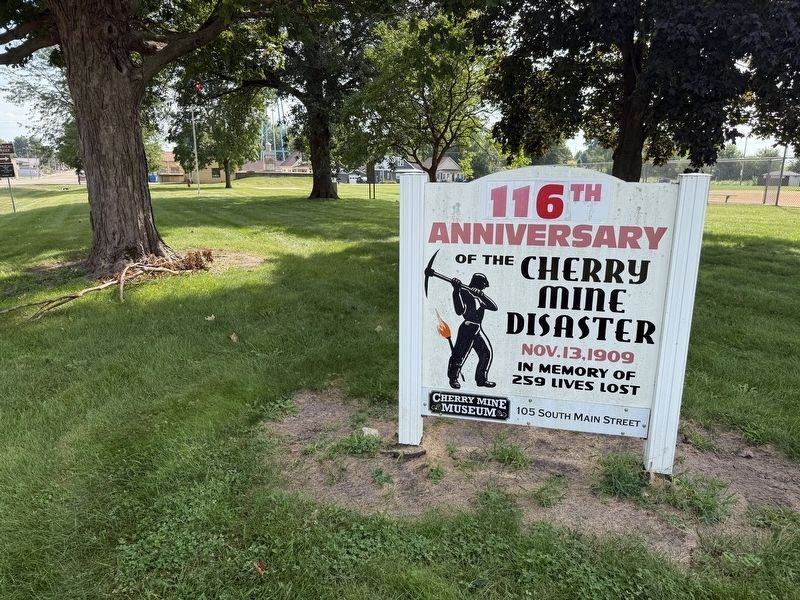
Credits. This page was last revised on September 15, 2026. It was originally submitted on October 9, 2010, by Cldisme of Joliet, Illinois. This page has been viewed 3,877 times since then and 233 times this year. Last updated on August 13, 2026, by Matthew Stevens of Washington, Illinois. Photos: 1, 2. submitted on October 9, 2010, by Cldisme of Joliet, Illinois. 3, 4, 5. submitted on September 7, 2026, by Matthew Stevens of Washington, Illinois. • Devry Becker Jones was the editor who published this page.
