Canton in Norfolk County, Massachusetts — The American Northeast (New England)
Ponkapoag
| — | Paul Revere Heritage Site | — |
Photographed by G.W.Bartlett, August 14, 2026
1. Ponkapoag Marker
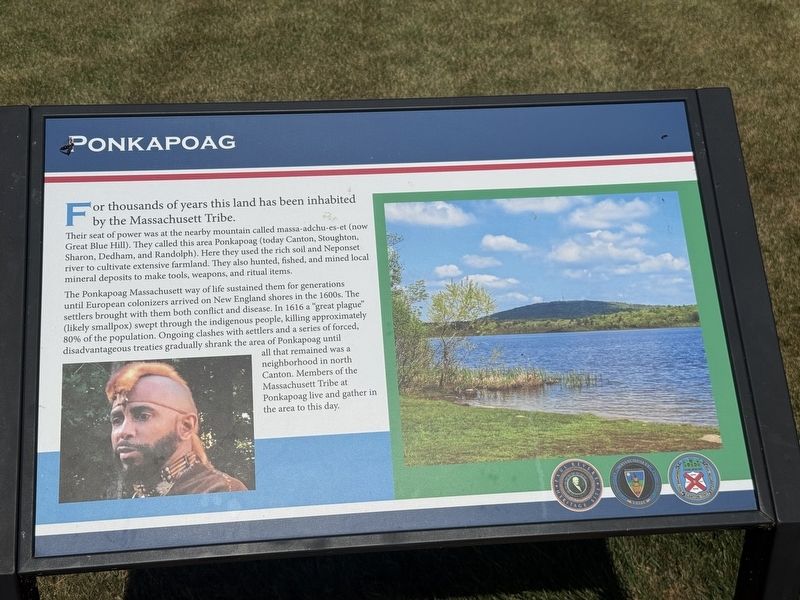
For thousands of years this land has been inhabited inhabited by the Massachusett Tribe.
Their seat of power was at the nearby mountain called massa-adchu-es-et (now Great Blue Hill). They called this area Ponkapoag (today Canton, Stoughton. Sharon, Dedham, and Randolph). Here they used the rich soil and Neponset river to cultivate extensive farmland. They also hunted, fished, and mined local mineral deposits to make tools, weapons, and ritual items.
The Ponkapoag Massachusett way of life sustained them for generations until European colonizers arrived on New England shores in the 1600s. The settlers brought with them both conflict and disease. In 1616 a "great plague" (likely smallpox) swept through the indigenous people, killing approximately 80% of the population. Ongoing clashes with settlers and a series of forced, disadvantageous treaties gradually shrank the area of Ponkapoag until all that remained was a neighborhood in north Canton. Members of the Massachusett Tribe at Ponkapoag live and gather in the area to this day.
Erected 2025 by Paul Revere Heritage Site.
Topics. This
this page online
Location. 42° 9.314′ N, 71° 8.964′ W. Marker is in Canton, Massachusetts, in Norfolk County. It can be reached from Revere Street, on the left when traveling north. Touch for map. Marker is in this post office area: Canton MA 02021, United States of America. Touch for directions.

Regionally, this marker is in Greater Boston. It is also in the American Northeast, in New England, and on the Eastern Seaboard. Globally, it is in the North Atlantic Region, North America, the Western Hemisphere, the Western World, and the Anglosphere. Historically, it finds itself in what was once one of the original Thirteen Colonies.
Other nearby markers. At least 8 other markers are within walking distance of this marker: Rubber Plant Worker (a few steps from this marker); Massachusett Tribe Member at Ponkapoag (within shouting distance of this marker); The Power’s in the Water (within shouting distance of this marker); Harnessing Nature (within shouting distance of this marker); Honest Miller’s House (within shouting
Photographed by G.W.Bartlett, August 14, 2026
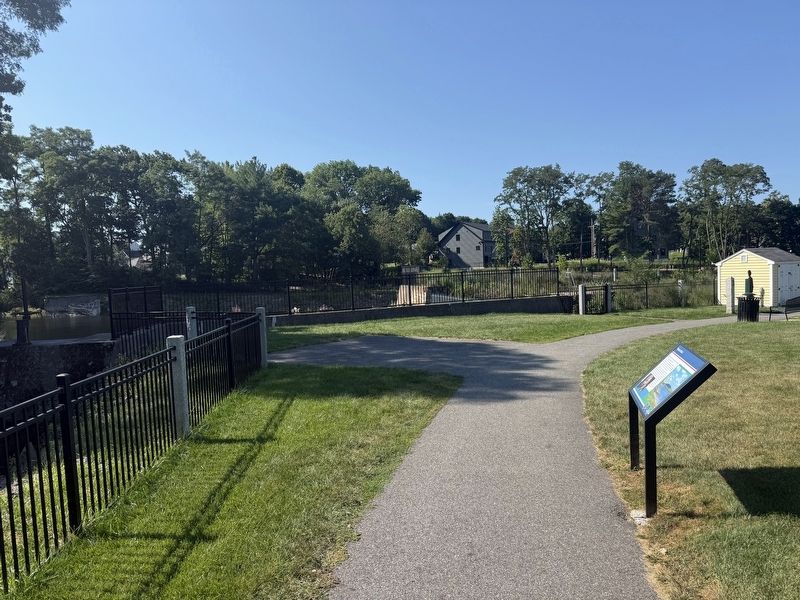
2. Ponkapoag Marker (wide)
Related markers. Click here for a list of markers that are related to this marker. Some additional markers about Ponkapoag and the Massachusett Indians
Also see . . .
1. Ponkapoag - Wikipedia.
Ponkapoag, is the name of a Native American "praying town" settled in the late 17th century western Blue Hills area of eastern Massachusetts by persons who had accepted Christianity. It was established in 1657, during the colonization of the Atlantic seaboard of the United States by settlers from Britain. This was the name given to the winter residence (and subsequently to the tribe) of the group of Massachusett who lived at the mouth of the Neponset River near Dorchester in the summer, in what colonists called Neponset Mill.(Submitted on August 16, 2026, by G.W.Bartlett of Hingham, Massachusetts.)
2. The Massachusett Tribe at Ponkapoag.
The Massachusett tribe are the descendants of the original people that the English Invaders first encountered in what is now the Commonwealth of Massachusetts. We against all odds have survived as the descendants of the first people of Massachusetts. We continue to survive as Massachusett people because we have retained the oral tradition of storytelling just as our ancestors did.(Submitted on August 16, 2026, by G.W.Bartlett of Hingham, Massachusetts.)
Credits. This page was last revised on August 19, 2026. It was originally submitted on August 14, 2026, by G.W.Bartlett of Hingham, Massachusetts. This page has been viewed 21 times since then. Photos: 1, 2. submitted on August 14, 2026, by G.W.Bartlett of Hingham, Massachusetts. • Andrew Ruppenstein was the editor who published this page.
