Douglas in Chicago in Cook County, Illinois — The American Midwest (Great Lakes)
Monument to the Great Northern Migration
Alison Saar, Sculptor
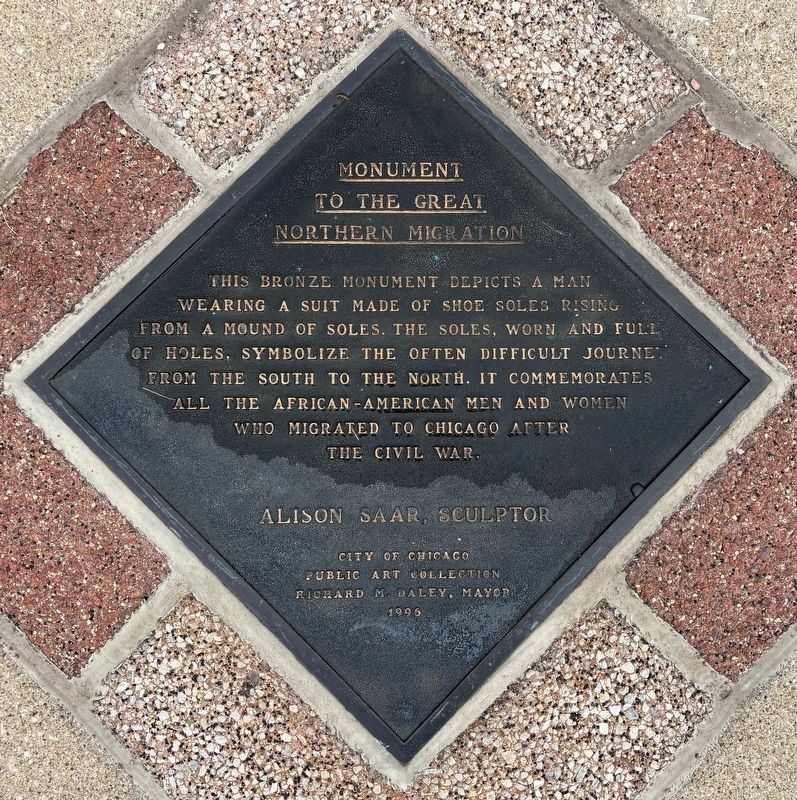
Photographed by Sean P. Flynn, August 14, 2026
1. Monument to the Great Northern Migration Marker
Erected 1996 by City of Chicago.
Topics. This historical marker is listed in these topic lists: African Americans • Arts, Letters, Music • Settlements & Settlers • War, US Civil.
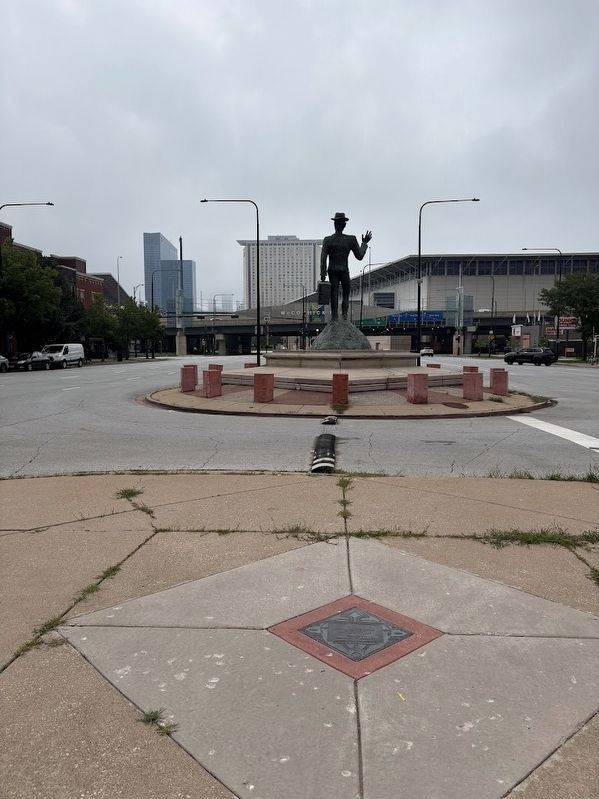
Location. 41° 50.822′ N, 87° 37.051′ W. Marker is in Chicago, Illinois, in Cook County. It is in Douglas. It is at the intersection of South Doctor Martin Luther King Junior Drive and Eastgate Place, in the median on South Doctor Martin Luther King Junior Drive. The marker is embedded into the sidewalk in the median of King Drive, just north of the sculpture itself. Touch for map. Marker is in this post office area: Chicago IL 60616, United States of America. Touch for directions.

Regionally, this marker is on Chicago’s South Side and in Chicago’s Bronzeville. It is also in
this page online
Other nearby markers. At least 8 other markers are within walking distance of this marker: Marjorie Stewart Joyner (within shouting distance of this marker); Bessie Coleman (within shouting distance of this marker); Carter G. Woodson (within shouting distance of this marker); Dr. Daniel Hale-Williams (within shouting distance of this marker); St. Claire Drake / Horace R. Clayton (within shouting distance of this marker); Nat “King” Cole (within shouting distance of this marker); John H. Johnson (about 300 feet away, measured in a direct line); McCormick Place (about 300 feet away). Touch for a list and map of all markers in Chicago.
More about this marker. The diamond-shaped styling of the marker matches that used by the Bronzeville Walk of Fame, a series of sidewalk-embedded memorials that were erected on King Drive in honor
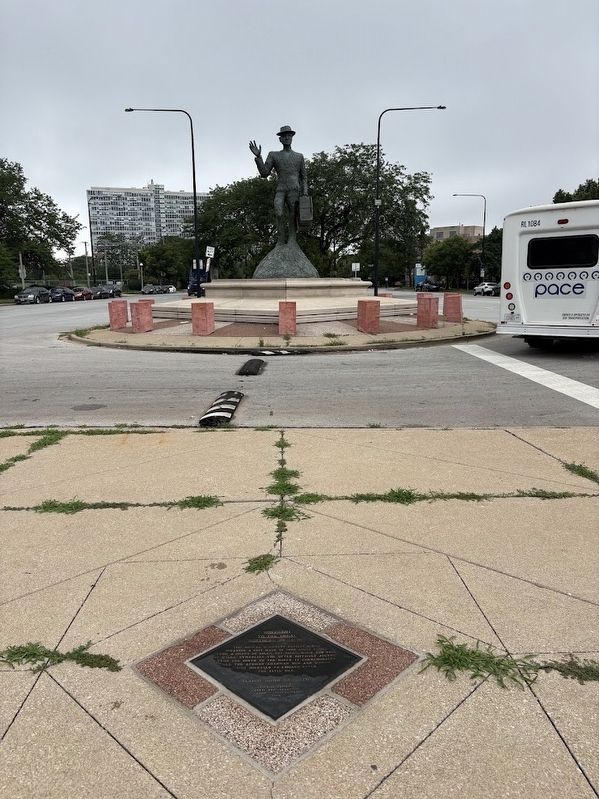
Photographed by Sean P. Flynn, August 14, 2026
2. Monument to the Great Northern Migration Marker
Regarding Monument to the Great Northern Migration. About 7 million African Americans migrated from the Southern U.S. to the North between the 1910s and 1970s; an estimated 500,000 emigrated to Chicago between World War I and the 1930s. A large number of those people settled in the Bronzeville neighborhood on the city's South Side, about five miles south of downtown.
Also see . . .
1. Encyclopedia of Chicago: The Great Migration. From the Chicago History Museum.
Excerpt: "Before this migration, African Americans constituted 2 percent of Chicago's population; by 1970, they were 33 percent. What had been in the nineteenth century a largely southern and rural African American culture became a culture deeply infused with urban sensibility in the twentieth century. And what had been a marginalized population in Chicago emerged by the mid-twentieth century as a powerful(Submitted on August 15, 2026, by Sean P. Flynn of Oak Park, Illinois.)force in the city's political, economic, and cultural life."Photographed by Sean P. Flynn, August 14, 20263. Monument to the Great Northern Migration
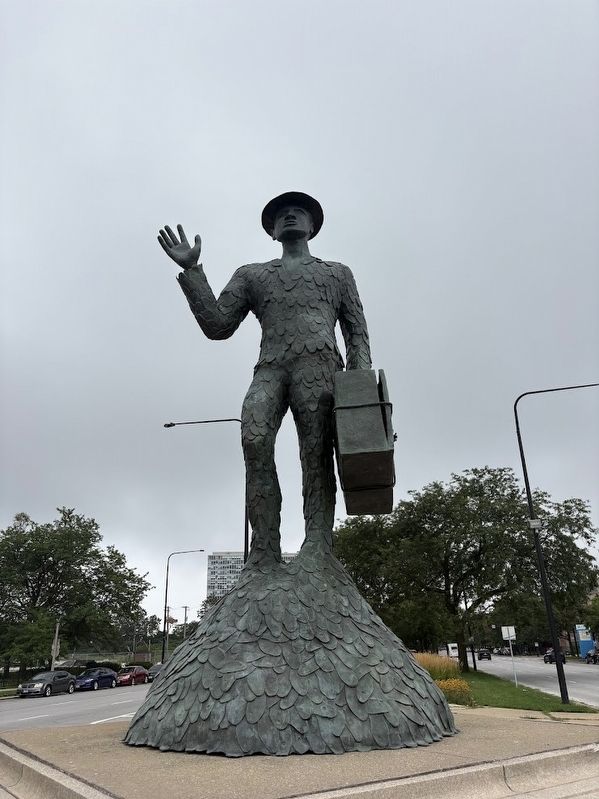
2. History of Bronzeville. From the Illinois Institute of Technology, whose campus is in this neighborhood.
Excerpt: "The Great Migration, when African Americans left the South for Chicago with the promise of better jobs and reduced oppression, began in 1916. The reality, however, fell far short of these promises, as conditions were still repressive and segregated. African Americans were restricted to live in the Black Belt in white-owned housing that was largely dilapidated and densely populated yet more expensive than housing in white areas.(Submitted on August 15, 2026, by Sean P. Flynn of Oak Park, Illinois.)
"Forced to live in this isolated area, Bronzeville’s residents toiled hard and cooperatively to establish a full-fledged community with business, culture, and community institutions that did not have the racial restrictions enforced in most parts of the city. Bronzeville’s institutions grew to have national influence rivaling, and even exceeding, those of New York’s Harlem."
3. Alison Saar biography.
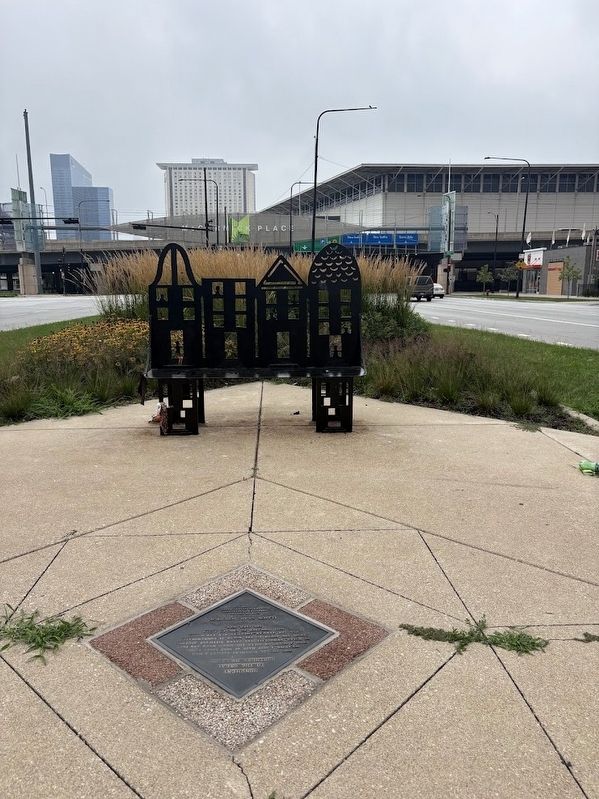
Photographed by Sean P. Flynn, August 14, 2026
4. Monument to the Great Northern Migration Marker, facing north
McCormick Place is in the background.
Photographed by Sean P. Flynn, August 14, 2026
5. Monument to the Great Northern Migration
A Bronzeville Walk of Fame marker for Carter G. Woodson is in the foreground of this north-facing photo. In the background is Interstate 55 (the Stevenson Expressway), whose eastern terminus is a short distance to the right of this photograph, and behind that McCormick Place, Chicago's convention center.
Credits. This page was last revised on September 29, 2026. It was originally submitted on August 15, 2026, by Sean P. Flynn of Oak Park, Illinois. This page has been viewed 20 times since then. Photos: 1, 2, 3, 4, 5. submitted on August 15, 2026, by Sean P. Flynn of Oak Park, Illinois.
