Frisco in Collin County, Texas — The American South (West South Central)
Calaboose
Replica
Photographed by Mansfieldphoto.com, August 2, 2026
1. Calaboose Marker
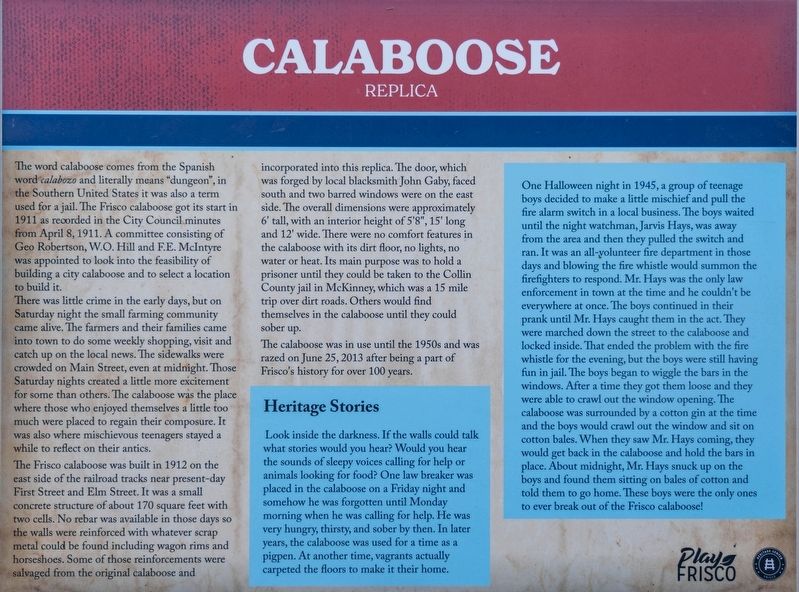
The word calaboose comes from the Spanish word calabozo and literally means “dungeon”, in the Southern United States it was also a term used for a jail. The Frisco calaboose got its start in 1911 as recorded in the City Council minutes from April 8, 1911. A committee consisting of Geo Robertson, W.O. Hill and F.E. McIntyre was appointed to look into the feasibility of building a city calaboose and to select a location to build it.
There was little crime in the early days, but on Saturday night the small farming community came alive. The farmers and their families came into town to do some weekly shopping, visit and catch up on the local news. The sidewalks were crowded on Main Street, even at midnight. Those Saturday nights created a little more excitement for some than others. The calaboose was the place where those who enjoyed themselves a little too much were placed to regain their composure. It was also where mischievous teenagers stayed a while to reflect on their antics.
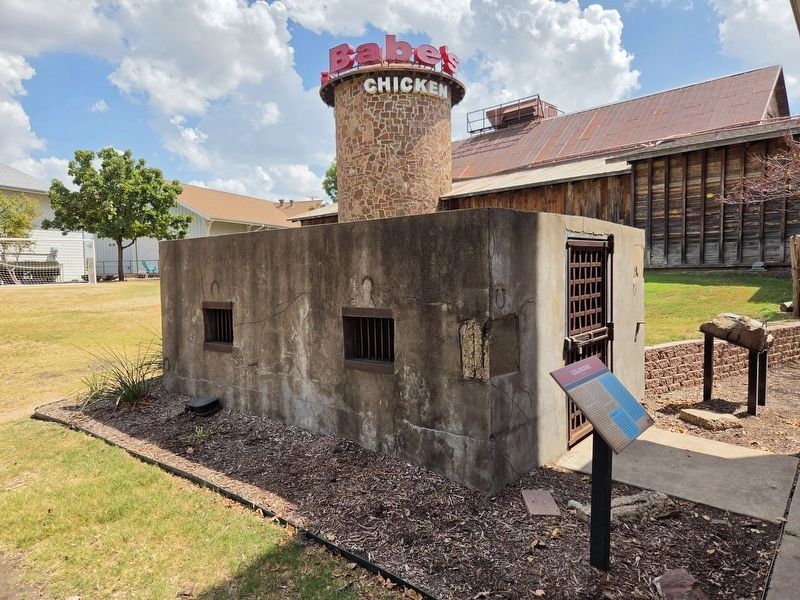
The Frisco calaboose was built in 1912 on the east side of the railroad tracks near present-day First Street and Elm Street. It was a small
this page online
The calaboose was in use until the 1950s and was razed on June 25, 2013 after being a part of Frisco’s history for over 100 years.
Heritage Stories
Look inside the darkness. If the walls could talk what stories would you hear? Would you hear the sounds of sleepy voices calling for help or

Photographed by Mansfieldphoto.com, August 2, 2026
2. Calaboose - Side View
The marker stands just outside the frame to the right.
One Halloween night in 1945, a group of teenage boys decided to make a little mischief and pull the fire alarm switch in a local business. The boys waited until the night watchman, Jarvis Hays, was away from the area and then they pulled the switch and ran. It was an all-volunteer fire department in those days and blowing the fire whistle would summon the firefighters to respond. Mr. Hays was the only law enforcement in town at the time and he couldn’t be everywhere at once. The boys continued in their prank until Mr. Hays caught them in the act. They were marched down the street to the calaboose and locked inside. That ended the problem with the fire whistle for the evening, but the boys were still having fun in jail. The boys began to wiggle the bars in the windows. After a time

Photographed by Mansfieldphoto.com, August 2, 2026
3. Calaboose Entrance
Erected by Frisco Heritage Center.
Topics. This historical marker is listed in this topic list: Law Enforcement. A significant historical date for this entry is April 8, 1911.
Location. 33° 8.942′ N, 96° 49.837′ W. Marker is in Frisco, Texas, in Collin County. It is at the intersection of Page Street and Railroad Ave on Page Street. Touch for map. Marker is at or near this postal address: 6475 Page St, Frisco TX 75034, United States of America. Touch for directions.

Regionally, this marker is in the Prairies & Lakes Region and in the Dallas-Fort Worth Metropolitan Area. Globally, it is in North America, a Gulf of Mexico state, the Western Hemisphere, the Western
Photographed by James Hulse, September 1, 2026
4. Calaboose and Marker
Other nearby markers. At least 8 other markers are within walking distance of this marker: Smith-Muse House (within shouting distance of this marker); Crozier-Sickles House (within shouting distance of this marker); Schoolhouse (within shouting distance of this marker); John Milton Turner (within shouting distance of this marker); Lebanon Baptist Church (within shouting distance of this marker); The Depot (within shouting distance of this marker); Gaby’s Blacksmith Shop (about 300 feet away, measured in a direct line); Steam Engine & Caboose (about 300 feet away). Touch for a list and map of all markers in Frisco.
Credits. This page was last revised on September 2, 2026. It was originally submitted on August 16, 2026, by James Hulse of Medina, Texas. This page has been viewed 26 times since then. Photos: 1. submitted on August 16, 2026, by James Hulse of Medina, Texas. 2, 3. submitted on August 17, 2026, by James Hulse of Medina, Texas. 4. submitted on September 2, 2026, by James Hulse of Medina, Texas.
