Griffin in Frisco in Collin County, Texas — The American South (West South Central)
The People and Towns That Became Frisco
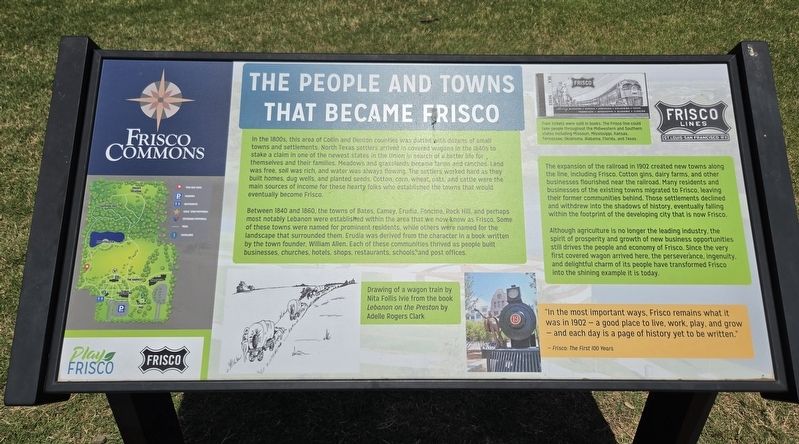
Photographed by James Hulse, July 9, 2026
1. The People and Towns That Became Frisco Marker
In the 1800s, this area of Collin and Denton counties was dotted with dozens of small towns and settlements. North Texas settlers arrived in covered wagons in the 1840s to stake a claim in one of the newest states in the Union in search of a better life for themselves and their families. Meadows and grasslands became farms and ranches. Land was free, soil was rich, and water was always flowing. The settlers worked hard as they built homes, dug wells, and planted seeds. Cotton, corn, wheat, oats, and cattle were the main sources of income for these hearty folks who established the towns that would eventually become Frisco.
Between 1840 and 1860, the towns of Bates, Carney, Erudia, Foncine, Rock Hill, and perhaps most notably Lebanon were established within the area that we now know as Frisco. Some of these towns were named for prominent residents, while others were named for the landscape that surrounded them. Erudia was derived from the character in a book written by the town founder, William Allen. Each of these communities thrived as people built businesses, churches, hotels, shops, restaurants, schools, and post
this page online
The expansion of the railroad in 1902 created new towns along the line, including Frisco. Cotton gins, dairy farms, and other businesses flourished near the railroad. Many residents and businesses of the existing towns migrated to Frisco, leaving their former communities behind. Those settlements declined and withdrew into the shadows of history, eventually falling within the footprint of the developing city that is now Frisco.
Although agriculture is no longer the leading industry, the spirit of prosperity and growth of new business opportunities still drives the people and economy of Frisco. Since the very first covered wagon arrived here, the perseverance, ingenuity, and delightful charm of its people have transformed Frisco into the shining example it is today.
“In the most important ways, Frisco remains what it was in 1902 – a good place to live, work, play, and grow – and each day is a page of history yet to be written.”
— Frisco: The First 100 Years
Drawing of a wagon train by Nita Follis Vlie from the book Lebanon on the Preston by Adelle Rogers Clark
Train tickets were sold in books. The Frisco line could take people throughout the Midwestern and Southern states including Missouri, Mississippi, Kansas, Tennessee, Oklahoma, Alabama, Florida, and Texas.
Erected by City

Photographed by James Hulse, July 9, 2026
2. The People and Towns That Became Frisco Marker
The view of the marker looking towards the south.
Topics. This historical marker is listed in these topic lists: Industry & Commerce • Parks & Recreational Areas • Railroads & Streetcars • Settlements & Settlers. A significant historical year for this entry is 1840.
Location. 33° 9.302′ N, 96° 48.954′ W. Marker is in Frisco, Texas, in Collin County. It is in Griffin. It is on McKinney Road east of Sycamore Street. The marker is located in the Frisco Commons Park. Touch for map. Marker is at or near this postal address: 8000 McKinney Rd, Frisco TX 75033, United States of America. Touch for directions.

Regionally, this marker is in the Prairies & Lakes Region and in the Dallas-Fort Worth Metropolitan Area. Globally, it is in North America, a Gulf of Mexico state, the Western Hemisphere, the Western World, and the Anglosphere. Historically, it finds itself in what was once New Spain, the Republic of Texas, one of the Confederate States of America, and the Antebellum South.
Other nearby markers. At least 8 other markers are within walking distance of this marker: Sergeant Michael Luke Boatright (within shouting distance of this marker); Corporal Peter John Courcy

Photographed by James Hulse, July 9, 2026
3. The People and Towns That Became Frisco Marker
The view of the marker looking towards the north.
Credits. This page was last revised on August 17, 2026. It was originally submitted on August 16, 2026, by James Hulse of Medina, Texas. This page has been viewed 18 times since then. Photos: 1, 2, 3. submitted on August 16, 2026, by James Hulse of Medina, Texas.
