Gruetli-Laager in Grundy County, Tennessee — The American South (East South Central)
Welcome to Gruetli-Laager
Photographed by Darren Jefferson Clay, June 7, 2026
1. Welcome to Gruetli-Laager Marker
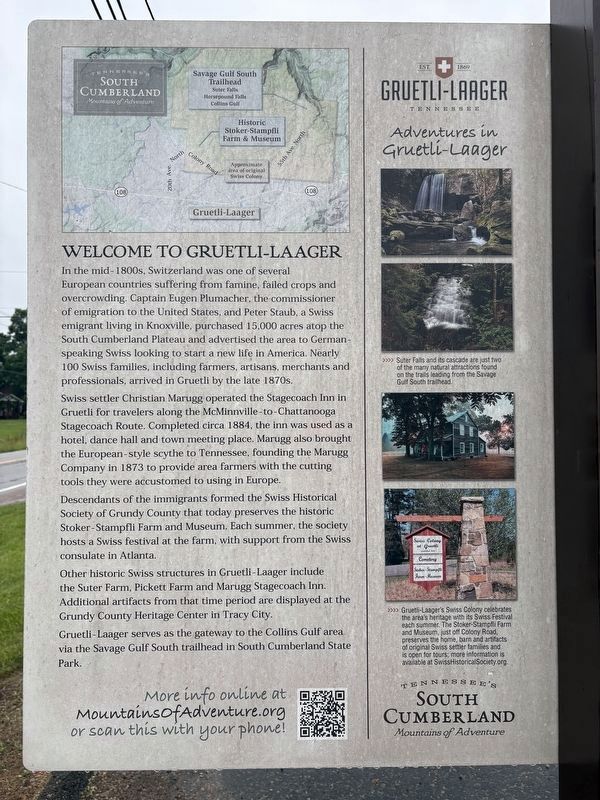
In the mid-1800s, Switzerland was one of several European countries suffering from famine, failed crops and overcrowding. Captain Eugen Plumacher, the commissioner of emigration to the United States, and Peter Staub, a Swiss emigrant living in Knoxville, purchased 15,000 acres atop the South Cumberland Plateau and advertised the area to German-speaking Swiss looking to start a new life in America. Nearly 100 Swiss families, including farmers, artisans, merchants and professionals, arrived in Gruetli by the late 1870s.
Swiss settler Christian Marugg operated the Stagecoach Inn in Gruetli for travelers along the McMinnville-to-Chattanooga Stagecoach Route. Completed circa 1884, the inn was used as a hotel, dance hall and town meeting place. Marugg also brought the European-style scythe to Tennessee, founding the Marugg Company in 1873 to provide area farmers with the cutting tools they were accustomed to using in Europe.
Descendants of the immigrants formed the Swiss Historical Society of Grundy County that today preserves the historic Stoker-Stampfli Farm and Museum. Each summer, the society hosts
this page online
Other historic Swiss structures in Gruetli-Laager include the Suter Farm, Pickett Farm and Marugg Stagecoach Inn. Additional artifacts from that time period are displayed at the Grundy County Heritage Center in Tracy City.
Gruetli-Laager serves as the gateway to the Collins Gulf area. via the Savage Gulf South trailhead in South Cumberland State Park.
Photo captions:
Suter Falls and its cascade are just two of the many natural attractions found on the trails leading from the Savage Gulf South trailhead.
Grueti-Laager's Swiss Colony celebrates the area's heritage with its Swiss Festival each summer. The Stoker-Stampi Farm and Museum, just off Colony Road, preserves the home, barn and artifacts of original Swiss setter families and is open for tours; more information is available at SwissHistorical Society.org
Erected by Tennessee’s South Cumberland Mountains of Adventures and Swiss Historical Society.
Topics. This historical marker is listed in these topic lists: Immigration • Settlements & Settlers. A significant historical year for this entry is 1884.
Location. 35° 22.288′ N,

Photographed by Darren Jefferson Clay, June 7, 2026
2. Welcome to Gruetli-Laager Marker

Regionally, this marker is in Tennessee’s Cumberland Plateau and in the Highland Rim. It is also in the American South, specifically in the Upper South, in Appalachia, and specifically in Southern Appalachia. Globally, it is in North America, the Western Hemisphere, the Western World, and the Anglosphere. Historically, it finds itself in what was once the territory of the Mississippian Culture, one of the Confederate States of America, and the Antebellum South.
Other nearby markers. At least 8 other markers are within 6 miles of this marker, measured as the crow flies: Gruetli (approx. 0.4 miles away); Stoker-Stampfli Farm (approx. 1.8 miles away); Creighton's Store (approx. 3.1 miles away); United Methodist Church (approx. 3.4 miles away); Long’s Mill and the Chickamauga Trace (approx. 4.7 miles away); Greeter Homeplace (approx. 4.8 miles away); The Northcutt-Moffitt “Manor” (approx. 5.1 miles away); Forrest's Murfreesboro Raid (approx. 5.1 miles away). Touch for a list and map of all markers in Gruetli-Laager.
Another marker is no longer nearby. Melchior Thoni, Jr (was within shouting distance of this marker but has been confirmed missing).
Credits. This page was last revised on August 27, 2026. It was originally submitted on August 16, 2026, by Darren Jefferson Clay of Duluth, Georgia. This page has been viewed 12 times since then. Photos: 1, 2. submitted on August 20, 2026, by Darren Jefferson Clay of Duluth, Georgia. • James Hulse was the editor who published this page.
