Loudonville in Albany County, New York — The American Northeast (Mid-Atlantic)
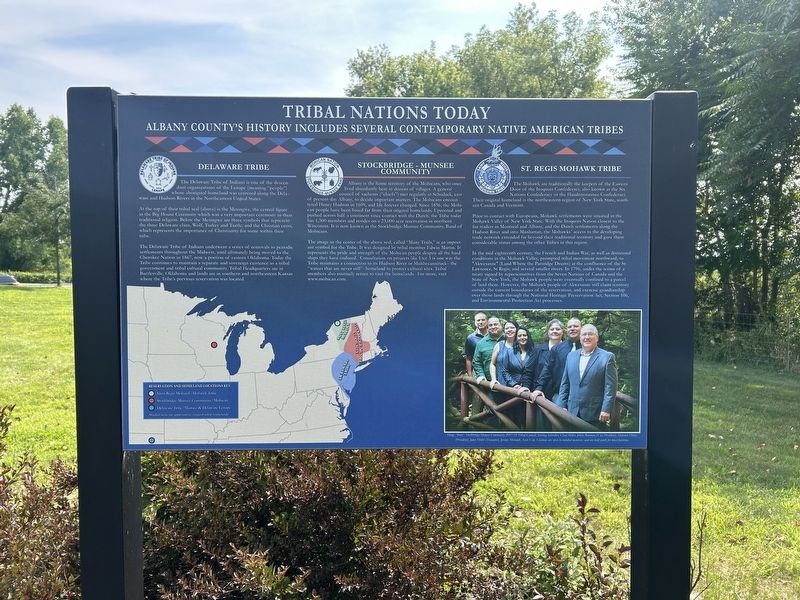
Tribal Nations Today
Albany County's history includes several contemporary Native American tribes
Photographed by Steve Stoessel, August 16, 2026
1. Tribal Nations Today Marker
Delaware Tribe
The Delaware Tribe of Indians is one of the descendant organizations of the Lenape (meaning "people") whose aboriginal homeland was centered along the Delaware and Hudson Rivers in the Northeastern United States.
At the top of their tribal seal (above) is the Mesingwe, the central Figure in the Big House Ceremony which was a very important ceremony in their traditional religion. Below the Mesingwe are three symbols that represent the three Delaware clans, Wolf, Turkey and Turtle; and the Christian cross, which represents the importance of Christianity for some within their tribe.
The Delaware Tribe of Indians underwent a series of removals to periodic settlements throughout the Midwest, until ultimately being moved to the Cherokee Nation in 1867, now a portion of eastern Oklahoma. Today the Tribe continues to maintain a separate and sovereign existence as a tribal government and tribal cultural community. Tribal Headquarters are in Bartlesville, Oklahoma and lands are in southern and northeastern Kansas where the Tribe's previous reservation was located.
Stockbridge-Munsee Community
Albany is the home
this page online
The image in the center of the above seal, called "Many Trails," is an important symbol for the Tribe. It was designed by tribal member Edwin Martin. It represents the pride and strength of the Mohican people despite all the hard ships they have endured. Consultation on projects like Exit 3 is one way the Tribe maintains a connection to its Hudson River or Muhhecannituck- the "waters that are never still"- homeland to protect cultural sites. Tribal members also routinely return to visit the homelands. For more, visit www.mohican.com.
St. Regis Mohawk Tribe
The
Photographed by Steve Stoessel, August 16, 2026
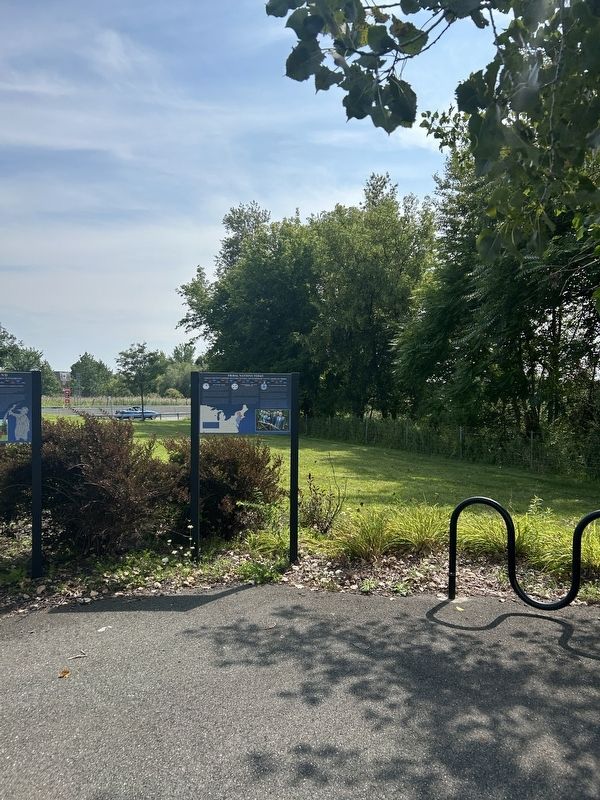
2. Tribal Nations Today Marker
Prior to contact with Europeans, Mohawk settlements were situated in the Mohawk Valley of New York State. With the Iroquois Nation closest to the fur traders in Montreal and Albany, and the Dutch settlements along the Hudson River and into Manhattan, the Mohawks access to the developing trade network extended far beyond their traditional territory and gave them considerable status among the other Tribes in this region.
In the mid-eighteenth century, the French and Indian War, as well as distressed conditions in the Mohawk Valley, prompted tribal movement northward, to "Akwesasne" (Land Where the Partridge Drums) at the confluence of the St. Lawrence, St. Regis, and several smaller rivers. In 1796, under the terms of a treaty signed by representatives from the Seven Nations of Canada and the State of New York, the Mohawk people were eventually confined to a parcel of land there.
Photographed by Steve Stoessel, August 16, 2026
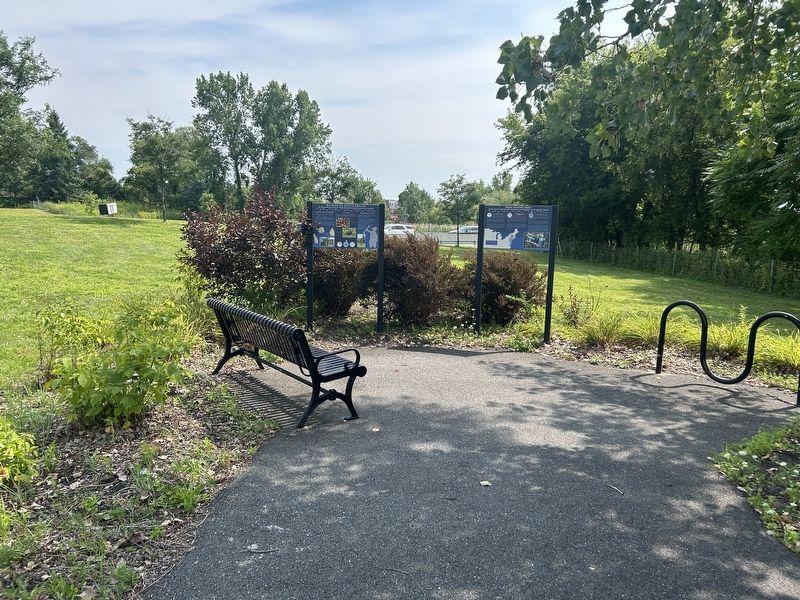
3. Tribal Nations Today Marker
( Photo Caption: ) Image Above: Stockbridge-Munsee Community 2017-18 Tribal Council: Sterling Schreiber, Chad Miller, Jolene Bowman (Vice President), Shannon Holsey (President), Janet Miller (Treasurer), Jeremy Mohawk, Scott Vele. Elections are open to enrolled members, and are held yearly for most positions.
Topics. This historical marker is listed in this topic list: Indigenous Peoples and Communities. A significant historical year for this entry is 1867.
Location. 42° 43.835′ N, 73° 47.996′ W. Marker is in Loudonville, New York, in Albany County. It is at the intersection of Albany-Shaker Road (New York State Route 155) and Northway Exit 3 (Interstate 87), on the right when traveling south on Albany-Shaker Road. Touch for map. Marker is in this post office area: Albany NY 12211, United States of America. Touch for directions.

Regionally, this marker is in Upstate New York, in the Capital District, and in the Albany Metropolitan Area. It is also in the American Northeast and in the Mid-Atlantic. Globally, it is in North America, the Western Hemisphere, the Western World, and the Anglosphere. Historically, it finds itself in what was once New Netherland and also one of the original Thirteen Colonies.
Other nearby markers. At least 8 other markers are within walking distance of this marker: Walking on Native Ground (here, next to this marker); Dalessondro Boulevard (approx. half a mile away); Mother Ann Lee (approx. 0.8 miles away); Trustee's Office (1830) (approx. 0.9 miles away); Shaker Garage (1920) (approx. 0.9 miles away); Meeting House (1848) (approx. 0.9 miles away); Shaker Meeting House (approx. 0.9 miles away); Welcome to the Shaker Apple Orchard (approx. 0.9 miles away).
Credits. This page was last revised on August 17, 2026. It was originally submitted on August 17, 2026, by Steve Stoessel of Niskayuna, New York. This page has been viewed 10 times since then. Photos: 1, 2, 3. submitted on August 17, 2026, by Steve Stoessel of Niskayuna, New York.
