
Butte in Silver Bow County, Montana — The American West (Mountains)
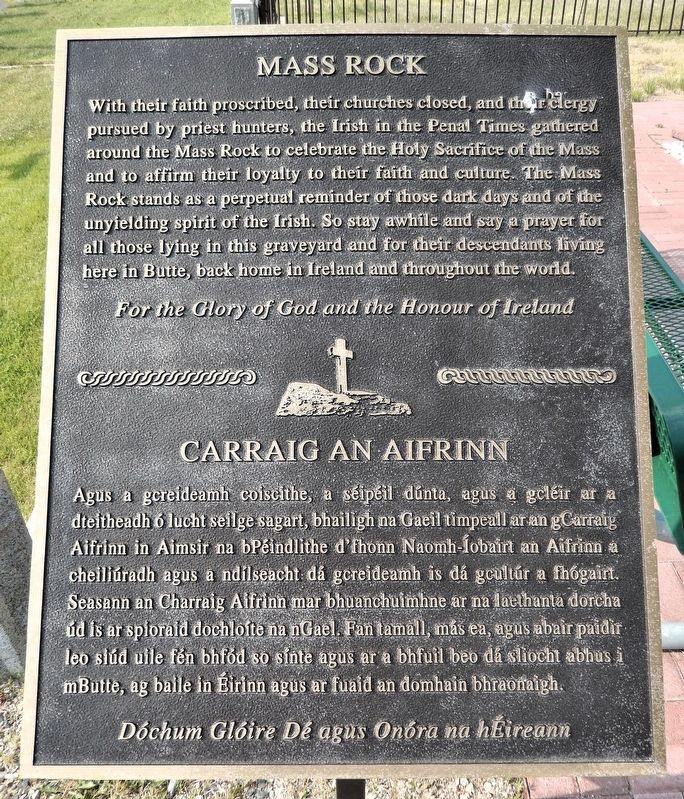
Mass Rock
⎯⎯⎯
Carraig an Aifrinn
Photographed by Cosmos Mariner, July 6, 2024
1. Mass Rock / Carraig an Aifrinn Marker
Carraig an Aifrinn
this page online
Topics. This historical marker is listed in these topic lists: Cemeteries & Burial Sites • Religion & Religious Structures.
Location. 45° 59.148′ N, 112° 32.55′ W. Marker is in Butte, Montana, in Silver Bow County. It can be reached from South Montana Street just south of Hobson Avenue, on the right when traveling south. The marker is on the north side of Saint Patrick Cemetery. Touch for map. Marker is at or near this postal address: 2725 South Montana Street, Butte MT 59701, United States of America. Touch for directions.

Regionally, this marker is in andspecifically outhwest Montana, in Gold West Country, in Mining Country. It is also in the American Mountain West and in the Lewis & Clark Corridor. Globally, it is in North America, the Rocky Mountains, the Western Hemisphere, the Western World, and the Anglosphere. Historically, it finds itself in what was once Rupert’s Land and also the Louisiana Purchase.
Other nearby markers. At least 8 other markers are within 2 miles of this marker, measured as
Photographed by Cosmos Mariner, July 6, 2024
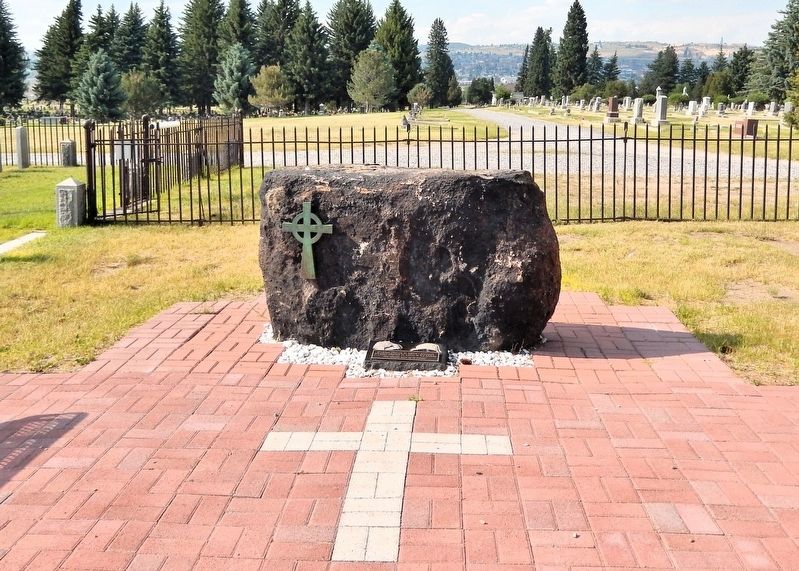
2. Mass Rock
Also see . . . Mass Rock (Wikipedia).
Excerpt: A Mass rock (Irish: Carraig an Aifrinn) was a rock used as an altar by the Catholic Church in Ireland, during the 17th and 18th centuries, as a location for secret and illegal gatherings of faithful attending the Mass offered by outlawed priests. Similar altars, known as Mass stones, were used by the Catholic Church in Scotland, membership in which was similarly criminalized by the Scottish Reformation Parliament in 1560.(Submitted on August 20, 2026, by Cosmos Mariner of Cape Canaveral, Florida.)During the religious persecution of the Catholic Church in Ireland, isolated locations were sought to hold religious ceremonies, as observing
the Catholic Mass was a matter of difficulty and danger at the time as a result of the Reformation in Ireland, Cromwell's campaign against the Irish, and the Penal Laws of 1695. Bishops were banished and priests had to register to preach under the Registration Act 1704. Priest hunters were also sometimes employed to arrest Catholic priests and nonjuring vicars of the Scottish Episcopal Church.Photographed by Cosmos Mariner, July 6, 20243. In front of the Mass RockÓ Láthair Charraig an Aifrinn i gCorcaigh
Ó Láthair Charraig an Aifrinn i nArd Mhacha
“Dá mbeadh caint ag na cloche”
• • •
From the Rock of the Mass in Cork
From the Rock of the Mass in Armagh
“If the stones could talk”
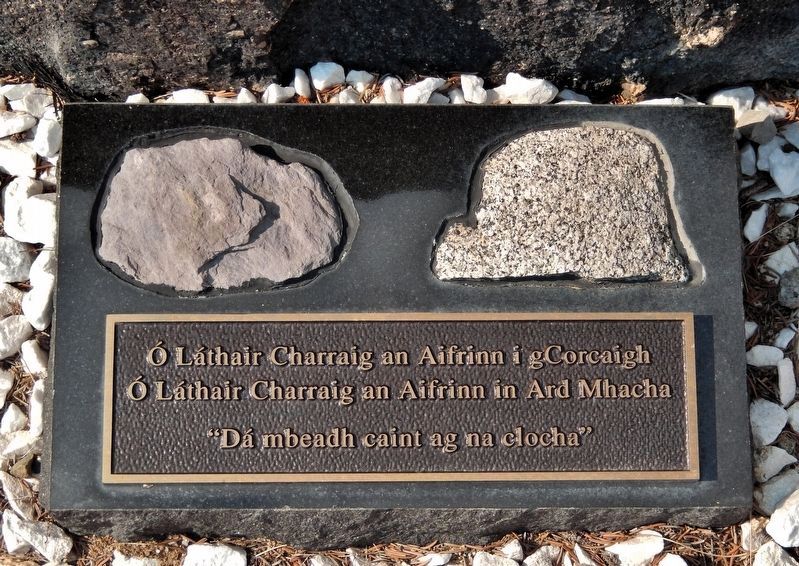
Photographed by Cosmos Mariner, July 6, 2024
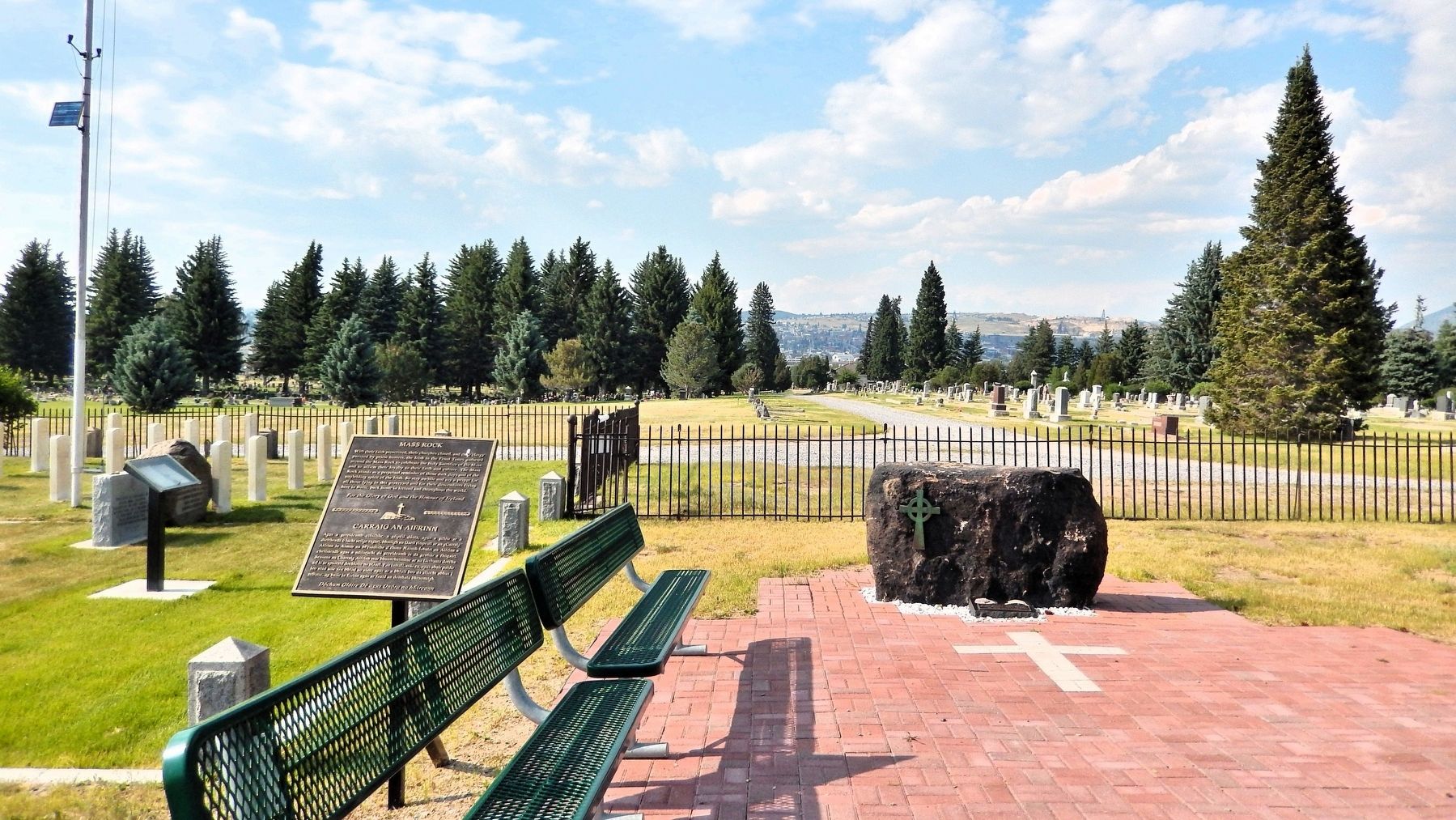
4. Mass Rock / Carraig an Aifrinn Marker
Looking north from the north end of Saint Patrick Cemetery. Mount Moriah Cemetery is in the background. The marker is beside the bench on the left and the Mass Rock is on the right.
Credits. This page was last revised on August 20, 2026. It was originally submitted on August 19, 2026, by Cosmos Mariner of Cape Canaveral, Florida. This page has been viewed 11 times since then. Photos: 1, 2, 3, 4. submitted on August 20, 2026, by Cosmos Mariner of Cape Canaveral, Florida.
