The Irish of Centerville
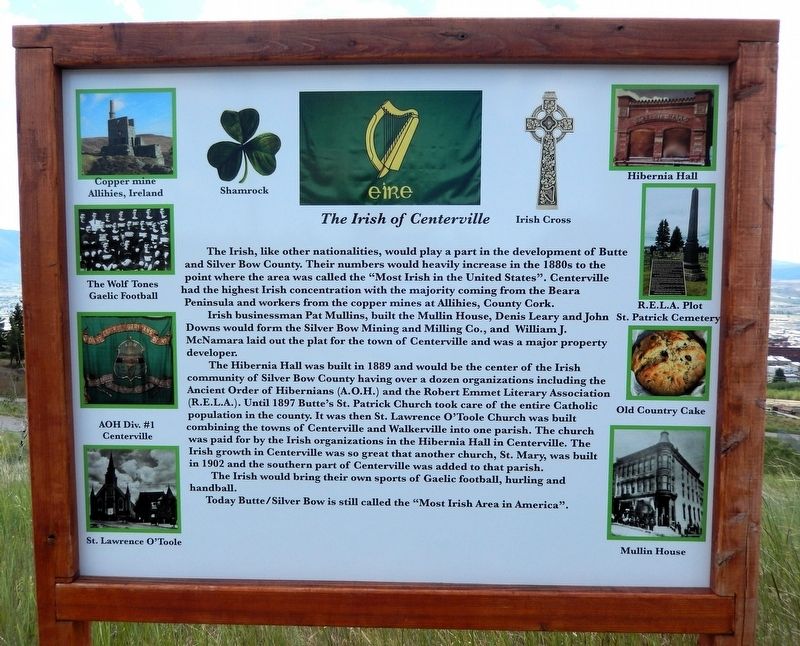
The Irish, like other nationalities, would play a part in the development of Butte and Silver Bow County. Their numbers would heavily increase in the 1880s to the point where the area was called the “Most Irish in the United States”. Centerville had the highest Irish concentration with the majority coming from the Beara Peninsula and workers from the copper mines at Allihies, County Cork.
Irish businessman Pat Mullins built the Mullin House, Denis Leary and John Downs would form the Silver Bow Mining and Milling Co., and William J. McNamara laid out the plat for the town of Centerville and was a major property developer.
The Hibernia Hall was built in 1889 and would be the center of the Irish community of Silver Bow County having over a dozen organizations including the Ancient Order of Hibernians (A.O.H.) and the Robert Emmet Literary Association (R.E.L.A.). Until 1897 Butte's St. Patrick Church took care of the entire Catholic population in the county. It was then St. Lawrence O'Toole Church was built combining the towns of Centerville and Walkerville into one parish. The church was paid for by the Irish organizations
this page online
The Irish would bring their own sports of Gaelic football, hurling and handball.
Today Butte/Silver Bow is still called the “Most Irish Area in America”.
[photo captions]
Copper mine Allihies, Ireland • Shamrock • Irish Cross • Hibernia Hall • The Wolf Tones Gaelic Football • AOH Div. #1 Centerville • St. Lawrence O'Toole • R.E.L.A. Plot, St. Patrick Cemetery • Old Country Cake • Mullin House
Topics. This historical marker is listed in these topic lists: Immigration • Industry & Commerce • Religion & Religious Structures • Settlements & Settlers.
Location. 46° 1.437′ N, 112° 31.89′ W. Marker is in Butte, Montana, in Silver Bow County. It is in Centerville. It can be reached from Wells Street just south of East Center Street. The marker is on the Butte, Anaconda & Pacific (BA&P) Hill Trail, overlooking the historic Mountain Consolidated Mine site. Touch for map. Marker is in this


Regionally, this marker is in andspecifically outhwest Montana, in Gold West Country, in Mining Country. It is also in the American Mountain West and in the Lewis & Clark Corridor. Globally, it is in North America, the Rocky Mountains, the Western Hemisphere, the Western World, and the Anglosphere. Historically, it finds itself in what was once Rupert’s Land and also the Louisiana Purchase.
Other nearby markers. At least 8 other markers are within walking distance of this marker: Cornish of Centerville (here, next to this marker); Mines of Centerville (here, next to this marker); The Con Hoist House (a few steps from this marker); The Con (within shouting distance of this marker); The Con Headframe (about 400 feet away, measured in a direct line); Welcome! To the Top of the World (about 500 feet away); St. Lawrence O’Toole Church (approx. ¼ mile away); Walkerville and the Lex (approx. 0.3 miles away). Touch for a list and map of all markers in Butte.
Related markers. Click here for a list of markers that are related to this marker.
Also see . . .
1. Centerville Neighborhood, Butte (Montana Historical Society).
Excerpt: Centerville’s Irish immigrants worked in nearby mines, like the legendary mile deep Mountain Con owned by Clark’s Irish rival, Marcus Daly. They fraternized at the Ancient Order of Hibernian Hall, formerly a block from the Sons of St. George. Local children attended the since demolished Adams School, Butte’s first public school. While the extensive collection of commercial and fraternal buildings that once lined Main Street are now gone, the many working-class residences continue to reflect the neighborhood’s rich history.(Submitted on August 21, 2026, by Cosmos Mariner of Cape Canaveral, Florida.)
2. The Irish Heartbeat of Butte, Montana (The Montana Explorer).
Excerpt: In the late 1800s, Butte was a booming mining town. Rich deposits of copper, silver, and gold transformed it into what was known as “The Richest Hill on Earth.” As the mining industry expanded, so too did the demand for skilled laborers willing to work grueling shifts in dangerous conditions. Meanwhile, across the Atlantic, Ireland was suffering under British rule, economic collapse, and famine. The Irish people had a long history of struggle, and many saw the New World—especially Butte—as a place to build a better future. By the early 1900s, nearly a quarter of Butte’s population was Irish, making it one of the most Irish cities per capita in the United States.(Submitted on August 21, 2026, by Cosmos Mariner of Cape Canaveral, Florida.)Life in Butte’s mines was not for the faint of heart. The work was backbreaking, the conditions were brutal, and the risks were constant—from cave-ins to gas explosions to lung disease. Yet, the Irish miners took pride in their labor. Many were recruited straight from the coal mines of Ireland, already skilled in underground work and accustomed to the dangers of mining life. They worked in tightly knit groups, often with other Irishmen from their own county back home. Their faith was a cornerstone of their strength. Catholicism played a major role in Butte’s Irish community, offering both spiritual support and social cohesion. St. Patrick’s Catholic Church, built in 1881, became a hub for the Irish population—a place where miners could gather, pray, and find solace from the harsh realities of their daily work.
Credits. This page was last revised on August 21, 2026. It was originally submitted on August 19, 2026, by Cosmos Mariner of Cape Canaveral, Florida. This page has been viewed 20 times since then. Photos: 1, 2. submitted on August 21, 2026, by Cosmos Mariner of Cape Canaveral, Florida.
