South Loop in Chicago in Cook County, Illinois — The American Midwest (Great Lakes)
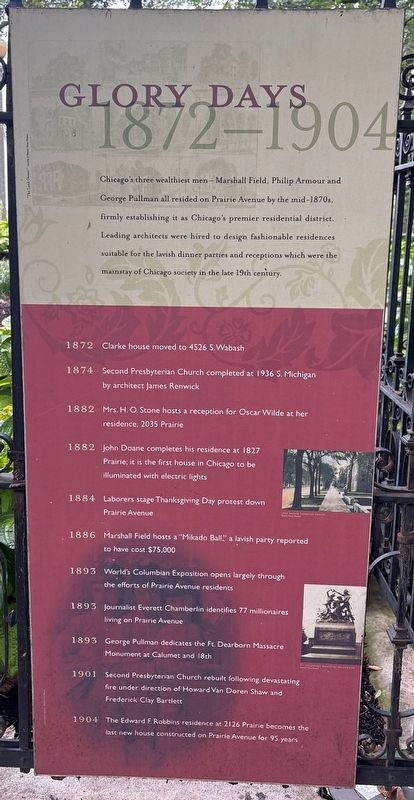
Glory Days 1872-1904
Photographed by Sean P. Flynn, August 14, 2026
1. Glory Days 1872-1904 Marker
1872 Clarke house moved to 4526 S. Wabash
1874 Second Presbyterian Church completed at 1936 S. Michigan by architect James Renwick
1882 Mrs. H. O. Stone hosts a reception for Oscar Wilde at her residence, 2035 Prairie
1882 John Doane completes his residence at 1827 Prairie; it is the first house in Chicago to be illuminated with electric lights
1884 Laborers stage Thanksgiving Day protest down Prairie Avenue
1886 Marshall Field hosts a "Mikado Ball" a lavish party reported to have cost $75,000
1893 World's Columbian Exposition opens largely through the efforts of Prairie Avenue residents
1893 Journalist Everett Chamberlin identifies 77 millionaires living on Prairie Avenue
1893 George Pullman dedicates the Ft. Dearborn Massacre Monument at Calumet and 18th
1901 Second Presbyterian Church rebuilt following devastating fire under direction of Howard Van Doren Shaw and Frederick Clay Bartlett
1904 The Edward F. Robbins residence at 2126 Prairie becomes the last new house constructed on Prairie Avenue for 95 years
Topics and series. This historical marker is listed in these topic lists: Architecture • Arts, Letters, Music • Labor Unions • Religion & Religious Structures. In addition, it is included in the Chicago's Surviving Pre-Fire Structures series list. A significant historical year for this entry is 1872.
Location. 41° 51.442′ N, 87° 37.251′ W. Marker is in Chicago, Illinois, in Cook County. It is in South Loop.
this page online

Regionally, this marker is on Chicago’s South Side. It is also in the American Midwest. Globally, it is in North America, on the Great Lakes, in the Western Hemisphere, in the Western World, and in the Anglosphere. Historically, it finds itself in what was once the Viceroyalty of New France, the territory of the Mississippian Culture, and the Northwest Territory.
Other nearby markers. At least 8 other markers are within walking distance of this marker: Lost Houses of Prairie Avenue: 1800-1900 Blocks (East Side) (here, next to this marker); Beginnings 1812-1871 (a few steps from this marker); Lost Houses of Prairie Avenue: 1600-1700 Blocks (a few steps from this marker); Lost Houses of Prairie Avenue: 1800-1900 Blocks (West Side) (a few steps from this marker); A Heritage Preserved (a few

Photographed by Sean P. Flynn, August 14, 2026
2. Glory Days 1872-1904 Marker on Prairie Avenue

Courtesy of Chicago History Museum (ICHi-021496), circa 1890
3. John Doane house at 1827 Prairie Ave.
The home was damaged by a fire in January of 1927 and razed in the 1930s. A modern multi-plex occupies part of the spot where the house once stood.

October 19, 2013
4. Second Presbyterian Church
The church was named a National Historic Landmark in 2013
Click for more information.
Click for more information.
Credits. This page was last revised on August 19, 2026. It was originally submitted on August 19, 2026, by Sean P. Flynn of Oak Park, Illinois. This page has been viewed 10 times since then. Photos: 1, 2, 3. submitted on August 19, 2026, by Sean P. Flynn of Oak Park, Illinois. 4. submitted on October 21, 2013.
