South Loop in Chicago in Cook County, Illinois — The American Midwest (Great Lakes)
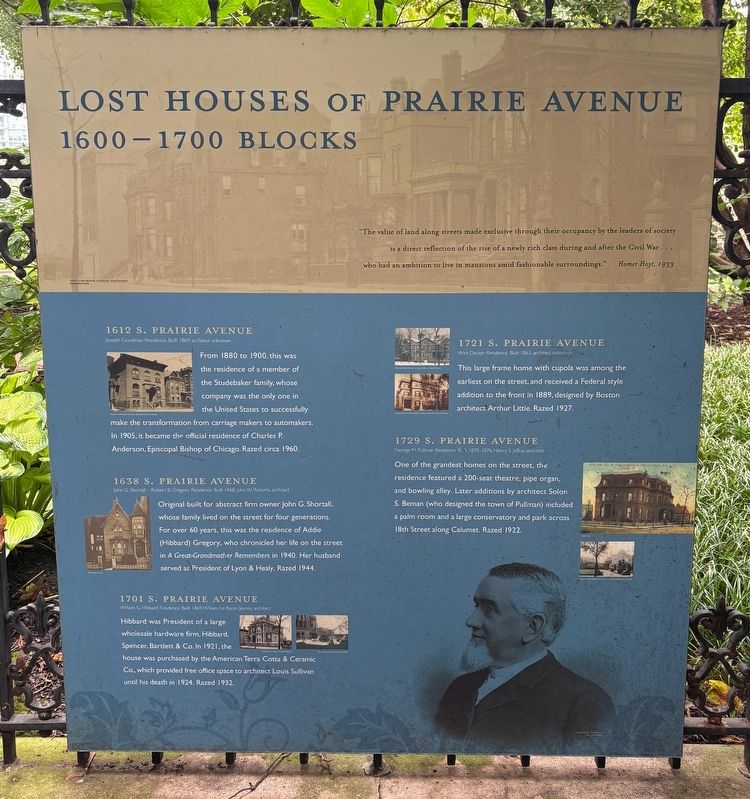
Lost Houses of Prairie Avenue: 1600-1700 Blocks
Photographed by Sean P. Flynn, August 14, 2026
1. Lost Houses of Prairie Avenue: 1600-1700 Blocks Marker
1612 S. Prairie Avenue
Joseph Goodman Residence. Built 1869; architect unknown
From 1880 to 1900, this was the residence of a member of the Studebaker family, whose company was the only one in the United States to successfully make the transformation from carriage makers to automakers. In 1905, it became the official residence of Charles P. Anderson, Episcopal Bishop of Chicago. Razed circa 1960.
1638 S. Prairie Avenue
John G. Shortall-Robert B. Gregory Residence. Built 1868; John W. Roberts, architect
Original built for abstract firm owner John G. Shortall, whose family lived on the street for four generations. For over 60 years, this was the residence of Addie (Hibbard) Gregory, who chronicled her life on the street in A Great-Grandmother Remembers in 1940. Her husband served as President of Lyon & Healy. Razed 1944.
1701 S. Prairie Avenue
William G. Hibbard Residence. Built 1869; William Le Baron Jenney, architect
Hibbard
this page online
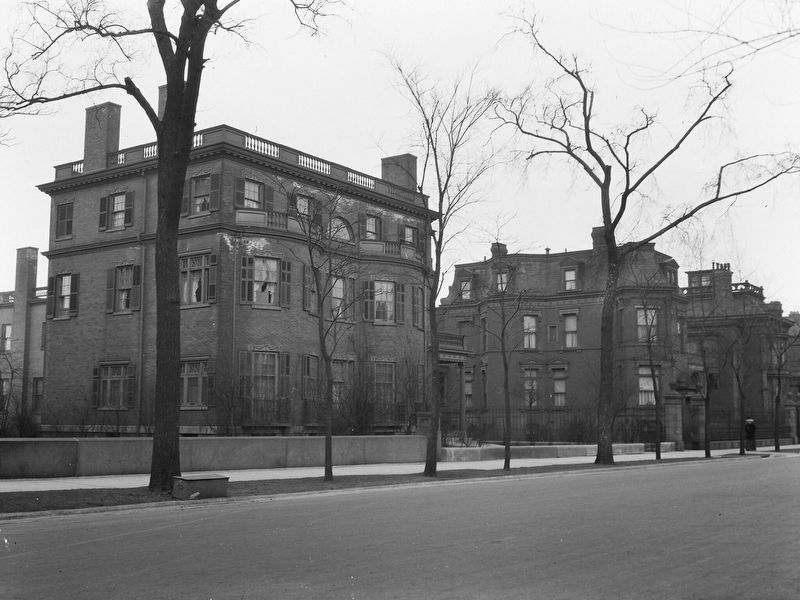
1721 S. Prairie Avenue
Wirt Dexter Residence. Built 1863; architect unknown
This large frame home with cupola was among the earliest on the street, and received a Federal style addition to the front in 1889, designed by Boston architect Arthur Little. Razed 1927.
1729 S. Prairie Avenue
George M. Pullman Residence. Built 1870-1876; Henry S. Jaffay, architect
One of the grandest homes on the street, the residence featured a 200-seat theatre, pipe organ, and bowling alley. Later additions by architect Solon S. Beman (who designed the town of Pullman) included a palm room and a large conservatory and park across 18th Street along Calumet. Razed 1922.
Topics. This historical marker is listed in these topic lists: Architecture • Arts, Letters, Music • Industry & Commerce • Roads & Vehicles. A significant historical year for this entry is 1869.
Location. 41° 51.451′ N, 87° 37.253′ W.
Photographed by Sean P. Flynn, August 14, 2026
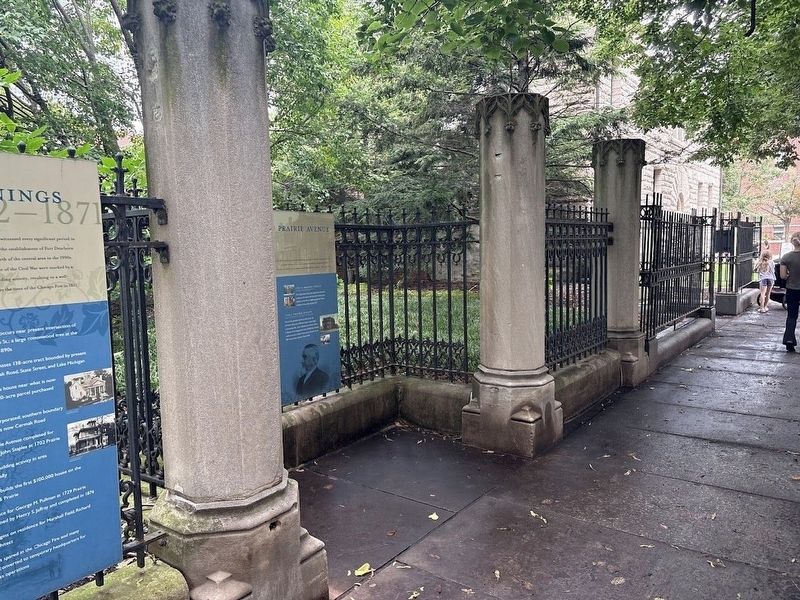
2. Two markers at Chicago Women's Park: Beginnings 1812-1871 and Lost Houses of Prairie Avenue
The Glessner House, a National Historic Landmark, is in the background.

Regionally, this marker is on Chicago’s South Side. It is also in the American Midwest. Globally, it is in North America, on the Great Lakes, in the Western Hemisphere, in the Western World, and in the Anglosphere. Historically, it finds itself in what was once the Viceroyalty of New France, the territory of the Mississippian Culture, and the Northwest Territory.
Other nearby markers. At least 8 other markers are within walking distance of this marker: Beginnings 1812-1871 (here, next to this marker); A Heritage Preserved (here, next to this marker); Outside the District (a few steps from this marker); Lost Houses of Prairie Avenue: 1800-1900 Blocks (East Side) (a few steps from this marker); Glory Days 1872-1904 (a few steps
Charles R. Clark, photographer; courtesy of Chicago History Museum (ICHi-071912), circa 1905
3. Wirt Dexler residence, 1721 S. Prairie
Another marker is no longer nearby. John J. Glessner House (was a few steps from this marker but has been replaced with another marker now near it).
Credits. This page was last revised on August 19, 2026. It was originally submitted on August 19, 2026, by Sean P. Flynn of Oak Park, Illinois. This page has been viewed 14 times since then. Photos: 1, 2, 3. submitted on August 19, 2026, by Sean P. Flynn of Oak Park, Illinois.
