Igel in Trier-Saarburg, Rhineland-Palatinate, Germany — Central Europe
Igeler Säule
⎯⎯⎯
Igel Column
Photographed by Andrew Ruppenstein, February 4, 2025
1. Igeler Säule / Igel Column Marker

Igeler Säule
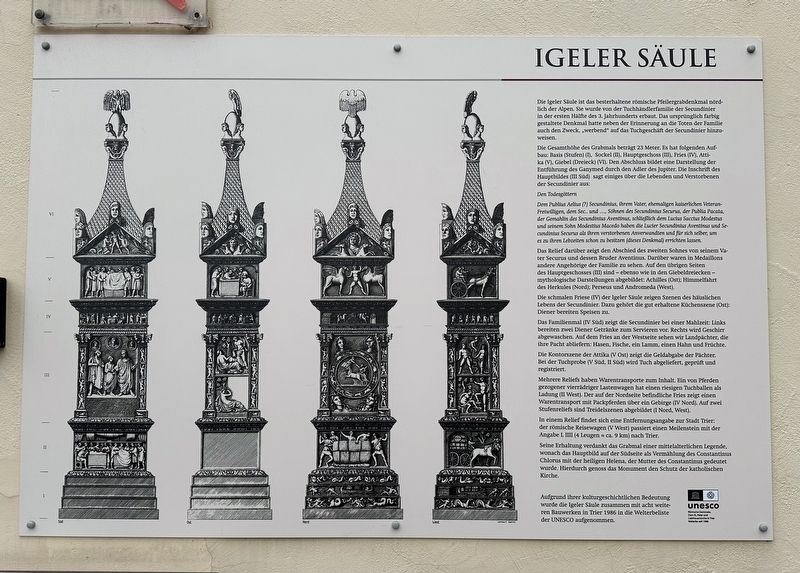
Die Igeler Säule ist das besterhaltene römische Pfeilergrabdenkmal nörd- lich der Alpen. Sie wurde von der Tuchhändlerfamilie der Secundinier in der ersten Hälfte des 3. Jahrhunderts erbaut. Das ursprünglich farbig gestaltete Denkmal hatte neben der Erinnerung an die Toten der Familie auch den Zweck. „werbend" auf das Tuchgeschäft der Secundinier hinzuweisen.
Die Gesamthöhe des Grabmals beträgt 23 Meter. Es hat folgenden Aufbau: Basis (Stufen) (1), Sockel (II), Hauptgeschoss (III), Fries (IV), Attika (V). Giebel (Dreieck) (VI). Den Abschluss bildet eine Darstellung der Entführung des Ganymed durch den Adler des Jupiter. Die Inschrift des Hauptbildes (III Süd) sagt einiges über die Lebenden und Verstorbenen der Secundinier aus:
Den Todesgöttern
Dem Publius Aelius (?) Secundinius, ihrem Vater, ehemaligen kaiserlichen Veteran-Freiwilligen, dem Sec.. und.... Söhnen des Secundinius Securus, der Publia Pacata, der Gemahlin des Secundinius Aventinus, schließlich dem Lucius Saccius Modestus und seinem Sohn Modestius Macedo haben die Lucier Secundinius Aventinus und Secundinius Securus als ihren verstorbenen Anverwandten und für sich selber, um es zu ihren Lebzeiten schon zu besitzen (dieses Denkmal) errichten lassen.
Das
this page online
Die schmalen Friese (IV) der Igeler Säule zeigen Szenen des häuslichen Lebens der Secundinier. Dazu gehört die gut erhaltene Küchenszene (Ost): Diener bereiten Speisen zu.
Das Familienmal (IV Süd) zeigt die Secundinier bei einer Mahlzeit: Links bereiten zwei Diener Getränke zum Servieren vor. Rechts wird Geschirr abgewaschen. Auf dem Fries an der Westseite sehen wir Landpächter, die ihre Pacht abliefern: Hasen, Fische, ein Lamm, einen Hahn und Früchte.
Die Kontorszene der Attika (V Ost) zeigt die Geldabgabe der Pächter. Bei der Tuchprobe (V Süd, II Süd) wird Tuch abgeliefert, geprüft und registriert.
Mehrere Reliefs haben Warentransporte zum Inhalt. Ein von Pferden. gezogener vierrädriger Lastenwagen hat einen riesigen Tuchballen
Photographed by Andrew Ruppenstein, February 4, 2025
2. Igeler Säule / Igel Column Marker - wide view
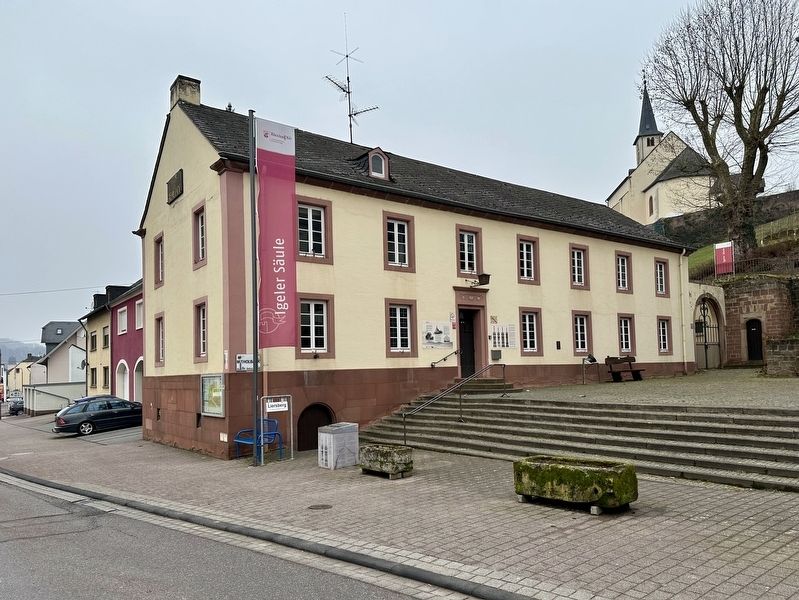
The marker is visible here just to the right of the doorway. The column itself is just out of the picture, on the right.
In einem Relief findet sich eine Entfernungsangabe zur Stadt Trier: der römische Reisewagen (V West) passiert einen Meilenstein mit der Angabe L IIII (4 Leugen ca. 9 km) nach Trier.
Seine Erhaltung verdankt das Grabmal einer mittelalterlichen Legende, wonach das Hauptbild auf der Südseite als Vermählung des Constantinus Chlorus mit der heiligen Helena, der Mutter des Constantinus gedeutet wurde. Hierdurch genoss das Monument den Schutz der katholischen Kirche.
Aufgrund ihrer kulturgeschichtlichen Bedeutung wurde die Igeler Säule zusammen mit acht weiteren Bauwerken in Trier 1986 in die Welterbeliste der UNESCO aufgenommen.
Igel Column
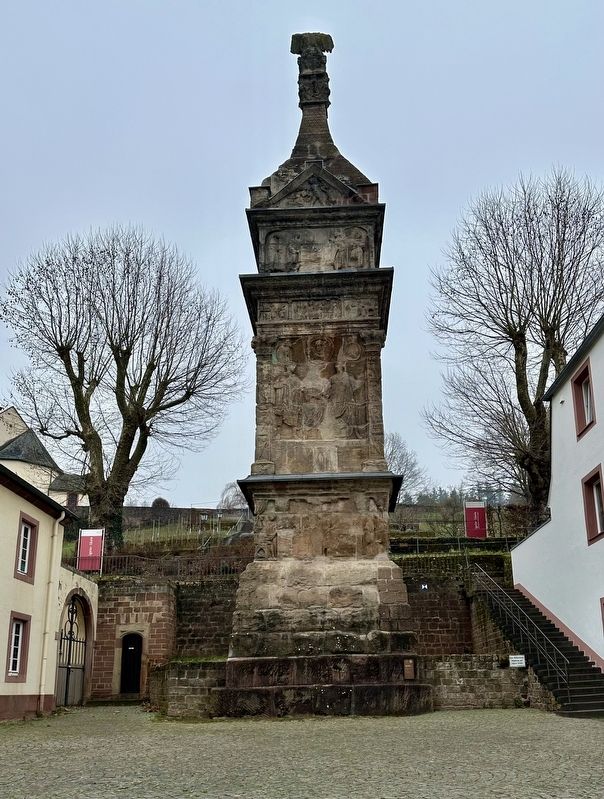
The Igel Column is the best-preserved Roman pillar tomb monument north of the Alps. It was erected by the Secundinius family—cloth merchants—in the first half of the 3rd century. Originally colorful, the monument served not only to commemorate the family's deceased
Photographed by Andrew Ruppenstein, February 4, 2025
3. Igeler Säule / Igel Column
The total height of the funerary monument is 23 meters. It has the following structure: base (steps) (1), plinth (II), main tier (III), frieze (IV), attic (V), and pediment (triangular) (VI). It is crowned by a depiction of the abduction of Ganymede by Jupiter's eagle. The inscription on the main panel (III South) reveals details about the living and deceased members of the Secundinius family:
To the Gods of the Underworld:The relief above depicts the second son bidding farewell to his father, Securus, and his brother, Aventinus. Medallions above this displayed other family members. The remaining sides of the main
Publius Aelius (?) Secundinius, their father—a former imperial veteran volunteer—along with the sons of Secundinius Securus, Publia Pacata (wife of Secundinius Aventinus), and finally Lucius Saccius Modestus and his son Modestius Macedo—these individuals were commemorated by Lucius Secundinius Aventinus and Secundinius Securus, who had this monument erected for their deceased relatives and for themselves, securing ownership during their own lifetimes.
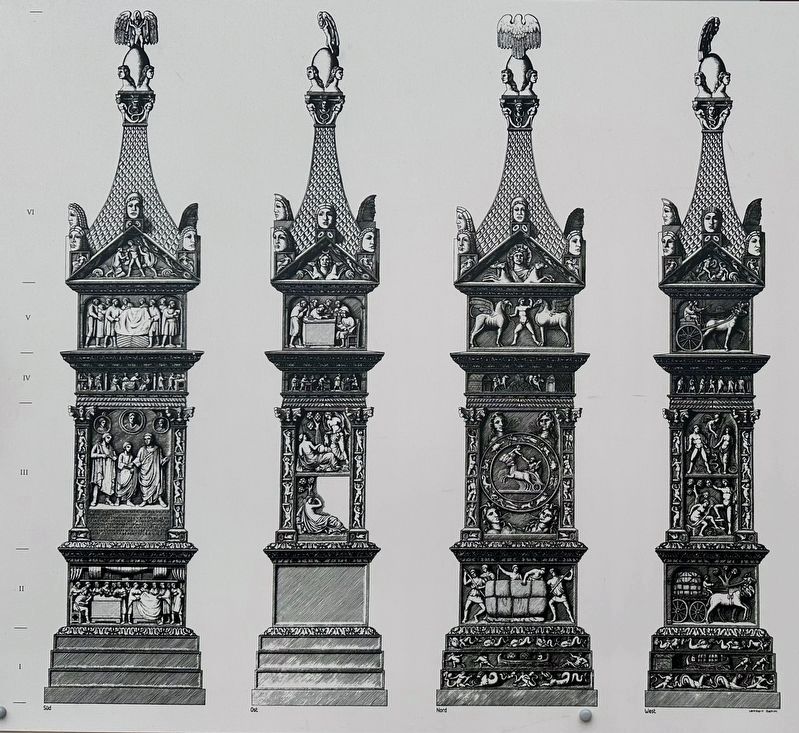
4. Marker illustration: the four faces of the column
Arranged (L-R): south, east, north west. On the left are also the Roman numerals for the various levels so that the viewer can match the illustration with the marker text.
The narrow friezes (IV) of the Igel Column depict scenes of the Secundinii family's domestic life. These include a well-preserved kitchen scene (East) showing servants preparing food.
The family meal scene (IV South) shows the Secundinii dining: on the left, two servants prepare drinks for serving, while on the right, dishes are being washed. The frieze on the west side shows tenant farmers delivering their rent in kind: hares, fish, a lamb, a rooster, and fruit.
The counting-house scene on the attic level (V East) depicts the tenants handing over money. The cloth inspection scene (V South, II South) shows fabric being delivered, examined, and recorded.
Several reliefs depict the transport of goods. A four-wheeled wagon drawn by horses carries a huge bale of cloth (II West). The frieze on the north side shows goods being transported across a mountain range by packhorses (IV Nord). Two stepped reliefs depict scenes of towing vessels (I Nord, West).
One relief
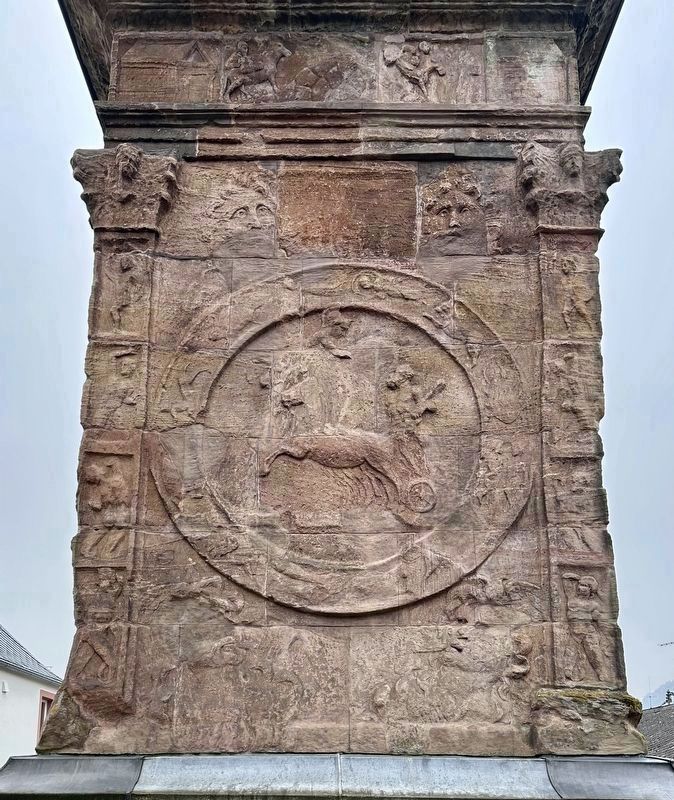
Photographed by Andrew Ruppenstein, February 4, 2025
5. Igel Column detail (north face, III - the apotheosis of Hercules)
The monument owes its preservation to a medieval legend, according to which the main relief on the south side was interpreted as the marriage of Constantius Chlorus to Saint Helena, the mother of Constantine. Thanks to this, the monument enjoyed the protection of the Catholic Church.
Due to its cultural-historical significance, the Igel Column—along with eight other structures in Trier—was inscribed on the UNESCO World Heritage List in 1986.
Erected by the UNESCO.
Topics and series. This historical marker is listed in this topic list: Cemeteries & Burial Sites. In addition, it is included in the UNESCO World Heritage Sites series list. A significant historical year for this entry is 1986.
Location. 49° 42.545′ N, 6° 32.968′ E. Marker is in Igel, Rheinland-Pfalz (Rhineland-Palatinate), in Trier-Saarburg. It is on Trierer Straße, on the right when traveling west. Touch for map. Marker is at or near this postal address: Trierer Str 39, Igel RP 54298, Germany.
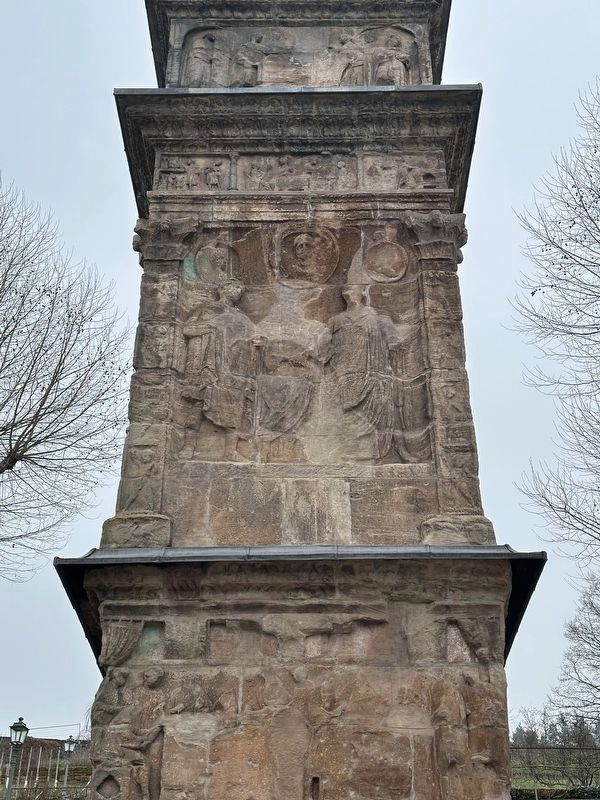
Photographed by Andrew Ruppenstein, February 4, 2025
6. Igel Column detail (south face, III - the second son bidding farewell to his father, Securus…)

Regionally, this marker is in the German Rhineland and in the Moselle Valley. Globally, it is in Europe, the European Union, Atlantic Europe, Central Europe, the Schengen Area, Western Europe, and the Western World. Historically, it finds itself in what was once the Roman Empire, the Holy Roman Empire, and the former West Germany.
Other nearby markers. At least 8 other markers are within 8 kilometers of this marker, measured as the crow flies: Goetheplatz / Goethe Square (here, next to this marker); Igel (here, next to this marker); a different marker also named Igeler Säule / Igel Column (a few steps from this marker); Umfeldgestaltung Igeler Säule / Design of the Igel Column Surroundings (within shouting distance of this marker); Burghaus/Gasthaus “zum Löwen” / Castle House/Inn “zum Löwen” (about 120 meters away, measured in a direct line); Otto Rienermann (approx. 3.4 kilometers away in Luxembourg); Wartime Refuge Memorial (approx. 3.7 kilometers away in Luxembourg); Karl Marx (approx. 8 kilometers away). Touch for a list and map of all markers in Igel.
Also see . . . Igel Column (Wikipedia). Overview:
The Igel Column (German: Igeler Säule) is a multi-storeyed Roman sandstone column in the municipality of Igel, Trier, Germany, dated to c. 250 AD. The column is the burial monument of the Secundinii cloth merchant family, and was built by two of the family members, Lucius Secundinius Aventinus and Lucius Secundinus Securus.(Submitted on August 21, 2026.)
Credits. This page was last revised on August 21, 2026. It was originally submitted on August 21, 2026, by Andrew Ruppenstein of Lamorinda, California. This page has been viewed 15 times since then. Photos: 1, 2, 3, 4, 5, 6. submitted on August 21, 2026, by Andrew Ruppenstein of Lamorinda, California.
