Naperville in Will County, Illinois — The American Midwest (Great Lakes)
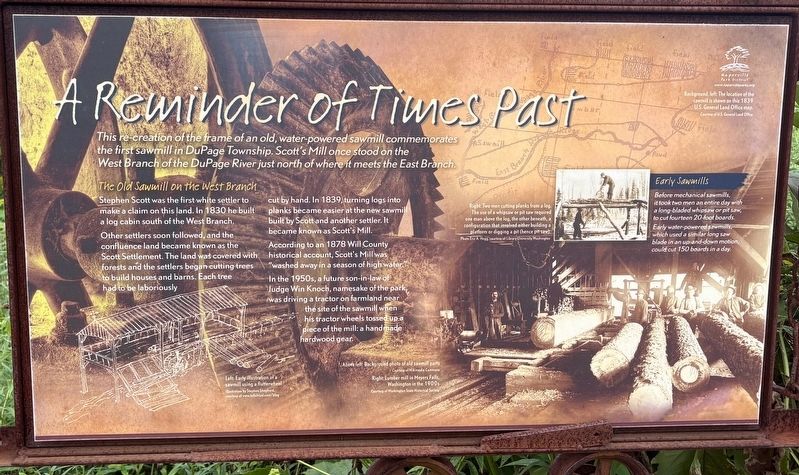
A Reminder of Times Past
Photographed by Sean P. Flynn, August 18, 2026
1. A Reminder of Times Past Marker
The Old Sawmill on the West Branch
Stephen Scott was the first white settler to make a claim on this land. In 1830 he built a log cabin south of the West Branch.
Other settlers soon followed, and the confluence land became known as the Scott Settlement. The land was covered with forests and the settlers began cutting trees to build houses and barns. Each tree had to be laboriously cut by hand. In 1839, turning logs into planks became easier at the new sawmill built by Scott and another settler. It became known as Scott's Mill.
According to an 1878 Will County historical account, Scott's Mill was "washed away in a season of high water.
In the 1950s, a future son-in-law of Judge Win Knoch, namesake of the park, was driving a tractor on farmland near the site of the sawmill when his tractor wheels tossed up a piece of the mill: a hand made hardwood gear.
Early Sawmills
Before mechanical
this page online
Early water-powered sawmills, which used a similar long saw blade in an up-and-down motion, could cut 150 boards in a day.
Erected by Naperville Park District.
Topics. This historical marker is listed in these topic lists: Horticulture & Forestry • Industry & Commerce • Settlements & Settlers • Waterways & Vessels. A significant historical year for this entry is 1830.
Location. 41° 42.842′ N, 88° 8.493′ W. Marker is in Naperville, Illinois, in Will County. It is on Knoch Knolls Road 1.2 miles 95th Street, on the right when traveling east. The marker is in Knoch Knolls Park, a short walk between the Nature Center and the parking lot. Touch for map. Marker is at or near this postal address: 320 Knoch Knolls Road, Naperville IL 60565, United States of America. Touch for directions.

Regionally, this marker is in Greater Chicago. It is also in the American Midwest. Globally, it is in North America, on the Great Lakes, in the Western Hemisphere, in the Western World, and in the Anglosphere. Historically,
Photographed by Sean P. Flynn, August 18, 2026
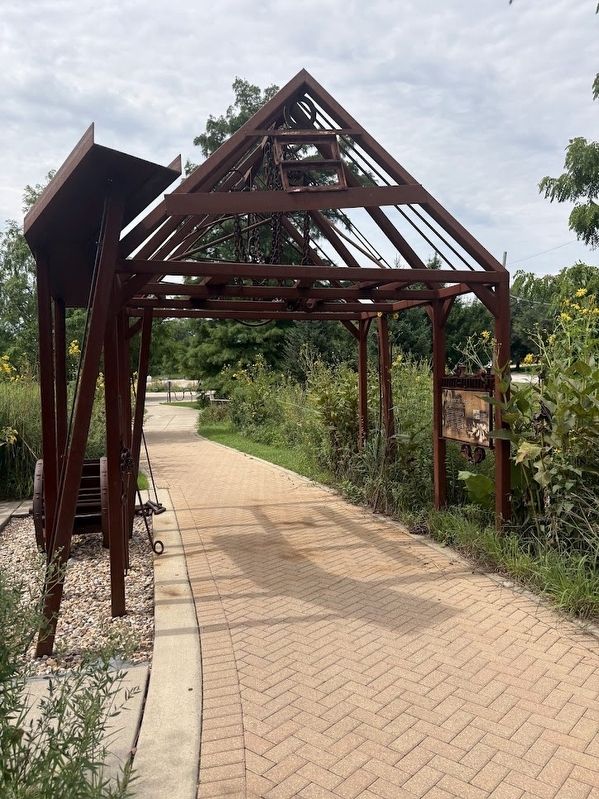
2. A Reminder of Times Past Marker
Other nearby markers. At least 8 other markers are within walking distance of this marker: Where the Rivers Meet (a few steps from this marker); a different marker also named Where the Rivers Meet (a few steps from this marker); Taking Care of Our Watershed (a few steps from this marker); Native Landscape Restoration at Knoch Knolls Park (a few steps from this marker); Green Builders Long Ago (within shouting distance of this marker); The Land Where the Rivers Meet (within shouting distance of this marker); McDonald Creek (within shouting distance of this marker); Living Off the Land (within shouting distance of this marker). Touch for a list and map of all markers in Naperville.
Also see . . . Reflections on Scott's Mill (2014). From the website of the Naperville Century Walk Public Art Guide.
Excerpt: "Chicago-based artist Lucy Slivinski used salvaged materials, including old gears, chains, and hooks reminiscent of a 19th-century water-powered sawmill in the making of this piece."(Submitted on August 21, 2026, by Sean P. Flynn of Oak Park, Illinois.)
Photographed by Sean P. Flynn, August 18, 2026
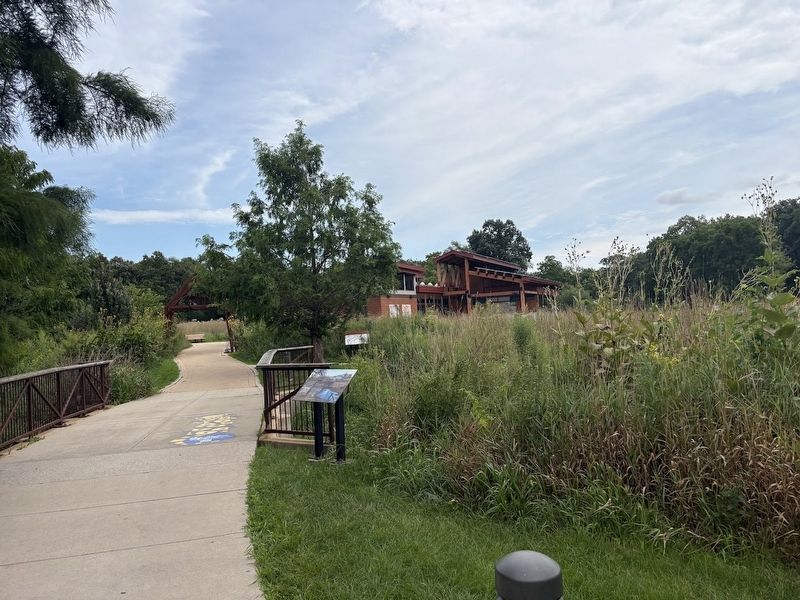
3. Knoch Knolls Nature Center
The A Reminder of Times Past marker and installation are in the distance on the left.
Credits. This page was last revised on August 21, 2026. It was originally submitted on August 21, 2026, by Sean P. Flynn of Oak Park, Illinois. This page has been viewed 12 times since then. Photos: 1, 2, 3. submitted on August 21, 2026, by Sean P. Flynn of Oak Park, Illinois.
