Central Business District in Melbourne, Victoria, Australia — Oceania
Victoria Meat Market
| — | Queen Victoria Market | — |
Photographed by Dean Barton-Ancliffe, July 16, 2026
1. Queen Victoria Market - Victoria Meat Market Marker
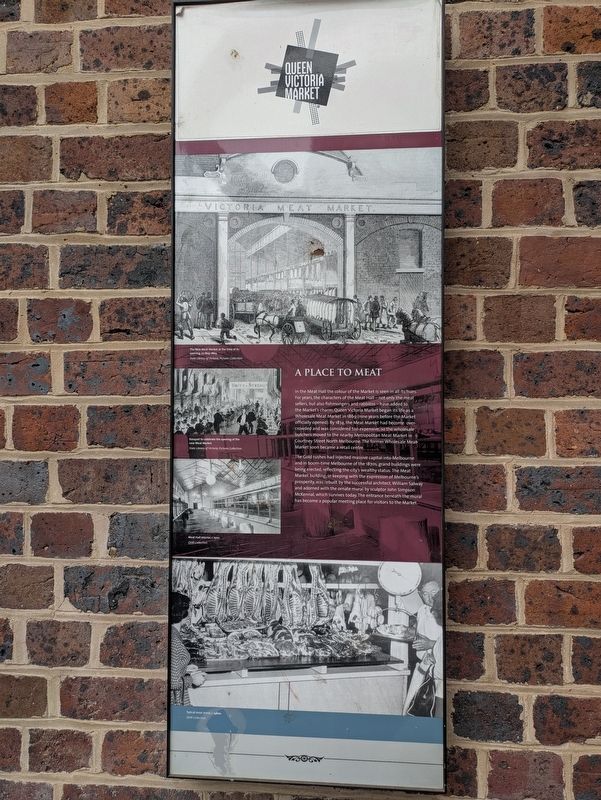
In the Meat Hall the colour of the Market is seen in all its hues. For years, the characters of the Meat Hall - not only the meat sellers, but also fishmongers and rabbitos - have added to the Market's charm. Queen Victoria Market began life as a Wholesale Meat Market in 1869 (nine years before the market officially opened). By 1874, the Meat Market had become over-crowded and was considered too expensive, so the wholesale butchers moved to the nearby Metropolitan Meat Market in Courtney Street North Melbourne. The former Wholesale Meat Market soon became a retail centre.
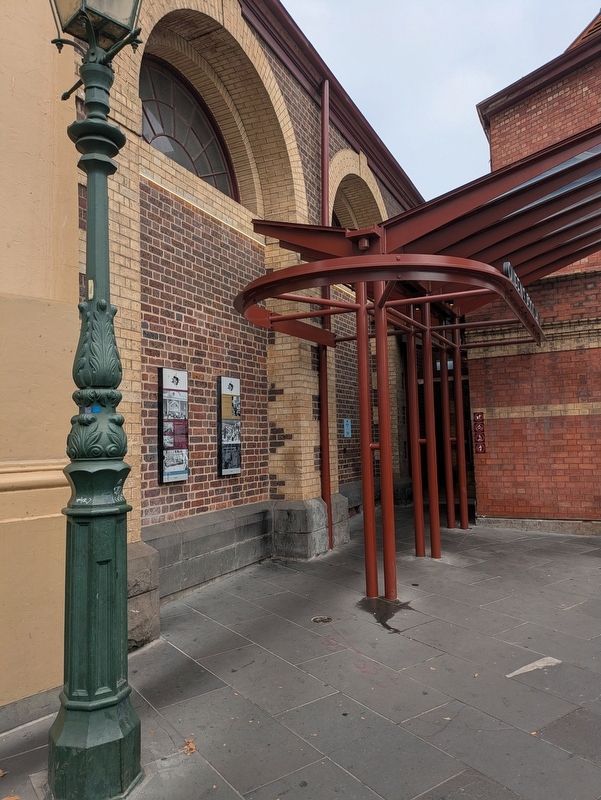
The Gold rushes had injected massive capital into Melbourne and in boom-time Melbourne of the 1870s, grand buildings were being erected, reflecting the city's wealthy status. The Meat Market building, in keeping with the expression of Melbourne's prosperity, was rebuilt by the successful architect, William Salway and adorned with the ornate mural by sculptor John Simpson McKennal, which survives today. The entrance beneath the mural has become a popular meeting place for visitors to the Market.
Topics. This historical marker
this page online
Location. 37° 48.381′ S, 144° 57.548′ E. Marker is in Melbourne, Victoria. It is in the Central Business District. It is at the intersection of Victoria Street (Victoria Route 32) and Elizabeth Street on Victoria Street. Touch for map. Marker is at or near this postal address: 65 Victoria Street, Melbourne VIC 3000, Australia. Touch for directions.

Regionally, it is in Oceania, in Australasia, in the Pacific Ocean, in South Pacific, on the Pacific Rim, in the Western World, and in the Anglosphere. Historically, it finds itself in what was once a British colony.
Other nearby markers. At least 8 other markers are within walking distance of this marker: Engaging the Senses (here, next to this marker); Queen Victoria Market - Blue Plaque (within shouting distance of this marker); Melbourne's Marvellous Meat Hall (within shouting distance of this marker); The Market Gates (about 150 meters away, measured in a direct line); Market Opening - Floor Plaque (about 180 meters away); Wholesale to Retail (about 180 meters
Photographed by Dean Barton-Ancliffe, July 16, 2026
2. Victoria Meat Market Marker at the entrance to the Food Hall
Also see . . . Queen Victoria Market. City of Melbourne
Queen Victoria Market is much more than a market place. The site has been and continues to be of significance to many different people for many reasons. It is one of the great nineteenth century markets in Victoria and the only one surviving from a group of important central markets built in Melbourne during that era.(Submitted on August 22, 2026, by Dean Barton-Ancliffe of Rowville, Victoria.)
From its beginnings as Melbourne’s chief wholesale market, through to its successful reinvention as a retail market in the 1970s, Queen Victoria Market has played an important role in the economic and social history of the city.
It is the largest, most concentrated, continually trading place reserved for small independently operated businesses in Australia.
It is a critical element in the story of early Melbourne’s development and to this day continues to play a central role in the city’s cultural, business and social life.
The Queen Victoria Market was formally accepted for inclusion onto the Victorian Heritage Register in 1989 and the National Heritage List in 2018.
Not only has the market served the people of Melbourne continuously since at least 1878, it was previously the site of Melbourne’s first official cemetery, from 1837 and 1854.
The market site is also an important Aboriginal cultural place. It is part of the land of the Kulin Nations and includes an Aboriginal burial area of the former cemetery, which is specifically recognised under the Aboriginal Heritage Act as an Aboriginal historic place.
Credits. This page was last revised on August 27, 2026. It was originally submitted on August 22, 2026, by Dean Barton-Ancliffe of Rowville, Victoria. This page has been viewed 8 times since then. Photos: 1, 2. submitted on August 22, 2026, by Dean Barton-Ancliffe of Rowville, Victoria. • Andrew Ruppenstein was the editor who published this page.
