Butte in Silver Bow County, Montana — The American West (Mountains)
Labor History in Butte, Montana
Photographed by Cosmos Mariner, July 6, 2024
1. Labor History in Butte, Montana Marker
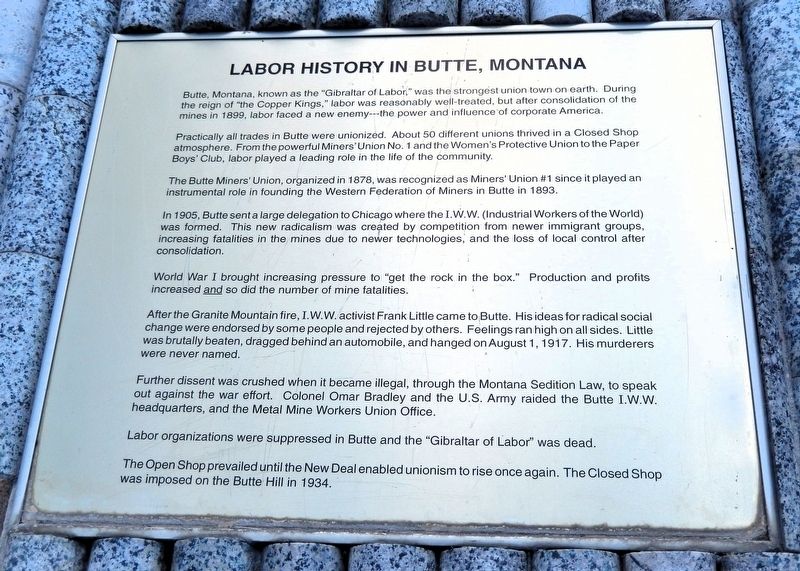
Butte, Montana, known as the “Gibraltar of Labor,” was the strongest union town on earth. During the reign of “the Copper Kings,” labor was reasonably well-treated, but after consolidation of the mines in 1899, labor faced a new enemy — the power and influence of corporate America.
Practically all trades in Butte were unionized. About 50 different unions thrived in a Closed Shop atmosphere. From the powerful Miners' Union No. 1 and the Women's Protective Union to the Paper Boys' Club, labor played a leading role in the life of the community.
The Butte Miners' Union, organized in 1878, was recognized as Miners' Union #1 since it played an instrumental role in founding the Western Federation of Miners in Butte in 1893.
In 1905, Butte sent a large delegation to Chicago where the I.W.W. (Industrial Workers of the World) was formed. This new radicalism was created by competition from newer immigrant groups, increasing fatalities in the mines due to newer technologies, and the loss of local control after consolidation.
World War I brought increasing pressure to “get the rock in the box.” Production and profits increased and so
this page online
After the Granite Mountain fire, I.W.W. activist Frank Little came to Butte. His ideas for radical social change were endorsed by some people and rejected by others. Feelings ran high on all sides. Little was brutally beaten, dragged behind an automobile, and hanged on August 1, 1917. His murderers were never named.
Further dissent was crushed when it became illegal, through the Montana Sedition Law, to speak out against the war effort. Colonel Omar Bradley and the U.S. Army raided the Butte I.W.W. headquarters, and the Metal Mine Workers Union Office.
Labor organizations were suppressed in Butte and the “Gibraltar of Labor” was dead.
The Open Shop prevailed until the New Deal enabled unionism to rise once again. The Closed Shop was imposed on the Butte Hill in 1934.
Topics. This historical marker is listed in these topic lists: Industry & Commerce • Labor Unions • War, World I.
Location. 46° 1.6′ N, 112° 31.42′ W. Marker is in Butte, Montana, in Silver Bow County. It can be reached from Bernie's Way just north of Alexander Street, on the

Photographed by Cosmos Mariner, July 6, 2024
2. Labor History in Butte, Montana Marker
Looking south; the city of Butte is in the background. The marker is mounted atop a concrete and granite pedestal on the southeast perimeter of the Granite Mountain Speculator Mine Memorial.

Regionally, this marker is in andspecifically outhwest Montana, in Gold West Country, in Mining Country. It is also in the American Mountain West and in the Lewis & Clark Corridor. Globally, it is in North America, the Rocky Mountains, the Western Hemisphere, the Western World, and the Anglosphere. Historically, it finds itself in what was once Rupert’s Land and also the Louisiana Purchase.
Other nearby markers. At least 8 other markers are within walking distance of this marker: Women of Butte (here, next to this marker); Badger State Mine / The Speculator-Granite Mountain Mine / The Bell-Diamond Mine (here, next to this marker); The Bell Diamond (about 400 feet away, measured in a direct line); The Con (approx. 0.4 miles away); The Con Hoist House (approx. 0.4 miles away); Cornish of Centerville (approx. 0.4 miles away); The Irish of Centerville (approx. 0.4 miles away); Mines of Centerville (approx. 0.4 miles away). Touch for a list and map of all markers in Butte.
Also see . . .
1. Franklin Henry Little (Wikipedia).
Excerpt: An American labor leader who was murdered in Butte, Montana. He joined the Industrial Workers of the World in 1905, organizing miners, lumberjacks, and oil field workers. He was a member of the union's Executive Board when he was murdered via lynching. In the early hours of August 1, 1917, six masked men broke into Nora Byrne's Steel Block boardinghouse where Frank Little was staying. Little was beaten in his room and abducted while still in his underwear. He was bundled into a car which sped away. Little was later tied to the car's rear bumper and dragged over the granite blocks of the street. Little was taken to Milwaukee Bridge at the edge of town where he was then hanged from a railroad trestle. The coroner found that Little died of asphyxiation. A note with the words “First and last warning” was pinned to his thigh, referring to earlier vigilantes giving people three warnings to leave town. No one was apprehended or prosecuted for Little's murder. Little's assassination gained national attention and was widely spread throughout the community of the Industrial Workers of the World (IWW).(Submitted on August 23, 2026, by Cosmos Mariner of Cape Canaveral, Florida.)
2. Federal Sedition Act Becomes Law, 1918 (TreasureState.com).
Excerpt: On May 16, 1918, the federal Sedition Act was enacted, making it a crime to “willfully utter, print, write, or publish any disloyal, profane, scurrilous, or abusive language about the form of government of the United States, or the Constitution of the United States, or the military or naval forces of the United States, or the flag of the United States, or the uniform of the Army or Navy of the United States.” This federal legislation followed Montana's own Sedition Act, passed in February 1918, which was the first of its kind in the nation. The federal act, and its Montana precursor, led to numerous arrests and convictions, particularly targeting labor organizers, socialists, and those perceived as disloyal. These acts are a controversial chapter in American history, raising significant questions about civil liberties and freedom of speech during wartime. For Montana, the Sedition Act had a particularly harsh impact, shaping the political and social climate of the era and leaving a lasting legacy on the state's legal and historical landscape.(Submitted on August 23, 2026, by Cosmos Mariner of Cape Canaveral, Florida.)
Credits. This page was last revised on August 23, 2026. It was originally submitted on August 22, 2026, by Cosmos Mariner of Cape Canaveral, Florida. This page has been viewed 20 times since then. Photos: 1. submitted on August 22, 2026, by Cosmos Mariner of Cape Canaveral, Florida. 2. submitted on August 23, 2026, by Cosmos Mariner of Cape Canaveral, Florida.
