The Cochran Ranch
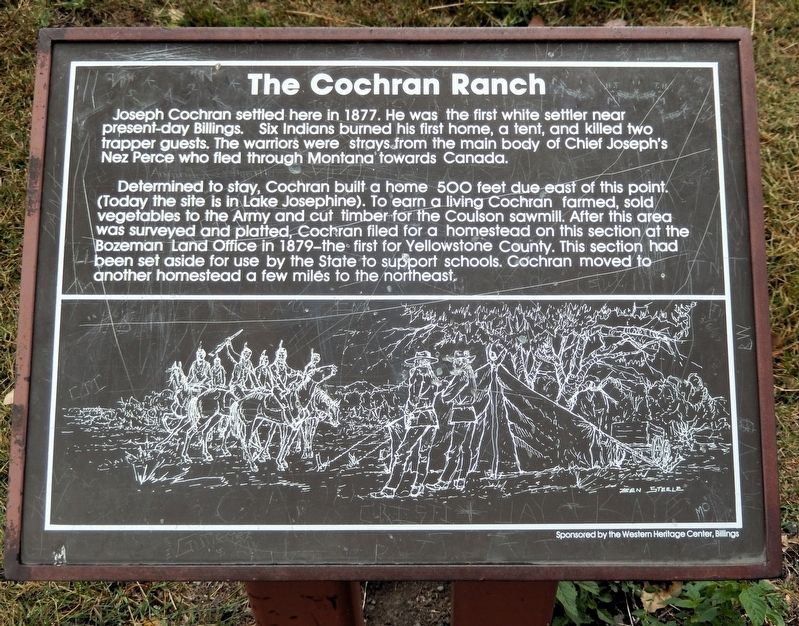
Joseph Cochran settled here in 1877. He was the first white settler near present-day Billings. Six Indians burned his first home, a tent, and killed two trapper guests. The warriors were strays from the main body of Chief Joseph’s Nez Perce who fled through Montana towards Canada.
Determined to stay, Cochran built a home 500 feet due east of this point. (Today the site is in Lake Josephine). To earn a living Cochran farmed, sold vegetables to the Army and cut timber for the Coulson sawmill. After this area was surveyed and platted, Cochran filed for a homestead on this section at the Bozeman Land Office in 1879 — the first for Yellowstone County. This section had been set aside for use by the State to support schools. Cochran moved to another homestead a few miles to the northeast.
Erected by Western Heritage Center.
Topics. This historical marker is listed in these topic lists: Indigenous Peoples and Communities • Settlements & Settlers. A significant historical year for this entry is 1877.
Location. 45° 44.723′ N, 108° 31.484′ W. Marker is in Billings, Montana, in Yellowstone County. It can be reached from South
this page online

Regionally, this marker is in Yellowstone Country. It is also in the American Mountain West and in the Lewis & Clark Corridor. Globally, it is in North America, the Western Hemisphere, the Western World, and the Anglosphere. Historically, it finds itself in what was once Rupert’s Land and also the Louisiana Purchase.
Other nearby markers. At least 8 other markers are within 3 miles of this marker, measured as the crow flies: West Side School (approx. 2.2 miles away); Garfield School (approx. 2.3 miles away); Moss Mansion (approx. 2.4 miles away); Fire House No. 2 (approx. 2.4 miles away); I.D. O'Donnell Home (approx. 2.4 miles away); The Great Montana Centennial Cattle Drive Monument (approx. 2.4 miles

Also see . . .
1. Joseph M. V. Cochran – First Homesteader (Yellowstone Genealogy Forum).
Excerpt: Cochran filed for the land in Section 16 in early spring, prior to arriving at the site in May 1877. He had selected the property location from his earlier visit in 1873. At the time, land office had not identified Section 16 for school exemption, thus allowing him to obtain title to the property. It consisted of 35.34 acres and was just north of Josephine Lake. Two years later the government took his land away, claiming it was platted on School Land. Cochran, after losing his Section 16 land acquired another piece of land located about 1 mile north of present day Riverfront Park, and he gained title on September 16, 1887. He had to pay an additional $450 since there were some improvements on it (a worthless cabin).(Submitted on August 24, 2026, by Cosmos Mariner of Cape Canaveral, Florida.)In September 1877, while Cochran, an Irish friend and others were logging, for McAdow’s sawmill operation, near Canyon Creek, on the Indian Reservation
land, two trappers named Clint Dills and Milton Summer were living in a tent on the Cochran property. Perry McAdow had heard the day prior that the Nez Perce might pass through, so he was prepared for an attack by having set up a palisade (fence of logs) to protect the sawmill. They later learned that white men at Ed Forest’s stage stop escaped the Nez Perce Indians by hiding in the timber. The logging party saw six Indians fording the river, and Cochran rode out for a parley, hoping to divert them from the horses picketing downstream. The braves, five young bucks and a grizzled old warrior halted. Cochran shook hands with the grizzled warrior, Chief Joseph, who was afraid that the younger Indians with him in full war paint might make a hostile move, and he would be the first victim of Cochran’s rifle. The Nez Perce proceeded on slowly and then raced back through the timber to “annex” the horses before joining the main body of Indians across the river. The loggers followed on foot and Cochran & his Irishman friend found the bodies of the two trappers, one shot in the head, the other in the back. Apparently, the men were surprised and had expected no trouble. They were living in Cochran’s tent at the time, and the Indians burned it, but their wagon was unmolested. Cochran left the bodies and headed for Coulson, finding that the Indians had set fire to the town’s saloon. Cochran reportedly submitted a claim to the government for $654.50 in property damage for loss of the tent and supplies. It was never paid. After this attack Cochran left the area with “Liver Eating” Johnson to become one of the Yellowstone Scouts commanded by George Houston and was scouting about 25 miles away when Chief Joseph surrendered for the Nez Perce to General Miles.
2. The Fight or Flight of the Nez Perce (TreasureState.com).
Excerpt: In the summer of 1877, the Nez Perce nation embarked upon a desperate and extraordinary journey that would carve its place deep into the annals of American frontier history. This was not a flight born of choice but of necessity, precipitated by the imposition of treaties which divided and dispossessed the Nez Perce from their ancestral lands in the Wallowa Valley of Oregon. Chiefs Joseph, Looking Glass, White Bird, and others led their people on a remarkable retreat through rugged mountain ranges and verdant river valleys, pursued relentlessly by the United States Army, determined to bring them to submission.(Submitted on August 24, 2026, by Cosmos Mariner of Cape Canaveral, Florida.)Their ultimate goal was the sanctuary of Canada, where they hoped to find refuge from the United States’ jurisdiction. The proximity of the border loomed tantalizingly close as they entered the Bear Paw Mountains, roughly forty miles south of the Canadian line. There, on September 30, 1877, Colonel Nelson A. Miles intercepted the Nez Perce, forcing a confrontation that would prove decisive. The Nez Perce flight remains significant not only for its military and tactical aspects but also for what it reveals about the broader conflicts between Native American nations and the encroaching United States. The complex negotiations, broken treaties, and struggles for autonomy played out on a vast stage, with the Nez Perce embodying the tragic consequences of these collisions.
Credits. This page was last revised on August 24, 2026. It was originally submitted on August 22, 2026, by Cosmos Mariner of Cape Canaveral, Florida. This page has been viewed 15 times since then. Photos: 1, 2. submitted on August 24, 2026, by Cosmos Mariner of Cape Canaveral, Florida.
