Ketchikan in Ketchikan Gateway Borough, Alaska — Northwest (North America)
Beegle Packing Co.
A cannery that typified the salmon-capital boom in early Ketchikan
| — | Newtown | — |
Photographed by Bradley Owen, August 13, 2026
1. Beegle Packing Co. Marker
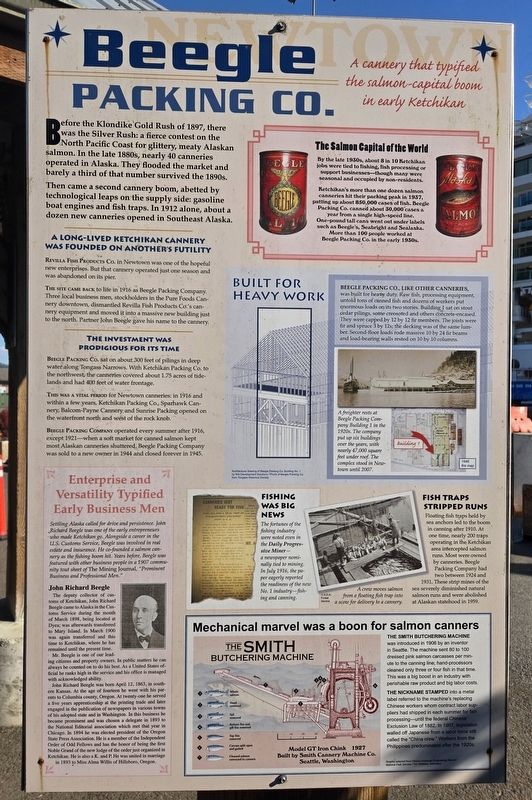
Before the Klondike Gold Rush of 1897, there was the Silver Rush: a fierce contest on the North Pacific Coast for glittery, meaty Alaskan salmon. In the late 1880s, nearly 40 canneries operated in Alaska. They flooded the market and barely a third of that number survived the 1890s.
Then came a second cannery boom, abetted by technological leaps on the supply side: gasoline boat engines and fish traps. In 1912 alone, about a dozen new canneries opened in Southeast Alaska.
A long-lived Ketchikan cannery was founded on another's futility
Revilla Fish Products Co. in Newtown was one of the hopeful new enterprises. But that cannery operated just one season and was abandoned on its pier.
The site came back to life in 1916 as Beegle Packing Company. Three local business men, stockholders in the Pure Foods Cannery downtown, dismantled Revilla Fish Products Co.'s cannery equipment and moved it into a massive new building just to the north. Partner John Beegle gave his name to the cannery.
The investment was prodigious for its time
Beegle Packing Co. sat on about 300 feet of pilings in deep water along Tongass Narrows. With Ketchikan Packing Co. to the northwest, the canneries covered about 1.75 acres of tidelands and had 400 feet of water frontage.
This was a vital period for Newtown canneries: in 1916 and within a few years, Ketchikan Packing Co., Sparhawk Cannery, Balcom-Payne Cannery and Sunrise Packing opened on the waterfront north and west of the rock knob.
Beegle Packing Company operated every summer after 1916, except 1921 - when a soft market for canned salmon kept most Alaskan canneries shuttered. Beegle Packing Company was sold to a new owner in 1944 and closed forever in 1945.
(Sidebars):
Enterprise and Versatility Typified Early Business Men
Settling Alaska called for drive and persistence. John Richard Beegle was one of the early entrepreneurs who made Ketchikan go. Alongside a career in the U.S. Customs Service, Beegle was involved in real estate and insurance. He co-founded a salmon cannery as the fishing boom hit. Years before, Beegle was featured with other business people in a 1907 community tout sheet of The
this page online
John Richard Beegle
The deputy collector of customs of Ketchikan, John Richard Beegle came to Alaska in the Customs Service during the month of March 1898, being located at Dyea; was afterwards transferred to Mary Island. In March 1900 was again transferred and this time to Ketchikan, where he has remained until the present time.
Mr. Beegle is one of our leading citizens and property owners. In public matters he can always be counted on to do his best. As a United States official he ranks high in the service and his office is managed with acknowledged ability.
John Richard Beegle was born April 12, 1863, in southern Kansas. At the age of fourteen he went with his parents to Columbia county, Oregon. At twenty-one he served a five years apprenticeship at the printing trade and later engaged in the publication of newspapers in various towns of his adopted state and in Washington. In this business he became prominent and was chosen a delegate in 1893 to the National Editorial association which met that year in Chicago. In 1894 he was elected president of the Oregon State
Photographed by Bradley Owen, August 13, 2026
2. Beegle Packing Co. Marker
The Salmon Capital of the World
By the late 1930s, about 8 in 10 Ketchikan jobs were tied to fishing, fish processing or support businesses - though many were seasonal and occupied by non-residents.
Ketchikan's more than one dozen salmon canneries hit their packing peak in 1937, putting up about 850,000 cases of fish. Beegle Packing Co. canned about 30,000 cases a year from a single high-speed line. One-pound tall cans went out under labels such as Beegle's, Seabright and Sealaska. More than 100 people worked at Beegle Packing Co. in the early 1930s.
Built for Heavy Work
Beegle Packing Co., like other canneries, was built for heavy duty. Raw fish, processing equipment, untold tons of canned fish and dozens of workers put enormous loads on its two stories. Building 1 sat on stout cedar pilings, some creosoted and others concrete-encased. They were capped by 12 by 12 fir members. The joists were fir and spruce 3 by 12s; the decking was of the same lumber. Second-floor loads rode massive 10 by 24 fir beams and load-bearing walls rested on 10 by 10 columns.
Fishing Was Big News
The fortunes of the fishing industry were noted even in the Daily Progressive Miner - a newspaper nominally tied to mining. In July 1916, the paper eagerly reported the readiness of the new No. 1 industry - fishing and canning.
Fish Traps Stripped Runs
Floating fish traps held by sea anchors led to the boom in canning after 1910. At one time, nearly 200 traps operating in the Ketchikan area intercepted salmon runs. Most were owned by canneries. Beegle Packing Company had two between 1924 and 1931. These strip mines of the sea severely diminished natural salmon runs and were abolished at Alaskan statehood in 1959.
Mechanical marvel was a boon for salmon canners
The Smith Butchering Machine was introduced in 1906 by an inventor in Seattle. The machine sent 80 to 100 dressed pink salmon carcasses per minute to the canning line; hand-processors cleaned only three or four fish in that time. This was a big boost in an industry with perishable raw product and big labor costs.
The nickname stamped into a metal label referred to the machine's replacing Chinese workers whom contract labor suppliers had shipped in each summer for fish processing - until the federal Chinese Exclusion Law of 1882. In 1907, legislation walled off Japanese from a labor force still called the "China crew." Workers from the Philippines predominated after the 1920s.
(Captions):
A freighter rests at Beegle Packing Company Building 1 in the 1920s. The company put up six buildings over the years, with nearly 47,000 square feet under roof. The complex stood in Newtown until 2007.
Architectural drawing of Beegle Packing Co. Building No. 1 by RAI Development Solutions/Photo of Beegle Packing Co. from Tongass Historical Society
A crew moves salmon from a floating fish trap into a scow for delivery to a cannery.
Model GT Iron Chink 1927
Built by Smith Cannery Machine Co.
Seattle, Washington
Topics. This historical marker is listed in these topic lists: Civil Rights • Industry & Commerce. A significant historical year for this entry is 1897.
Location. 55° 20.67′ N, 131° 39.337′ W. Marker is in Ketchikan, Alaska, in Ketchikan Gateway Borough. It is on Schoenbar Road south of Water Street, on the right when traveling south. Touch for map. Marker is at or near this postal address: 90 Schoenbar Road, Ketchikan AK 99901, United States of America. Touch for directions.

Regionally, this marker is in Southeast Alaska, in Tlingit and Haida & Tsimshian Region. It is also on the American Pacific Coast. Globally, it is in North America, in the Inside Passage, on the Pacific Rim, in the Western Hemisphere, in the Western World, and in the Anglosphere. Historically, it finds itself in what was once the Russian Empire.
Other nearby markers. At least 8 other markers are within walking distance of this marker: Northern Machine Works (here, next to this marker); Historic Newtown (here, next to this marker); Keeping the Catch! (approx. 0.3 miles away); Upon 'Thundering Wings' (approx. 0.3 miles away); From Planks to Pavement (approx. 0.3 miles away); The Easter Totem Pole (approx. 0.3 miles away); The Gilmore Hotel (approx. 0.3 miles away); Pioneer Hall (approx. 0.3 miles away). Touch for a list and map of all markers in Ketchikan.
Credits. This page was last revised on August 23, 2026. It was originally submitted on August 23, 2026, by Bradley Owen of Morgantown, West Virginia. This page has been viewed 24 times since then. Photos: 1, 2. submitted on August 23, 2026, by Bradley Owen of Morgantown, West Virginia.
