Central Business District in Melbourne, Victoria, Australia — Oceania
Engaging the Senses
| — | Queen Victoria Market | — |
Photographed by Dean Barton-Ancliffe, July 16, 2026
1. Engaging the Senses Marker
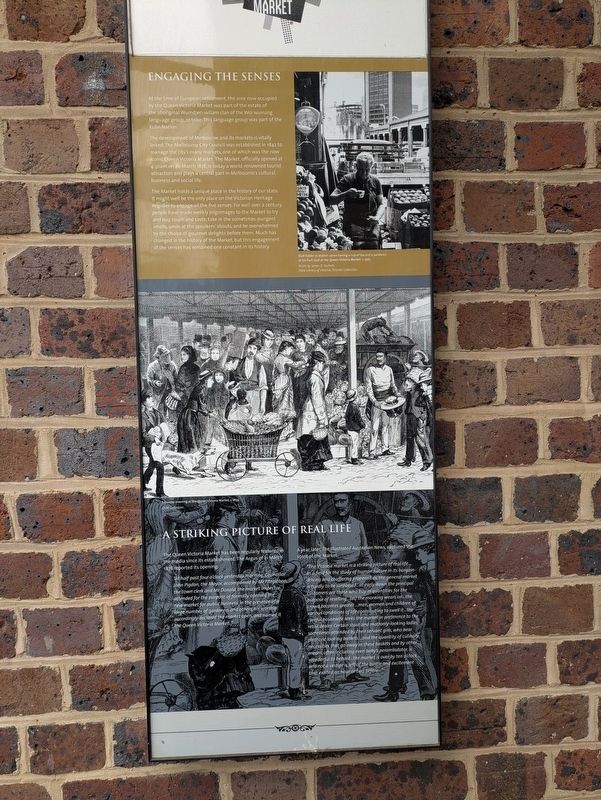
At the time of European settlement, the area occupied by the Queen Victoria Market was part of the estate of the Wurndjeri-william clan of the Woi wurrung language group, or tribe. This language group was part of the Kulin Nation.
The development of Melbourne and its markets is vitally linked. The Melbourne City Coucil was established in 1842 to manage the city's many markets, one of which was the now iconic Queen Victoria Market. The market, officially opened at 4:30am on 20 March 1878, is today a world-renowned tourist attraction and plays a central part in Melbourne's cultural, business and social life.
The market holds a unique place in the history of our state, It might be the only place on the Victorian Heritage Register to engage all the five senses. For well over a century, people have made weekly pilgrimages to the market to try and buy, touch and taste, take in the sometimes-pungent smells, smile at the spruikers' shouts, and be overwhelmed by the choice of gourmet delights before them. Much has changed in the history of the Market, but this engagement of the senses has remained on
this page online
A striking picture of real life
The Queen Victoria Market has regularly featured in the media since its establishment. The Athus of 21 March 1878 reported its opening:
"At half past four o'clock yesterday morning, Councillor John Pigeon, the Mayor, accompanied by Mr Fitzgibbon, the town clerk and Mr Donald, the market inspector attended for the purpose of formally opening the new market for public business. In the presence of a large number of gardeners and others, his worship accordingly declared the market open, and named it the Queen Victoria Market"
A year later, The illustrated Australian News, captured the spirit of the Market: "The Victoria Market is a striking picture of real life... as a field for the study of human nature in its bargain-driving and chaffering propensities, the general market is hardly to be surpassed...at early dawn the principal customers are those who buy in quantities for the purpose of reselling...(as) the morning wears on...the crowd becomes greater...men, women and children of various conditions of life contributing to swell it...the careful housewife seeks the market in preference to the retail dealer. Certainly stout and matronly-looking ladies sometimes attended by their servant girls, who bear plethoric looking baskets...and the quantity of culinary necessities that go away in these baskets and by other means, often in a baby's perambulator, is wonderful to behold...the market is over by ten o'clock...and not a vestige is left of the bustle and excitment that existed an hour or two before..."
Erected by Queen
Photographed by Dean Barton-Ancliffe, July 16, 2026
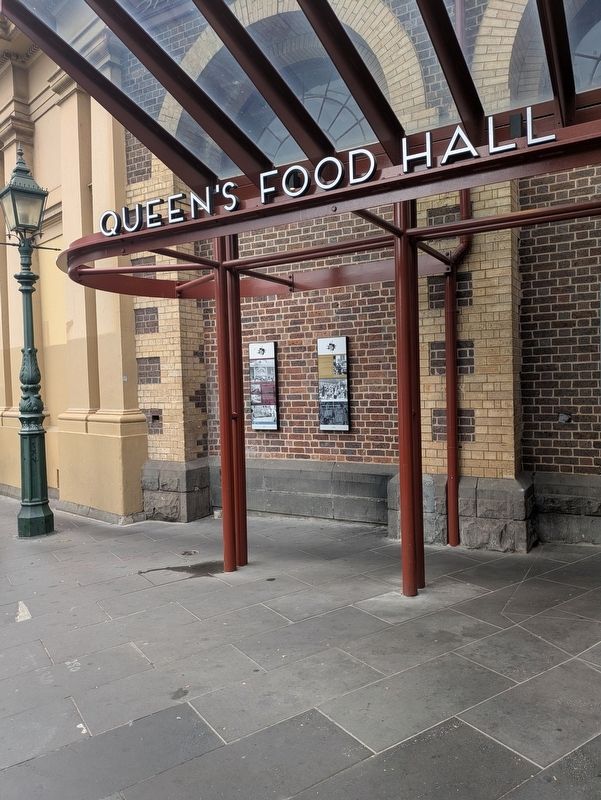
2. Engaging the Senses Marker outside the Queen's Food Hall
Topics. This historical marker is listed in these topic lists: Colonial Era • Industry & Commerce • Settlements & Settlers. A significant historical date for this entry is March 20, 1878.
Location. 37° 48.381′ S, 144° 57.548′ E. Marker is in Melbourne, Victoria. It is in the Central Business District. It is at the intersection of Victoria Street (Victoria Route 32) and Elizabeth Street, on the left when traveling west on Victoria Street. Touch for map. Marker is at or near this postal address: 65 Victoria Street, Melbourne VIC 3000, Australia. Touch for directions.

Regionally, it is in Oceania, in Australasia, in the Pacific Ocean, in South Pacific, on the Pacific Rim, in the Western World, and in the Anglosphere. Historically, it finds itself in what was once a British colony.
Other nearby markers. At least 8 other markers are within walking distance of this marker: Victoria Meat Market (here, next to this marker); Queen Victoria Market - Blue Plaque (within shouting distance of this marker); Melbourne's Marvellous Meat Hall (within shouting distance of this marker); The Market Gates (about 150 meters away, measured in a direct line); Wholesale to Retail (about 180 meters away); Market Opening - Floor Plaque (about 180 meters away); Market Football (about 180 meters away); Bringing home the Shopping (about 180 meters away). Touch for a list and map of all markers in Melbourne.
Also see . . . History and heritage. City of Melbourne
Queen Victoria Market is much more than a market place. The site has been and continues to be of significance to many different people for many reasons. It is one of the great nineteenth century markets in Victoria and the only one surviving from a group of important central markets built in Melbourne during that era.(Submitted on August 24, 2026, by Dean Barton-Ancliffe of Rowville, Victoria.)
From its beginnings as Melbourne’s chief wholesale market, through to its successful reinvention as a retail market in the 1970s, Queen Victoria Market has played an important role in the economic and social history of the city.
It is the largest, most concentrated, continually trading place reserved for small independently operated businesses in Australia.
It is a critical element in the story of early Melbourne’s development and to this day continues to play a central role in the city’s cultural, business and social life.
The Queen Victoria Market was formally accepted for inclusion onto the Victorian Heritage Register in 1989 and the National Heritage List in 2018.
Not only has the market served the people of Melbourne continuously since at least 1878, it was previously the site of Melbourne’s first official cemetery, from 1837 and 1854.
The market site is also an important Aboriginal cultural place. It is part of the land of the Kulin Nations and includes an Aboriginal burial area of the former cemetery, which is specifically recognised under the Aboriginal Heritage Act as an Aboriginal historic place.
Credits. This page was last revised on August 26, 2026. It was originally submitted on August 24, 2026, by Dean Barton-Ancliffe of Rowville, Victoria. This page has been viewed 18 times since then. Photos: 1, 2. submitted on August 24, 2026, by Dean Barton-Ancliffe of Rowville, Victoria. • Andrew Ruppenstein was the editor who published this page.
