St. Benedict's Catholic School
1921 — 1950
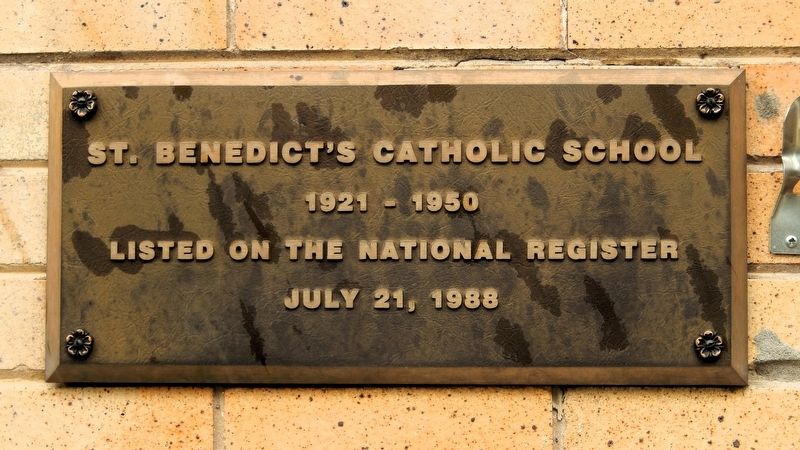
July 21, 1988
Topics and series. This historical marker is listed in these topic lists: Architecture • Education • Immigration • Religion & Religious Structures. In addition, it is included in the National Register of Historic Places (NRHP) series list. A significant historical year for this entry is 1921.
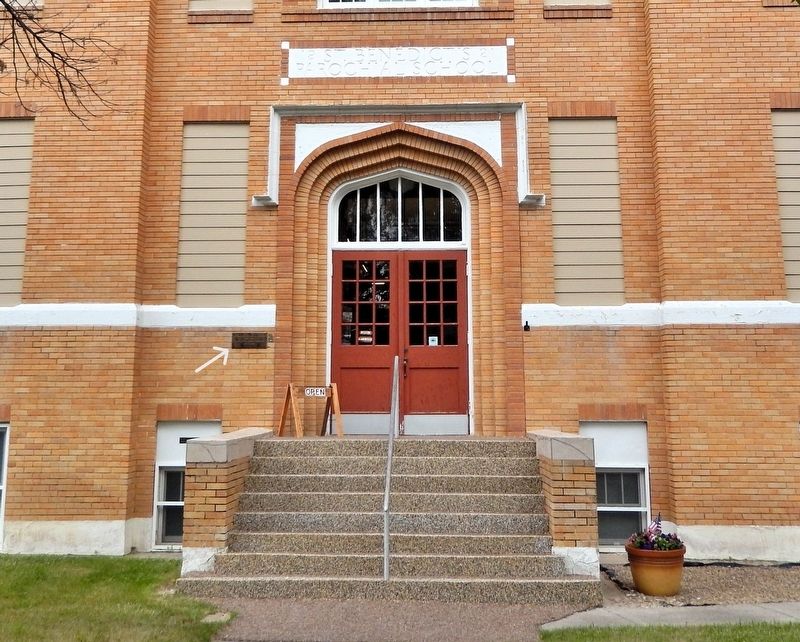
Location. 46° 26.796′ N, 108° 32.594′ W. Marker is in Roundup, Montana, in Musselshell County. It is at the intersection of 1st Street West and 6th Avenue West, on the right when traveling north on 1st Street West. The marker is mounted directly on the subject building, on the left side of the west/front entrance. Touch for map. Marker is at or near this postal address: 524 1st Street West, Roundup MT 59072, United States of America. Touch for directions.

Regionally, this marker is in the American Mountain West, in the Lewis & Clark Corridor, on the Great Plains, and specifically on the Northern Plains. Globally, it is in North America, the Western Hemisphere, the Western World, and the Anglosphere. Historically, it finds itself in what was once Rupert’s Land and
this page online
Other nearby markers. At least 3 other markers are within 2 miles of this marker, measured as the crow flies: The Great Montana Cattle Drive (about 400 feet away, measured in a direct line); Teddy Blue Abbott Crossing the Musselshell (about 400 feet away); Cow Country (approx. 1.2 miles away).
Regarding St. Benedict's Catholic School. National Register of Historic Places № 88001120.
From the National Register Nomination prepared by Dora E. Swanser, February 1988:
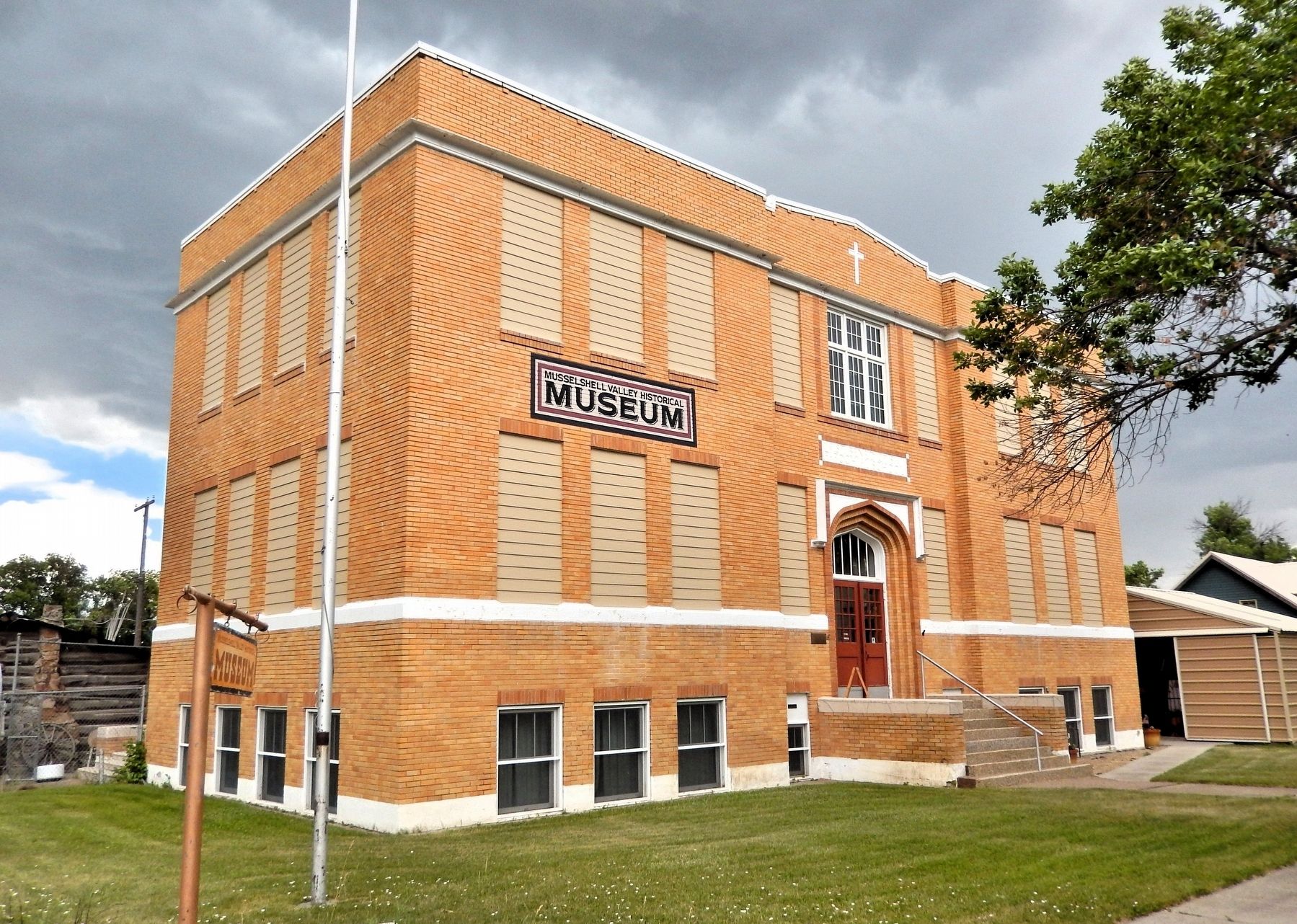
St. Benedict's Catholic School is a substantial, two-story, buff-colored brick building with a full daylight basement located within the west side residential neighborhood of Roundup, Montana. The building is basically rectangular in shape and has a concrete foundation. The facade is symmetrically organized and consists of three bays, with the central bay recessed slightly. A concrete belt course runs at the first-floor windowsill level around the three main elevations. Another belt course at the second-floor lintel level serves to define the parapet and the building is finished with concrete coping. A metal cap was installed over thecoping to keep water from deteriorating the building. Crosses set in the brick above the main and side entries serve as reminders of the original function of the building as a Catholic grade school.Photographed by Cosmos Mariner, July 2, 20242. St. Benedict's Catholic School MarkerThe marker is on the left side of the west/front entrance.St. Benedict's Catholic School is significant due to its association with the hundreds of European immigrants who came to the town of Roundup shortly after the Chicago, Milwaukee and St. Paul Railroad established major coal mines here in 1907-08. This school served as an important focal point for the Catholic community and helped preserve the Catholic heritage of the immigrant population as ethnic identities became less distinct in this new American environment. Roundup reached its peak of prosperity in about 1918 at the end of the First World War. The economic impact of the failure of dry land farming and the collapse of the local oil boom is reflected in the closure of all three banks in the community during the early 1920's. Coal production, the mainstay of the local economy, remained high throughout this period, employing from 800-850 men, as demonstrated by the ability of the mine workers from several European countries to support the
construction and operation of a separate school for their children. St. Benedict's embodies the distinctive characteristics of an early 20th century school building and possesses excellent historic architectural integrity. The symmetrical organization of this two-story rectangular masonry block, with its recessed central entry bay marked by a brick architrave, side entrances, central corridor floor plan, and full daylight basement are all features common to period school construction.Photographed by Cosmos Mariner, July 2, 20243. St. Benedict's Catholic School (northwest elevation)Today this building is home to the Musselshell Valley Historical Museum.
Also see . . . St. Benedict's Catholic School (Wikipedia).
Excerpt: The school was built in 1920-21 to serve the children of Roundup's Catholic immigrant community. Coal production, an oil boom, and homesteading all drove economic and population growth in Roundup during the 1910s, and many of the city's new residents were European immigrants. The city's newly established Catholic community built the school toward the end of Roundup's building boom. Architect John H. Grant, who served as the city's only resident architect, designed the two-story brick building. Various groups of nuns served as the school's teachers, with different orders replacing the previous one every few years; when a new order could not be found to replace a departing order in 1950, the school closed for good.(Submitted on August 27, 2026, by Cosmos Mariner of Cape Canaveral, Florida.)
Credits. This page was last revised on August 27, 2026. It was originally submitted on August 26, 2026, by Cosmos Mariner of Cape Canaveral, Florida. This page has been viewed 5 times since then. Photos: 1, 2, 3. submitted on August 26, 2026, by Cosmos Mariner of Cape Canaveral, Florida.
