Converse in Spartanburg County, South Carolina — The American South (South Atlantic)
Pacolet River/Lawsons Fork Creek Watershed
Photographed by Cosmos Mariner, October 7, 2022
1. Pacolet River/Lawsons Fork Creek Watershed Marker
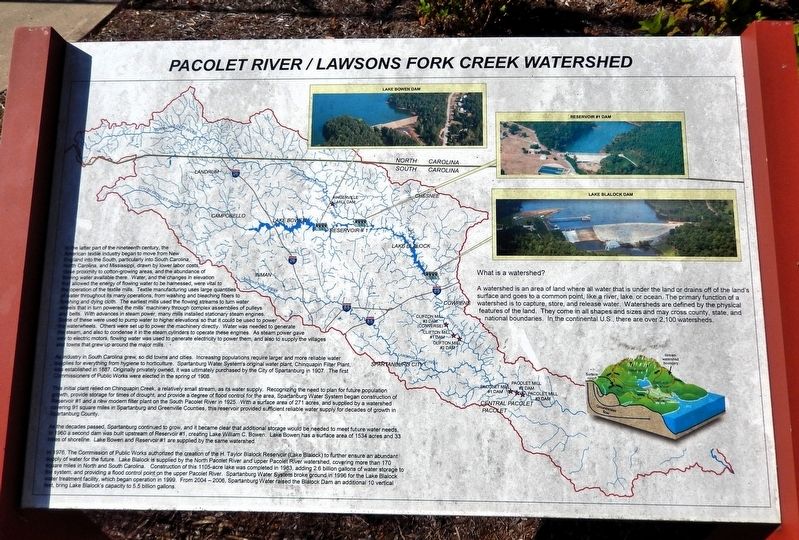
In the latter part of the nineteenth century, the American textile industry began to move from New England into the South, particularly into South Carolina, North Carolina, and Mississippi, drawn by lower labor costs, close proximity to cotton-growing areas, and the abundance of flowing water available there. Water, and the changes in elevation that allowed the energy of flowing water to be harnessed, were vital to the operation of the Textile mills. Textile manufacturing uses large quantities of water throughout its many operations, from washing and bleaching fibers to finishing and dying cloth. The earliest mills used the flowing streams to turn water wheels that in turn powered the mills' machinery through complex assemblies of pulleys and belts. With advances in steam power, many mills installed stationary steam engines. Some of these were used to pump water to higher elevations so that it could be used to power the waterwheels. Others were set up to power the machinery directly. Water was needed to generate the steam, and also to condense it in the steam cylinders to operate these engines. As steam power gave way to
this page online
As industry in South Carolina grew, so did towns and cities. Increasing populations require larger and more reliable water supplies for everything from hygiene to horticulture. Spartanburg Water System's original water plant, Chinquapin Filter Plant, was established in 1887. Originally privately owned, it was ultimately purchased by the City of Spartanburg in 1907. The first Commissioners of Public Works were elected in the spring of 1908.
This initial plant relied on Chinquapin Creek, a relatively small stream, as its water supply. Recognizing the need to plan for future population growth, provide storage for times of drought, and provide a degree of flood control for the area, Spartanburg Water System began construction of Reservoir #1 and a new modern filter plant on the South Pacolet River in 1925. With a surface area of 271 acres, and supplied by a watershed covering 91 square miles in Spartanburg and Greenville Counties, this reservoir provided sufficient reliable water supply
Photographed by Cosmos Mariner, October 7, 2022
2. Pacolet River/Lawsons Fork Creek Watershed Marker
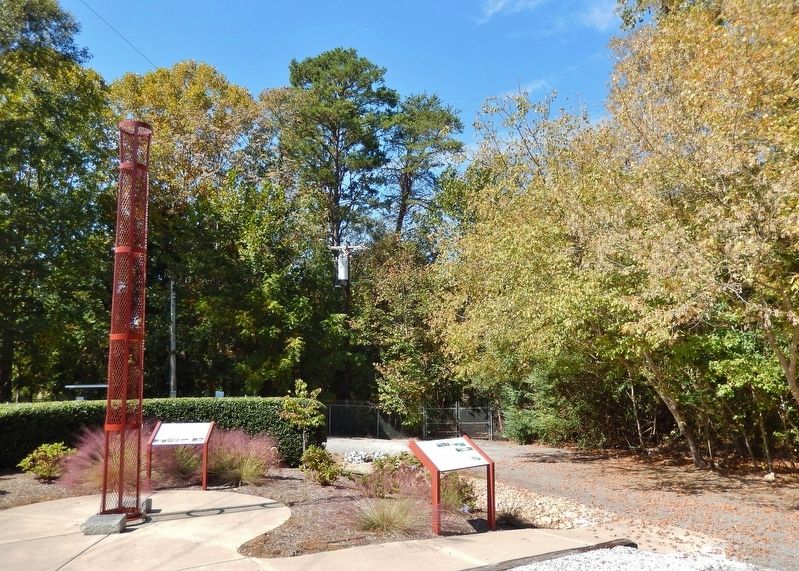
This marker is the interpretive panel on the right — closest to the driveway.
As the decades passed, Spartanburg continued to grow, and it became clear that additional storage would be needed to meet future water needs. In 1960 a second dam was built upstream of Reservoir #1, creating Lake William C. Bowen. Lake Bowen has a surface area of 1534 acres and 33 miles of shoreline. Lake Bowen and Reservoir #1 are supplied by the same watershed.
In 1976, The Commission of Public Works authorized the creation of the H. Taylor Blalock Reservoir (Lake Blalock) to further ensure an abundant supply of water for the future. Lake Blalock is supplied by the North Pacolet River and upper Pacolet River watershed, covering more than 170 square miles in North and South Carolina. Construction of this 1105-acre lake was completed in 1983, adding 2.6 billion gallons of water storage to the system, and providing a flood control point on the upper Pacolet River. Spartanburg Water System broke ground in 1996 for the Lake Blalock water treatment facility, which began operation in 1999. From 2004 - 2006, Spartanburg Water raised the Blalock Dam an additional 10 vertical feet, bringing Lake Blalock's capacity to 5.5 billion gallons.
What is a watershed?
A watershed is an area of land where all water that is under the land or drains off of the land's surface and goes to a common point, like a river, lake, or ocean. The primary function of a watershed is to capture, store, and release water. Watersheds are defined by the physical features of the land. They come in all shapes and sizes and may cross county, state, and national boundaries. In the continental U.S., there are over 2,100 watersheds.
[photo captions]
• Lake Bowen Dam
• Reservoir #1 Dam
• Lake Blalock Dam
Topics. This historical marker is listed in these topic lists: Industry & Commerce • Waterways & Vessels.
Location. 34° 59.646′ N, 81° 49.947′ W. Marker is in Converse, South Carolina, in Spartanburg County. It is at the intersection of East Main Street Extension (U.S. 29) and Brooklyn Road, on the right when traveling west on East Main Street Extension. Touch for map. Marker is in this post office area: Converse SC 29329, United States of America. Touch for directions.

Regionally, this marker is in Upstate and in the Greater Greenville-Spartanburg Area. It is also in the American South, specifically in the Deep South, in Appalachia, and specifically in Southern Appalachia. Globally, it is in North America, the Western Hemisphere, the Western World, and the Anglosphere. Historically, it finds itself in what was once the original Cherokee Nation, the territory of the Mississippian Culture, one of the original Thirteen Colonies, one of the Confederate States of America, and the Antebellum South.
Other nearby markers. At least 8 other markers are within 4 miles of this marker, measured as the crow flies: The Pacolet River Flood of 1903 (here, next to this marker); Clifton Baptist Church / First Baptist Church (approx. 0.8 miles away); Clifton World War II Memorial (approx. 0.8 miles away); Clifton Second Baptist Church (approx. 1.3 miles away); Cowpens Depot (approx. 2.2 miles away); Cowpens Veterans Memorial (approx. 2.2 miles away); First Baptist Church, Cowpens (approx. 2.2 miles away); Welcome to Glendale Shoals (approx. 3.6 miles away).
Another marker is no longer nearby. Early Iron Works (was approx. 3½ miles away but has been confirmed missing).
Also see . . . Spartanburg Water: Our History (SpartanburgWater.org).
Excerpt:(Submitted on August 27, 2026, by Cosmos Mariner of Cape Canaveral, Florida.)
1881: Spartanburg’s first water works was chartered by the South Carolina Secretary of State as a privately held company, and the original water plant, the Chinquapin Filter Plant, was established at 250 Whitney Road in Spartanburg.
1899: Chinquapin Filter Plant was purchased by local businessmen and became the Home Water Supply Company.
1907: The City of Spartanburg purchased the company, and the first Commissioners of Public Works were elected in the spring of 1908.
1929: The Spartanburg Metropolitan District (later the Spartanburg Sanitary Sewer District) was created by Act 556 of the S.C. General Assembly and was managed by the Commission of Public Works of the City of Spartanburg.
1973: The Spartanburg Sanitary Sewer District Commission was established as the governing body of the District, comprised of eight commissioners, later reduced to seven by the State Supreme Court.
2008: The City of Spartanburg's sewer system was transferred to the Spartanburg Sanitary Sewer District.
2013: Blalock Water Treatment Facility is renamed the Myles W. Whitlock Water Treatment Facility.
2019: Fairforest Wastewater Treatment Facility is renamed the A. Manning Lynch Wastewater Treatment Facility in honor of Lynch’s 28 years of service to the Spartanburg Sanitary Sewer District.
2026: R.B. Simms Drinking Water Treatment Facility turns 100.
Credits. This page was last revised on August 27, 2026. It was originally submitted on August 27, 2026, by Cosmos Mariner of Cape Canaveral, Florida. This page has been viewed 13 times since then. Photos: 1, 2. submitted on August 27, 2026, by Cosmos Mariner of Cape Canaveral, Florida.
